


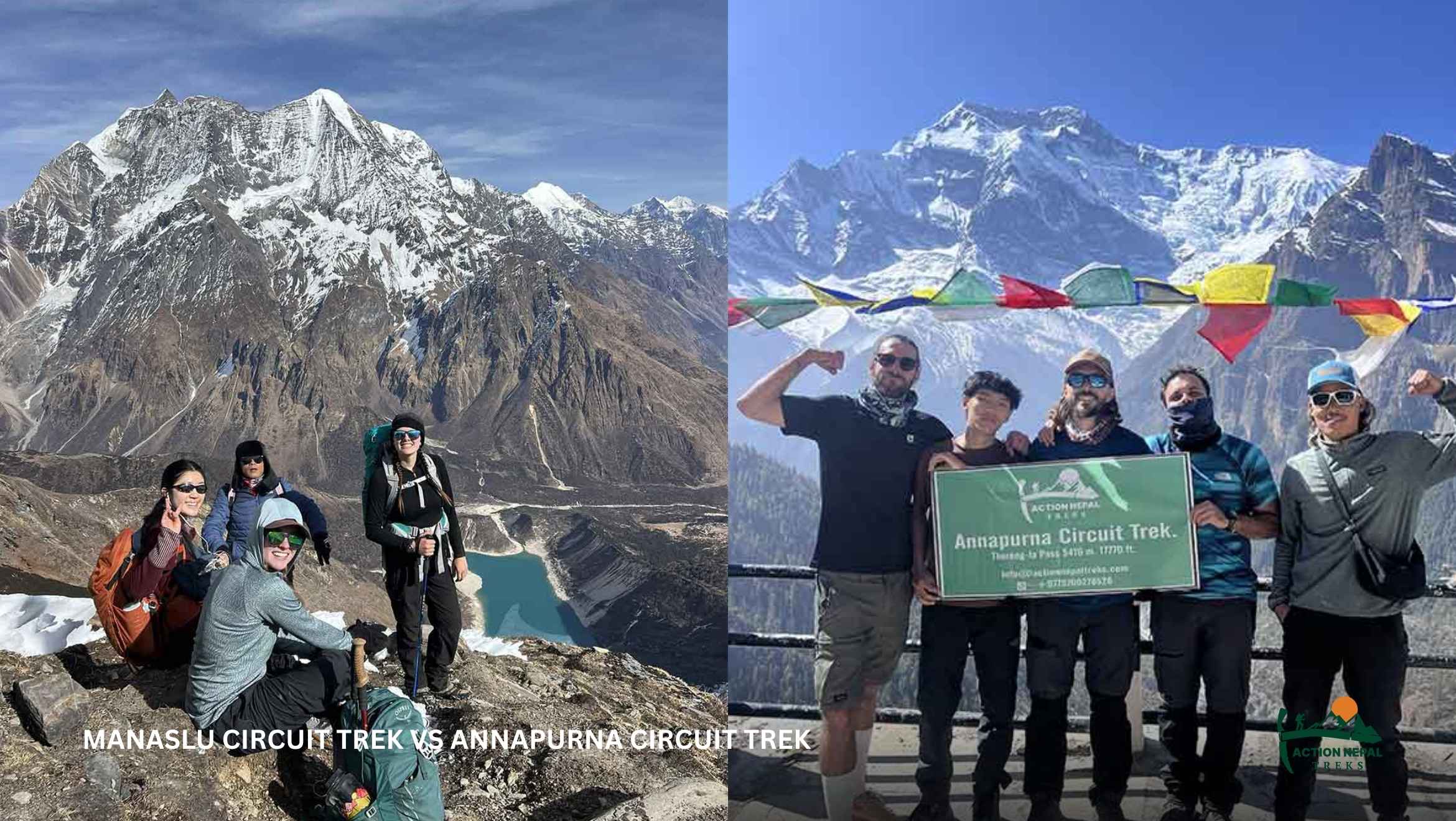
If you’re looking at the Manaslu Circuit Trek vs Annapurna Circuit Trek, it can be hard to know which one is actually the better choice. Both take you deep into the Himalayas, cross a major high-altitude pass, and offer incredible mountain scenery, but the experience between them is quite different. Annapurna is more developed and busier, with plenty of teahouses, food options, and other trekkers along the way. Manaslu is quieter and more remote, with a more rugged feel and fewer people on the trail.
The Annapurna Circuit crosses the 5,416 m Thorong La Pass, while the Manaslu Circuit crosses the 5,106 m Larkya La Pass. Beyond the passes, you’ll notice differences in everything from trail conditions and infrastructure to culture and crowds. So, if you’re trying to decide between the two, it really comes down to whether you prefer the convenience and variety of Annapurna or the quieter, more remote experience of Manaslu.
A Quick Side-by-Side Comparison Before You Dive Deeper
| Feature | Annapurna Circuit Trek | Manaslu Circuit Trek |
|---|---|---|
| Highest Point of the trek | Thorong La Pass (5,416m / 17,769 ft) | Larkya La Pass (5,106m / 16,752 ft) |
| Crowd Levels | High (very social, busy trails) | Low (remote, quiet, off-the-beaten-path) |
| Infrastructure | Excellent (luxury teahouses, Wi-Fi, diverse menus) | Basic (authentic, simpler lodges, limited electricity) |
| Road Interference | High (jeep tracks cut into major sections) | None (pristine, wild wilderness trails) |
| Guide Requirement | Optional (independent trekking allowed) | Mandatory (requires licensed guide + minimum 2 trekkers) |
| Permit Difficulty | Easy (standard TIMS card and ACAP permit) | Complex (Restricted Area Permit required) |
| Physical Difficulty | Moderate to Strenuous | Strenuous (more rugged, steeper ascents) |
| Cultural Vibe | Diverse Gurung, Thakali, and Hindu villages | Deeply authentic Tibetan Buddhist culture |
Why These Two Treks Are Nepal’s Most Popular Circuit Treks
The Annapurna and Manaslu circuits are among Nepal’s most popular treks because they offer the complete Himalayan experience in one journey. Both take you through dramatic landscapes, from green valleys and deep river gorges to high alpine terrain, while passing through culturally rich mountain villages and crossing a major Himalayan pass above 5,000 meters.
Both are also classic teahouse treks, so you can complete a long, high-altitude journey without carrying camping equipment or days of food. Add spectacular mountain views, diverse cultures, challenging trails, and the sense of achievement that comes with crossing Thorong La or Larkya La, and it is easy to see why these two circuits remain among Nepal’s most sought-after trekking adventures.
Overview of the Manaslu Circuit Trek
The Manaslu Circuit Trek is a high-altitude journey around Mount Manaslu, the world’s eighth-highest mountain at 8,163 meters. The route follows the Budhi Gandaki Valley through green lower hills, deep river gorges, and Tibetan-influenced mountain villages before reaching the high Himalayas.
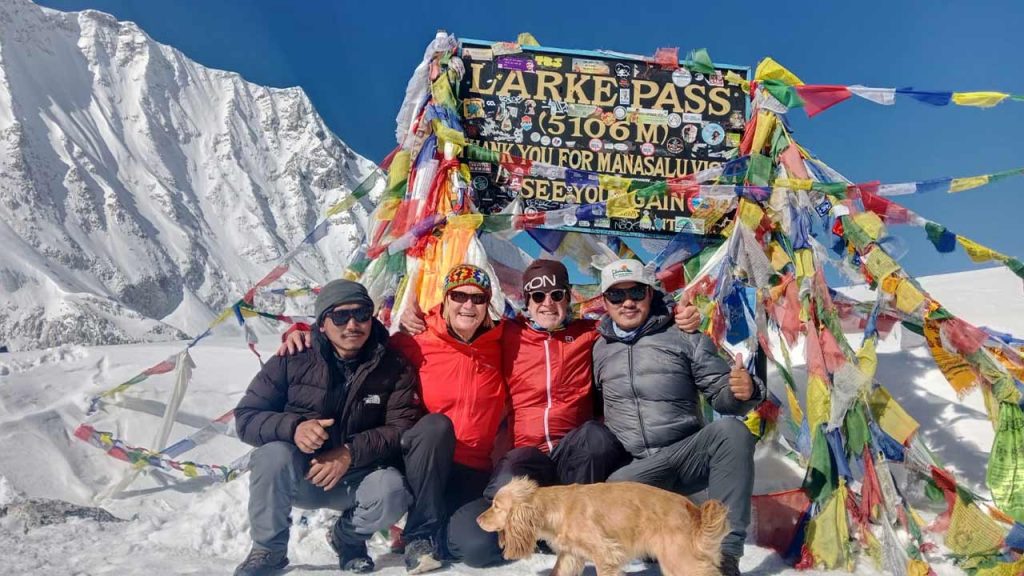
Located in a restricted area near the Tibetan border, the trek requires a special permit: Manaslu Restricted Area Permit, along with Manaslu Conservation Area Permit and a licensed guide. Compared with Nepal’s busier trekking routes, Manaslu generally offers a quieter, more remote experience.
Manaslu Circuit Trek Highlights
- Larkya La Pass: Cross the trek’s highest point at 5,106 meters (16,752 ft), with panoramic views of the surrounding Himalayas.
- Mount Manaslu Views: Enjoy close-up views of Mount Manaslu (8,163 m) and neighboring peaks along the upper sections of the route.
- Birendra Tal: Visit the glacial lake near Samagaon, surrounded by dramatic mountain scenery.
- Tibetan Buddhist Culture: Experience prayer walls, monasteries, mani stones, and Tibetan Buddhist traditions throughout the upper Manaslu region.
- Budhi Gandaki Valley: Trek through deep gorges, riverside trails, waterfalls, and suspension bridges along the valley.
- Samagaon and Samdo: Explore high-altitude villages known for their Tibetan-influenced culture and traditional mountain lifestyle.
What Makes the Manaslu Circuit Unique?
The Manaslu Circuit Trek stands out for its remoteness, quieter trails, and strong Tibetan Buddhist culture. Its restricted-area status means fewer trekkers, special permits, and a licensed guide, while the route passes through traditional mountain villages, monasteries, and rugged high-altitude landscapes. Unlike the Annapurna region, it offers a more secluded trekking experience with simpler infrastructure.
Overview of the Annapurna Circuit Trek

The Annapurna Circuit Trek is a classic long-distance route around the Annapurna Massif. You trek inside the Annapurna Conservation Area, known for its wide variety of landscapes and cultures. The trail moves from lush lower valleys through the high, dry landscapes of Manang and Mustang, then crosses the 5,416 m Thorong La Pass and descends toward the Kali Gandaki Valley. With its well-developed teahouse network and flexible route options, Annapurna offers a more accessible and comfortable way to experience Nepal’s high Himalayas.
Annapurna Circuit Trek Highlights
- Thorong La Pass: Cross the trek’s highest point at 5,416 m (17,769 ft).
- Muktinath Temple: Visit an important pilgrimage site sacred to both Hindus and Buddhists.
- Kali Gandaki Valley: Trek through one of the world’s deepest river valleys, between Annapurna and Dhaulagiri.
- Tilicho Lake: Take an optional side trip to the high-altitude lake at 4,919 m.
- Thakali and Gurung Culture: Experience the traditions, food, and mountain villages of communities along the route.
- Changing Landscapes: Travel through the trail that shifts from subtropical forests and terraced fields to dry alpine terrain.
What Makes the Annapurna Circuit Unique?
The Annapurna Circuit Trek stands out for its landscape diversity, well-developed infrastructure, and flexibility. You can move from lush valleys to dry Himalayan terrain, experience several distinct cultures, and cross the iconic Thorong La Pass within a single trek. Compared with Manaslu, the route also offers more accommodation, food choices, and services. For this reason, it remains a comfortable option for trekkers who want a classic Himalayan adventure with fewer logistical challenges.
Manaslu Circuit vs Annapurna Circuit: Which Trek Matches Your Travel Style Best?
Honestly, neither Manaslu nor Annapurna is objectively the better choice. Both are challenging high-altitude treks, but they appeal to different travel styles and trekking backgrounds. Your decision depends on factors such as your previous trekking experience, preferred level of comfort, budget, available time, and whether you prefer a busier route or a more remote setting.
Who Should Choose the Manaslu Circuit Trek?
Experienced trekkers looking for quiet trails, remote wilderness, and a more rugged mountain experience should choose Manaslu. It suits those who don’t mind rustic facilities, long walking days, and the more complex planning involved with restricted-area permits. The steep elevation gain between Samdo and the high camp at Dharmasala also requires strong physical conditioning and good high-altitude endurance.
It is particularly appealing to trekkers who want a largely vehicle-free route and the option to extend the journey into the deeply spiritual and isolated Tsum Valley, provided they are prepared for higher seasonal permit costs and mandatory agency arrangements.
Who Should Choose the Annapurna Circuit Trek?
Beginner to intermediate trekkers who want a balance of spectacular scenery, flexible itineraries, and reliable comforts should consider the Annapurna Circuit. The route is ideal for social travelers who enjoy well-developed teahouses, varied food menus, and Wi-Fi access at the end of a long day. Its itinerary also allows for a more gradual approach to altitude, with time to acclimatize around Manang before crossing the pass.
Although road development means some lower sections are shared with jeep traffic, it also gives budget-conscious trekkers the flexibility to use local transport to skip road sections, shorten the trip, or add side trips such as the popular Tilicho Lake Trek.
Still Not Sure? Here’s the Quick Recommendation.
- Choose Manaslu if: You are an experienced trekker looking for a higher-budget, guide-led, crowd-free mountain journey with largely vehicle-free trails and strong Tibetan cultural influences.
- Choose Annapurna if: You want a classic, more budget-friendly Himalayan trek with a gradual acclimatization schedule, comfortable lodges, and the flexibility to adjust your itinerary along the way.


Manaslu Circuit Trek vs Annapurna Circuit Trek, Detailed Comparison
The Annapurna Circuit and Manaslu Circuit Trek offer two distinct Himalayan experiences, with differences in difficulty, duration, scenery, cost, infrastructure, culture, and overall trail experience.
Difficulty and Physical Challenge
Both the Manaslu Circuit Trek and Annapurna Circuit Trek are physically demanding high-altitude treks, but they challenge trekkers in different ways. Annapurna reaches a higher elevation at Thorong La Pass (5,416 m), making altitude a major concern, while its more gradual ascent and established trail infrastructure generally make the overall journey easier to manage. Manaslu crosses the 5,106 m Larkya La Pass, but its rougher terrain, more remote sections, and fewer facilities can make the trek feel more demanding overall.
Is Larkya La Pass Harder Than Thorong La Pass?
No. Larkya La Pass is not necessarily harder than Thorong La Pass. It lies 310 meters lower than Thorong La, but the approach can feel tougher because of the rugged terrain, long walking days, and more remote conditions. Thorong La presents a greater altitude challenge. Larkya La combines altitude with rougher trails and a more wilderness-oriented setting. Your acclimatization, fitness, weather conditions, and previous high-altitude experience can ultimately make a bigger difference than the elevation alone.
Trek Distance and Duration
The total distance and duration vary depending on the itinerary and road access points used. The tables below compare the classical versions of the Manaslu and Annapurna Circuit treks. However, both routes can be shortened or modified, with options such as the Short Annapurna Circuit Trek available for trekkers with limited time.
| Itinerary | Manaslu Circuit Trek | Annapurna Circuit Trek |
|---|---|---|
| Typical Duration | 14-18 days | 12-18 days |
| Trek Distance | Around 160-180 km | Around 160-230 km |
| Highest Point | Larkya La, 5,106 m | Thorong La, 5,416 m |
| Typical Trek Start | Machha Khola | Dharapani or Besisahar |
| Typical Trek End | Dharapani/Besisahar | Jomsom/Muktinath or Tatopani |
| Acclimatization Stop | Samagaon | Manang |
Altitude and Acclimatization
Altitude is one of the biggest physical challenges on both circuits, as both routes reach elevations where Acute Mountain Sickness (AMS) becomes a serious concern. The Annapurna Circuit has a relatively gradual ascent, with an acclimatization stop around Manang (3,540 m) before heading toward the 5,416 m Thorong La Pass. This gives your body more time to adjust to the increasing elevation.
The Manaslu Circuit also includes an acclimatization day around Samagaon (3,530 m), but the approach to Larkya La has intense elevation gain, which makes it more demanding. The stretch from Samdo (3,860 m) to Dharmasala (4,460 m) itself involves a rapid 600-meter elevation gain with no intermediate village, making careful pacing and acclimatization especially important.
Mountain Views and Scenic Diversity
Both treks offer exceptional mountain scenery, but the landscapes differ. The Annapurna Circuit Trek is known for its dramatic ecological variety, moving from subtropical valleys and terraced farmland through pine and rhododendron forests to the stark, dry landscapes of Manang and Mustang. Along the way, you can see the Annapurna I-IV, Dhaulagiri, Nilgiri, Manaslu, and Tilicho Peak, while the Kali Gandaki Gorge adds another major highlight to the route.

In contrast, the Manaslu Circuit Trek offers a wilder progression through the Budhi Gandaki Valley, where deep river gorges, waterfalls, suspension bridges, and steep mountain walls shape the lower sections. As the trail climbs, Mount Manaslu (8,163 m) becomes increasingly dominant, with views of Himalchuli, Ngadi Chuli, Shringi Himal, Himlung Himal, and Cheo Himal from different sections of the route. The landscape becomes increasingly alpine toward Larkya La, where glaciers, high mountain peaks, and rugged moraines replace the greener valleys below.
Trekking Permits and Regulations
The two routes have different permit requirements and trekking regulations. Manaslu falls within a restricted area, so trekkers need a Restricted Area Permit and must arrange the trek through a registered agency with a licensed guide. Annapurna requires an Annapurna Conservation Area Permit (ACAP) and follows a simpler permit system.
| Permit / Requirement | Manaslu | Annapurna |
|---|---|---|
| Restricted Area Permit | Required | Not required |
| Annapurna Conservation Area Project (ACAP) | Not required | Required |
| Manaslu Conservation Area Project (MCAP) | Required | Not required |
| TIMS | Required, where applicable | Required, where applicable |
| Guide Required | Yes | Yes for foreign trekkers under current regulations |
Cost Breakdown, What Actually Costs More?
A typical Annapurna Circuit Trek costs around USD 950-1,500 per person, depending on the trek duration, accommodation, transportation, guide or porter services, and optional side trips. The Manaslu Circuit Trek costs more, around USD 1,200-2,000+ per person, mainly due to restricted-area permits, mandatory agency arrangements, guiding costs, and higher logistical expenses in remote areas.
| Expense | Manaslu Circuit | Annapurna Circuit |
|---|---|---|
| Permits | USD 150-215 | USD 40-50 |
| Guide | USD 350-450 | USD 300-400 |
| Porter | USD 250-300 | USD 200-250 |
| Accommodation | USD 50-80 | USD 80-150 |
| Meals | USD 350-450 | USD 300-400 |
| Transportation | USD 70-140 | USD 40-100 |
| Total Estimated Budget | USD 1,200-2,000 | USD 950-1,500 |
At Action Nepal Treks, the 12-day Manaslu Circuit Trek starts at an unbeatable price of USD 890, while the 12-day Annapurna Circuit Trek via Poon Hill starts at USD 830. Both packages cover the required permits, trekking accommodation, meals, transportation, and essential trekking services.
The only major expenses not included are travel insurance, personal daily expenses on the trail, international flights, Nepal visa fees, and accommodation and meals in Kathmandu and Pokhara. You get exactly what you’re paying for, with no surprise costs for the essentials once the trek begins.
Tea Houses, Food, and Accommodation
The choice between the Manaslu Circuit Trek vs Annapurna Circuit Trek also comes down to how much comfort and convenience you want along the trail. Both use the traditional teahouse system, but Annapurna has more developed facilities and more options, while Manaslu offers a simpler, more rustic trekking experience.
Accommodation Standards
- Annapurna Circuit: Offers a well-developed network of teahouses with comfortable rooms, better mattresses, and shared or private bathroom options. In larger villages such as Manang and Jomsom, some lodges have attached bathrooms, hot showers, heated common areas, electric blankets, and reliable Wi-Fi.
- Manaslu Circuit: Accommodation is more basic and rustic, particularly in the higher villages. Rooms generally have twin beds with simple foam mattresses, while bathrooms are mostly shared. Hot showers may be limited to bucket showers for an additional fee, and common dining areas are often warmed by a central wood-burning stove.
Food Options and Menu Variety
- Annapurna Circuit: Known as the “Apple Pie Trail,” Annapurna has a much wider range of food choices. Teahouses serve traditional dal bhat alongside pizza, pasta, burgers, steaks, noodles, bakery items, and fresh apple pie, particularly in the more developed villages.
- Manaslu Circuit: Food options are simpler and more repetitive because supplies have to travel farther into the remote region, often by mule or porter. Dal bhat remains the staple and is a reliable source of energy, while other common choices include fried rice, noodles, and porridge. Western options are generally more limited.
Power, Charging, and Connectivity
- Annapurna Circuit: Most teahouses have electricity from hydropower or solar systems, making it relatively easy to charge phones, cameras, and power banks. Wi-Fi is also available in many villages, although the connection can become less reliable at higher elevations.
- Manaslu Circuit: Power becomes less reliable as you move deeper into the circuit, with remote villages relying heavily on small solar systems. Charging devices may come with an additional hourly fee, while internet access is limited and can be nearly nonexistent in the higher sections. A power bank is strongly recommended, and a local SIM may provide connectivity only in occasional areas with network coverage.
Best Time to Trek Each Route
The best time to trek both the Manaslu Circuit and Annapurna Circuit is spring (March to May) and autumn (October to November). These seasons bring stable weather, clear mountain views, and better trail conditions for crossing the high passes. However, the two routes respond differently to winter and monsoon conditions because of their geography and road accessibility.
| Season | Manaslu Circuit Trek | Annapurna Circuit Trek | Recommendation |
|---|---|---|---|
| Spring (Mar-May) | Excellent: Warm lower valleys, blooming rhododendrons, and generally clear mornings, although afternoon clouds can develop. | Excellent: Pleasant temperatures, blooming vegetation, and good conditions toward Thorong La. | Both: Excellent season for either circuit. |
| Autumn (Oct-Nov) | Peak season: Dry trails, crisp skies, and excellent mountain visibility, though teahouses can be busy. | Peak season: Clear post-monsoon skies, excellent mountain views, and good trail conditions. | Both: The best overall season for both routes. |
| Winter (Dec-Feb) | Very challenging: Heavy snowfall can make Larkya La difficult or inaccessible, while some high-altitude lodges may close. | Possible: Cold nights and snow around the pass are possible, but many sections remain accessible. | Annapurna: The better choice for experienced winter trekkers. |
| Monsoon (Jun-Sep) | Difficult: Heavy rain can trigger landslides and make sections of the Budhi Gandaki Valley difficult to navigate. | Partially viable: Manang and Mustang lie in the rain shadow and can remain relatively dry. | Annapurna: The better choice, particularly for the rain-shadow sections. |
Can Beginners Do Either Trek?
Yes, fit beginners can tackle the Annapurna Circuit, while the Manaslu Circuit only suits trekkers with some high-altitude experience.
The Annapurna Circuit is the more forgiving option for a first Himalayan trek. Its gradual ascent, acclimatization stop around Manang, established teahouses, and greater road access provide more flexibility throughout the journey. Still, crossing Thorong La at 5,416 m is no small feat, so proper preparation and pacing are essential.

In comparision, the Manaslu Circuit demands more from trekkers because of its rugged terrain, remote sections, limited facilities, and challenging Larkya La crossing at 5,106 m, which can take 8 to 10 hours. Beginners can attempt it with thorough preparation and a carefully planned itinerary, but prior experience with long, high-altitude hikes makes the challenge considerably more manageable.
Which Trek Offers Better Value for Money?
For most trekkers, the Annapurna Circuit offers better value for money because it has lower permit costs, a wider range of accommodation and food options, and more flexibility in planning the trek. Manaslu generally costs more because of restricted-area permits, agency arrangements, and higher costs of trekking in a remote region.
Why Annapurna Offers Better Value
- Lower permit costs: Annapurna generally requires less spending on permits than Manaslu, where Restricted Area Permit fees add significantly to the total cost.
- More comfort for your money: Annapurna has a wider range of teahouses, food choices, hot showers, Wi-Fi, and other amenities at different price points.
- More flexibility: Its road network allows trekkers to shorten the route or use local transport on certain sections, giving you more control over your time and budget.
- More accommodation and food choices: Competition between lodges means you have more options to match your preferred comfort level and spending.
When Is Manaslu Worth the Extra Cost?
Manaslu can be better value if solitude and remoteness are your priorities. The higher cost comes with access to a quieter trail, fewer trekkers, more remote villages, and a less developed mountain environment. If you are willing to pay more for wilderness, Tibetan-influenced culture, and a less commercialized experience, the premium may be worth it.
Hidden Differences Most Trekkers Don’t Realize
Maps and basic trail statistics only tell half the story. The real differences along the Manaslu Circuit vs. the Manaslu Circuit become clear in everyday details such as pack-animal traffic, trail conditions, connectivity, and emergency access. Understanding these less obvious realities helps you prepare realistically for either trek.
The Pack Mule vs. Human Porter Reality
- Manaslu Circuit: Pack mules and yaks transport supplies commonly to remote villages, so trekkers may share narrow sections with animal caravans. On tight or cliffside paths, stay alert and give animals plenty of room to pass.
- Annapurna Circuit: Jeep roads carry supplies to many villages, reducing reliance on large animal caravans along some sections. Human porters and vehicles remain important, although pack animals are still used in parts of the route.
The Dust Factor and Air Quality
- Annapurna Circuit: Jeep traffic on road-accessible sections can create considerable dust, particularly during dry periods. A buff or face covering can be useful when walking alongside vehicles.
- Manaslu Circuit: With much less motorized traffic, the trail generally offers a quieter and cleaner walking environment, especially through the remote upper sections.
Micro-Climates and Wildlife Encounters
- Manaslu Circuit: Its quieter, less-developed setting offers opportunities to experience diverse Himalayan environments and spot wildlife such as Himalayan blue sheep and langur monkeys.
- Annapurna Circuit: The route also crosses several ecosystems and supports diverse wildlife, but greater development, road access, and visitor numbers can make wildlife encounters less common along the main trail.
Emergency Evacuation Logistics
- Annapurna Circuit: Greater road access makes reaching lower-altitude areas easier from many sections. Established medical and rescue services around places such as Manang provide additional support, with helicopter evacuation available when required.
- Manaslu Circuit: Remote terrain and limited road access make emergencies more challenging, particularly in the upper sections. Weather, terrain, and communication limitations can affect helicopter evacuations, requiring greater preparation and self-reliance.
Mobile Network and Wi-Fi
- Annapurna Circuit: Connectivity is generally better, particularly around larger settlements such as Manang and Jomsom. Ncell and NTC mobile data and teahouse Wi-Fi are available in many areas, although speeds vary.
- Manaslu Circuit: Connectivity becomes increasingly limited in remote sections. Ncell and NTC coverage is patchy, while teahouse Wi-Fi can be slow or unreliable, so expect stretches with little or no internet access.
Local Interactions and Cultural Preservation
- Manaslu Circuit: Restricted tourism has helped preserve traditional stone villages, mani walls, monasteries, and Tibetan Buddhist practices. Interactions can feel quieter and less commercialized, particularly in the upper region.
- Annapurna Circuit: Gurung, Thakali, and other communities have a long history of welcoming trekkers. Tourism has brought better facilities and services, but many settlements are now more developed and commercialized.
Real-Time Itinerary Flexibility
- Annapurna Circuit: Road access and developed infrastructure give you more freedom to add rest days, use local transport, extend your stay, or leave the route early.
- Manaslu Circuit: Remote terrain, restricted-area regulations, and guided trekking requirements mean you need to plan more carefully. Changes are possible, but major itinerary adjustments are less straightforward.
Expert Recommendation Based on Different Travel Styles
The right choice depends on how you want to experience the Himalayas. Matching your trekking experience, comfort level, interests, and priorities with the right route can help you choose a circuit that fits your travel style.
| Traveler Type | Recommended Trek | Why It Fits |
|---|---|---|
| First-time Trekker | Annapurna Circuit | Gradual ascent, better facilities, and easier road access. |
| Adventure Seeker | Manaslu Circuit | Rugged terrain, challenging pass, and remote wilderness. |
| Photographer | Annapurna Circuit | Exceptional landscape variety and the Tilicho Lake side trip. |
| Solitude Seeker | Manaslu Circuit | Fewer trekkers, quieter trails, and remote surroundings. |
| Culture Enthusiast | Manaslu Circuit | Preserved Tibetan Buddhist culture and traditional villages. |
| Digital Nomad / Professional | Annapurna Circuit | Better Wi-Fi, mobile coverage, and access to electricity. |
Conclusion
Ultimately, choosing between the Manaslu Circuit Trek vs Annapurna Circuit Trek comes down to your trekking style. Annapurna is the better fit if you value comfort, infrastructure, varied landscapes, and itinerary flexibility, while Manaslu is ideal if you prefer quieter trails, rugged terrain, and a more remote cultural experience. Both offer an unforgettable journey through the Himalayas; the right one depends on what you want from the trek.
Ready to plan your trek? Contact Action Nepal Treks with your travel dates, group size, and preferred route, and we’ll help you plan the right Himalayan adventure.

