Sambir
Connect With a Trek Expert(Simbir) +977 9709278526

Kanchenjunga Circuit Trek

Mountain Icon

Max. Altitude

5,143m/16,873ft (Pang Pema – North Base Camp)

Meals Icon

Meals Included

Breakfast in Kathmandu; Breakfast, Lunch & Dinner during trek
Activity Icon

Activity

Wilderness Treks

Season Icon

Best Season

Mar–May & Sept–Nov

Transportation Icon

Transportation

Domestic flight & Private Jeep

Duration Icon

Duration

19 Days

Destination Icon

Destination

Tours & Treks in Nepal

Destination Icon

Group Size

2 - 12

Grade Icon

Grade

Strenuous
Activity Icon

Activity Per Day

5–8hrs walking

Start End Icon

Start/End Point

Kathmandu / Kathmandu

Nature Icon

Nature Of Trek

Guided Tea House Trek

Overview of Kanchenjunga Circuit Trek

The Kanchenjunga Circuit Trek in Nepal is a remote and challenging adventure around the world’s third-highest mountain, Mt. Kanchenjunga (8,586m). This trek in eastern Nepal is strenuous and takes you to both the Kanchenjunga North Base Camp (Pang Pema, 5,143m) and the Kanchenjunga South Base Camp (Oktang, 4,730m). The entire route spans just 19 days. More importantly, it is less crowded than the Everest or Annapurna Base Camp Treks and offers wild landscapes and deep cultural immersion.

The restricted trek route ranges from lush, subtropical forests in the lower valleys to high alpine meadows, glacial rivers, and towering gorges. In between them, villages like Yamphudin, Lhonak, Ramche, and Pangpema give you a unique cultural experience. The trek also passes through three high mountain passes: Sele La, Sinion La, Mirgin La, and Sinelapche La. Each of them offers the panorama of Kanchenjunga, Jannu, Yalung Kang, and the Twins, and also distant giants like Makalu, Lhotse, and Everest. Accommodation is basic, giving you a real taste of life in isolated Tibetan Buddhist villages.

This trek route is not for beginners or independent trekkers due to its remoteness and difficulty. It demands solid trekking experience, proper preparation, and excellent fitness to handle steep climbs, high altitude, and unpredictable weather. In addition, as it lies in the restricted Kanchenjunga Conservation Area, you must trek with the proper permits and a licensed guide. These rules ensure your safety and let you experience the Himalayan legends and folklore that make this journey truly unforgettable.

Detailed Itinerary of 19 Days Kanchenjunga Circuit Trek

Day 1: Arrival in Kathmandu

Upon arrival at Tribhuvan International Airport, Kathmandu, our team will welcome you and transfer you to a nice hotel. You can take some time to rest and later stroll around the busy streets of Thamel. You’ll see lots of tourists, shops, cafes, and trekking gear outlets. In the evening, you’ll meet your fellow trekkers and guide for a detailed briefing about the trek and its route. We’ll also check your gear to make sure you’re fully prepared. Overnight stay in Kathmandu.


Itinerary Details
Itinerary Fact Details
Meals Icon
Meals
Dinner
Accommodation Icon
Accomodations
Hotel in Kathmandu
Mountain Icon
Highest Altitude
1,324m

Day 2: Trek Permit preparation day / Sightseeing optional

Today is dedicated to trek preparations. Your guide will secure the Kanchenjunga trekking permits. While the paperwork is handled, you can explore the UNESCO World Heritage Sites around Kathmandu Valley, such as Swayambhunath (the Monkey Temple), Pashupatinath, or Boudhanath Stupa. These landmarks hold great cultural, religious, and historical significance. In the evening, do a final gear check and pack your essentials for an early flight the next day.

swayambhunath stupa

Itinerary Details
Itinerary Fact Details
Meals Icon
Meals
Breakfast
Accommodation Icon
Accomodations
Hotel in Kathmandu
Mountain Icon
Highest Altitude
1,324m

Day 3: Flight to Bhadrapur, then drive to Taplejung

The day starts with a short domestic flight from Kathmandu to Bhadrapur, a bustling city in the lowlands of eastern Nepal. From here, a private jeep will take you on a long, scenic drive that steadily climbs into the hills. The route follows the Tamor River and winds past the famous emerald tea gardens of Ilam. Along the drive, you’ll also see quiet rural villages, nestled in the hillsides and ridgelines.

As the jeep goes up hills, the paths are unpaved and rough. On the sides, you’ll see terraced farmlands filled with crops and seasonal vegetables. By late afternoon, you’ll arrive at Taplejung, the administrative hub of the region. Here, you’ll check into a local guesthouse, enjoy a warm meal, and rest well before the Kanchenjunga Circuit trekking adventure begins.

  • Drive Distance: 220km


Itinerary Details
Itinerary Fact Details
Meals Icon
Meals
Breakfast, Lunch, Dinner
Accommodation Icon
Accomodations
Teahouse in Taplejung
Mountain Icon
Highest Altitude
1,820m
Duration Icon
Trek Duration
7–9hrs drive

Day 4: Drive from Taplejung to Sekathum (1,650m)

From Taplejung, you’ll again take a jeep drive. This section has a more rugged mountain road that only a sturdy 4WD can handle. You’ll pass cardamom and maize fields, through thick subtropical forests, and above deep river valleys, where the Tamor and its tributaries sparkle far below. On clear days, you can enjoy the fleeting views of Kanchenjunga and Jannu at a distance. You also see the traditional wooden houses, stone walls, and prayer flags fluttering in the Limbu and Rai villages.

At a point, the road narrows and you’ll see a checkpoint that marks the entry to the Kanchenjunga Conservation Area. The drive will stop here to show permits and take the final stretch to Sekathum. You’ll feel the remoteness of the Kanchenjunga region of Nepal, with unpaved tracks clinging to cliffs and the sound of rivers flowing. At the teahouse, the services are basic, but enough to rest and recharge. The Limbu, Sherpa, and Tibetan-origin communities live side by side here, so you experience a mix of cultures and lifestyles.

  • Drive Distance: 40km
Itinerary Details
Itinerary Fact Details
Meals Icon
Meals
Breakfast, Lunch, Dinner
Accommodation Icon
Accomodations
Teahouse in Sekathum
Mountain Icon
Highest Altitude
1,820m
Duration Icon
Trek Duration
5hrs drive

Day 5: Trek from Sekathum (1,650m) to Amjilosa

Finally, on day 5, the Kanchenjunga circuit trek begins. You’ll start with a gradual climb and cross several suspension bridges over the Ghunsa Khola. Next, you’ll pass through dense bamboo, oak, and rhododendron forest before the terrain changes into steep climbs, rocky sections, and narrow cliffside paths that allow you to see the entire valley. Along the way, you may spot small to big waterfalls, river gorges, and Himalayan wildlife such as langurs and various birds.

Then, you’ll trek past small settlements like Jonggim, Ghaiyabari, and Solima, where Gurung and Sherpa communities farm cardamom and rear livestock. Finally, you reach Amjilosa, where you’ll find basic teahouse accommodations with solar lighting, pay-per-use hot water, and limited facilities. Here, you may also sample fresh yak milk or yak cheese.

Itinerary Details
Itinerary Fact Details
Meals Icon
Meals
Breakfast, Lunch, Dinner
Accommodation Icon
Accomodations
Teahouse in Amjilosa
Distance Icon
Trek Distance
9km
Mountain Icon
Highest Altitude
2,498m
Duration Icon
Trek Duration
5–6hrs

Day 6: Trek from Amjilosa (2,498m) to Gyabla

Today’s trek will begin with a short but rewarding climb from Amjilosa. This climb leads over a ridge, then into dense forests of bamboo, rhododendron, oak, and birch. Walking ahead, you’ll cross small waterfalls and streams, which serve as both scenery and refreshing stops. Then, the path passes through untouched forest zones without any human settlements nearby. You get a true sense of wilderness, and if you’re a wildlife enthusiast, you may be lucky enough to spot the rare red panda here, though chances are low.

Finally, the forest path will end, and you’ll reach summer grazing pastures and alpine clearings. After a short walk, you arrive at Gyabla (Kyapra), a small Sherpa village nestled on forested slopes. Here also, the teahouses are basic. However, they have their own rustic charm, and you experience genuine local hospitality. More importantly, you can go to the meadows and adjacent slopes to enjoy first glimpses of the Jannu (Kumbhakarna), parts of the Kanchenjunga massif, and Ghunsa Peak.

Itinerary Details
Itinerary Fact Details
Meals Icon
Meals
Breakfast, Lunch, Dinner
Accommodation Icon
Accomodations
Teahouse in Gyabla
Distance Icon
Trek Distance
8km
Mountain Icon
Highest Altitude
2,725m
Duration Icon
Trek Duration
4–5hrs

Day 7: Trek from Gyabla (2,725m) to Ghunsa

From Gyabla, the Kanchenjunga Circuit trek has steep, winding forest paths. You’ll again cross small streams and minor waterfalls on this path. The forest ground is often covered with soft moss, which can become slippery near streams and waterfalls, and also during the monsoon season. Then, the path gradually opens to alpine meadows, and you’ll see a closer view of the north face of Jannu (Kumbhakarna) and a portion of the vast Kanchenjunga massif.

Within some minutes, you will arrive at Ghunsa. This village is a Sherpa settlement with similar wooden houses adorned with prayer flags, mani walls, and chortens. The only difference is language and culture, which reflect its Tibetan Buddhist heritage. As you walk into the village, you can get a sense of their daily life, which is centered around yak herding and subsistence farming. Moreover, this village actually hosts a health post, a Kanchenjunga Conservation Area office, and better teahouse facilities, including electricity and basic internet. So, you’ll be more comfortable here.

Itinerary Details
Itinerary Fact Details
Meals Icon
Meals
Breakfast, Lunch, Dinner
Accommodation Icon
Accomodations
Teahouse in Ghunsa
Distance Icon
Trek Distance
11km
Mountain Icon
Highest Altitude
3,415m
Duration Icon
Trek Duration
5hrs

Day 8: Trek from Ghunsa (3,415m) to Khambachen

Today, the trek finally starts in an open alpine meadow dotted with colorful wildflowers. You’ll see yaks grazing and playful marmots. Then, the Kanchenjunga Base Camp Trek trail slowly climbs up, moving through juniper and pine groves. Occasionally, you’ll pass by chortens and fluttering prayer flags reflecting the local Sherpa culture. This section has rocky moraines and scree sections, so this day may feel moderately challenging.

Here, you should keep an eye out for high-altitude wildlife, including blue sheep. Some trekkers mention that they can see snow leopards on distant slopes on rare occasions. You can see the dramatic Mt. Jannu (Kumbhakarna) dominating the skyline from the cliffside as you approach Khambachen. It is a small, windswept yak-herding settlement with stone-built teahouses. You’re back to basic shelter, limited heat, and other facilities, which is a more authentic Himalayan experience.


Itinerary Details
Itinerary Fact Details
Meals Icon
Meals
Breakfast, Lunch, Dinner
Accommodation Icon
Accomodations
Teahouse in Khambachen
Distance Icon
Trek Distance
11km
Mountain Icon
Highest Altitude
4,145m
Duration Icon
Trek Duration
5–6hrs

Day 9: Acclimatization and Rest Day in Khambachen

Since you’ll be above 4,100 m now, Day 9 is reserved for acclimatization. At this altitude, mild signs of altitude sickness may appear, so it’s essential to rest and let your body adjust. You can take a short hike to nearby ridgelines or viewpoints, or choose an optional trek to a beautiful high-altitude lake.

The most popular option is a hike to the Jannu Viewpoint, offering stunning views of Mt. Jannu, Kanchenjunga’s north face, and the Jannu Glacier. Alternatively, you can trek to Nupchu Pokhari, a high-altitude lake surrounded by peaks like Ghabur and Pholesobi and the Lhonak Glacier. In both of the hikes, you’ll pass high-altitude pastures, yak herders, and seasonal shelters. After the return, just dedicate the remainder of the day to rest.

Itinerary Details
Itinerary Fact Details
Meals Icon
Meals
Breakfast, Lunch, Dinner
Accommodation Icon
Accomodations
Teahouse in Khambachen
Mountain Icon
Highest Altitude
4,145m

Day 10: Trek from Khambachen (4,145m) to Lhonak

After a full day of rest, you’ll continue your trek to Kanchenjunga circuit across a stony moraine plateau and then into scree-covered terrain above the treeline. You can feel the clean mountain air as the path gets more and more rugged as you near the Khando Waterfall (≈4,381m). Shortly after, you’ll pass Ramtang Gompa, which provides a spiritual and cultural waypoint amidst the rocks.

Then you’ll walk along Kanchenjunga Glacier’s rocky moraines and occasional snow patches, with impressive views of peaks like Jannu (Kumbhakarna) and Tent Peak, and other summits of the Kanchenjunga massif itself. The final stretch climbs steeply to Lhonak, a remote village on a plateau. You’ll stay in a more basic teahouse, where the only warm place will be a shared space. Hence, the day immerses you in the raw beauty and isolation of the high mountains.

Itinerary Details
Itinerary Fact Details
Meals Icon
Meals
Breakfast, Lunch, Dinner
Accommodation Icon
Accomodations
Teahouse in Lhonak
Distance Icon
Trek Distance
10km
Mountain Icon
Highest Altitude
4,792m
Duration Icon
Trek Duration
4–5hrs

Day 11: Hike to Kanchenjunga North Base Camp – Pang Pema and return to Lhonak (4,792m)

Finally, on the 11th day of the Kanchenjunga Circuit trip, you’ll do a pre-dawn hike to the North Base Camp of Kanchenjunga. You’ll have to trek along the Kanchenjunga Glacier moraine again, while staying above 4,700m all day. The trail is of moderate challenge, but the thin air and rocky paths make it slow and tiring. The weather remains unpredictable here, so strong winds and sudden cold can hit you anytime. You’ll pass yak pastures and herders’ shelters along the way.

As you near Pang Pema (North Base Camp) at 5,143m, the landscape opens into a vast amphitheater of peaks. You’ll see the north face of Kanchenjunga towering above, surrounded by Wedge Peak, Nepal Peak, Tent Peak, Sharphu, Pathibhara Chuli, and distant Jannu. Prayer flags flutter and spread strength, goodwill, and compassion among the trekkers. You’ll spend 30–60 minutes here taking photos and admiring the views before retracing your steps to Lhonak.

Kanchenjunga North Base Camp Trek

Itinerary Details
Itinerary Fact Details
Meals Icon
Meals
Breakfast, Lunch, Dinner
Accommodation Icon
Accomodations
Teahouse in Lhonak
Distance Icon
Trek Distance
18km
Mountain Icon
Highest Altitude
5,143m
Duration Icon
Trek Duration
7–8hrs

Day 12: Trek from Lhonak (4,792m) to Ghunsa

Today’s trek retraces the familiar path back to Ghunsa via Khambachen. It’s a long day with a descent of nearly 1,400m. At first, the trail begins with rocky paths, then scree slopes, exposed edges, and eventually high pastures where the wind feels sharp against the skin. You pass by mani walls carved with Tibetan prayers, huts for yak herders, and small streams that glisten in the sun. The towering snow peaks that dominated the horizon will now slowly start to fade behind you with every step down.

As you continue, the terrain shifts into dense rhododendron and pine forests. The air will feel thicker and warmer compared to the barren highlands above. During the walk in the forest, the sound of birdsong and rushing water replaces the sounds of wind in the alpine zone. After hours of steady descent, you arrive in the comfort of Ghunsa village.

Itinerary Details
Itinerary Fact Details
Meals Icon
Meals
Breakfast, Lunch, Dinner
Accommodation Icon
Accomodations
Teahouse in Ghunsa
Distance Icon
Trek Distance
21km
Mountain Icon
Highest Altitude
4,792m
Duration Icon
Trek Duration
7–8hrs

Day 13: Trek from Ghunsa (3,415m) to Sele Le Base Camp

Continuing on the trek, you’ll leave Ghunsa climbing uphill through dense birch, pine, and rhododendron forests, which bloom in the spring. First, the path narrows into uneven stone steps, then mossy juniper and larch groves. After that, you walk along the exposed alpine ridges, which have mani walls, and small chortens. Then, you’ll pass yak pastures and herders’ huts. Animals like musk deer, Himalayan monals, or even the elusive red panda, may be spotted in peak trekking seasons, the autumn and spring. Note: The chances of seeing a red panda are low.

While resting, you can look from the ridges to see the massive bulk of Jannu Himal still dominating the skyline. The climb ends at Sele Le Base Camp (4,240m) and you’ll gain over 800m elevation in total. This base camp only houses a couple of stone teahouses or tents with limited food and no comforts. But the isolation has its own reward, and with zero light pollution, the night sky is perfect for stargazing.

Itinerary Details
Itinerary Fact Details
Meals Icon
Meals
Breakfast, Lunch, Dinner
Accommodation Icon
Accomodations
Teahouse in Sele Le Base Camp
Distance Icon
Trek Distance
9km
Mountain Icon
Highest Altitude
4,240m
Duration Icon
Trek Duration
5–6hrs

Day 14: Trek from Sele Le Base Camp to Tseram (3,868m)

The 14th day will be the most challenging day of the entire trek to the Kanchenjunga circuit. It starts with a steep climb out of Sele Le Base Camp across multiple high passes: Sele Le La (~4,290m), Sinion La (~4,660m), Mirgin La (~4,480m), and Sinelapche La (~4,645m). The trail is rocky and exposed, and the weather can change quickly to snowstorms. Take in the views of Kanchenjunga, Makalu, Everest, Lhotse, Chamlang, and Baruntse with nearby peaks like Kabru, Rathong, Talung, and Jannu from the summits.

After these passes, you’ll descend into the Simbua Khola Valley. You’ll pass by alpine meadows and yak pastures, and maybe also see Lammergeiers, vultures, and blue sheep grazing on the lower slopes. In Tseram, teahouses are basic but warmer, and the air is easier to breathe. It provides a pleasant rest after a long day at high altitude.

Itinerary Details
Itinerary Fact Details
Meals Icon
Meals
Breakfast, Lunch, Dinner
Accommodation Icon
Accomodations
Teahouse in Tseram
Distance Icon
Trek Distance
12km
Mountain Icon
Highest Altitude
4,240m
Duration Icon
Trek Duration
6–7hrs

Day 15: Trek from Tseram (3,868m) to Ramche (4,580m) and Hike to Oktang – Yalung South Base Camp Viewpoint (4,740m), then return to Tseram (3,868m)

From Tseram, the Kanchenjunga Circuit Trekking Route starts with a gradual climb through alpine meadows and along the Simbua Khola Valley. You’ll pass yak pastures and moraines, then reach Ramche (≈4,580m), a high camp with stone shelters and seasonal teahouses. Once you get here, the trail shifts into rocky moraines and glacial flats. It’ll lead you to Oktang, where the dramatic Kanchenjunga South Base Camp is located.

Additionally, you’ll see Yalung Glacier below, framed by Kabru North, Kabru South, Kabru Dome, Rathong, and Talung peaks. Prayer flags decorate Yalung South Base Camp Viewpoint, too. After taking in the scenery, return the same way to Tseram. Though the descent feels easier, keep a steady pace, as trekking for this long in the high altitude causes fatigue and increases the risk of altitude sickness (AMS).

Itinerary Details
Itinerary Fact Details
Meals Icon
Meals
Breakfast, Lunch, Dinner
Accommodation Icon
Accomodations
Teahouse in Tseram
Distance Icon
Trek Distance
16km
Mountain Icon
Highest Altitude
4,740m
Duration Icon
Trek Duration
7–8hrs

Day 16: Trek from Tseram to Tortong (2,980m)

Now that you’ve seen both the North and South Base Camps of Mount Kanchenjunga, you’ll now descend, leaving the high alpine zone behind. The trail goes through pine, rhododendron, and juniper forests, and it often has rocky paths and stone steps. Occasionally, you’ll have to walk through steep stretches, wooden bridges, and streams. These sections offer you views of Rathong and Kabru peaks fading behind as if bidding goodbye.

You’ll also pass yak grazing clearings and shepherd huts, with chances to spot Himalayan monal and other pheasants in the undergrowth. Then, you’ll get to Tortong, a cozy forested valley settlement with a few teahouses. Though the shelter and meals are basic, you’ll be more comfortable. You’ll now be at a lower altitude after completing all the major sections of the Kanchenjunga Circuit journey.

Itinerary Details
Itinerary Fact Details
Meals Icon
Meals
Breakfast, Lunch, Dinner
Accommodation Icon
Accomodations
Teahouse in Tortong
Distance Icon
Trek Distance
13km
Mountain Icon
Highest Altitude
3,868m
Duration Icon
Trek Duration
6–7hrs

Day 17: Trek from Tortong to Yamphudin (1,692m)

On day 17, you’ll continue descending from the subalpine forests into subtropical valleys, following the Simbua Khola. However, the path still consists of a brief climb over a ridge before it again drops toward the Khebang Valley. You’ll go through a mixed path of steep stone steps and rocky paths with gentler forest stretches. You’ll pass smaller streams, waterfalls, and suspension bridges that break up the route. Once again, terraced fields and distant villages hint at a return from the remote section to more inhabited areas.

The forests are lush with rhododendron, pine, chestnut, and bamboo, alive with langurs, barking deer, and vibrant birdlife. You’ll pass similar Sherpa, Limbu, and Rai villages, often greeted with warm hospitality, local tea, or fresh fruit. You’ll rest at Yamphudin, which is a larger village with basic teahouses and shops. It is also a Kanchenjunga permit checkpoint. Though it’s just descents, your knees can strain. Adjusting to the humid lowlands can also be a new challenge after the high, dry mountains.

Itinerary Details
Itinerary Fact Details
Meals Icon
Meals
Breakfast, Lunch, Dinner
Accommodation Icon
Accomodations
Teahouse in Yamphudin
Distance Icon
Trek Distance
16km
Mountain Icon
Highest Altitude
2,980m
Duration Icon
Trek Duration
7–8hrs

Day 18: Drive from Yamphudin to Kanyam (1,210m)

From Yamphudin, the trekking day ends. A jeep will drive you to Kanyam along rough mountain roads. These roads are a mix of unpaved dirt tracks and winding asphalt and descend through forested hills into more populated valleys. They get slippery in the monsoon and dusty in dry months. The ride is scenic, but the warmer, humid climate of the lowlands may feel a little heavy at first.

As the jeep descends, terraced fields, small villages, and markets come into view. You’ll witness the misty tea gardens again near Kanyam. They stretch across the hills until the Limbu, Rai, and other Kirati villages line the route, with roadside stalls serving fresh tea. Kanyam is a tea tourism hub with viewpoints, simple teahouses, and local restaurants. Here, enjoy your return to Nepal’s lowland culture and take a comfortable rest.


Itinerary Details
Itinerary Fact Details
Meals Icon
Meals
Breakfast, Lunch, Dinner
Accommodation Icon
Accomodations
Teahouse in Kanyam
Mountain Icon
Highest Altitude
1,692m

Day 19: Drive from Kanyam (1,210m) to Bhadrapur (91m), then Flight back to Kathmandu

From Kanyam, you’ll drive through the lush tea gardens of Ilam toward Bhadrapur airport for a flight back to Kathmandu. The flight offers one last aerial glimpse of the Himalayas. Once you get back in the city, you can relax in your hotel or wander the lively streets of Thamel to pick up souvenirs. Enjoy a farewell dinner in the evening and tell us about your journey. It’s the perfect moment to reflect on the past 19 days of challenge, beauty, and discovery in the circuit trek to the base camp of Kanchenjunga before heading home the following day.

Itinerary Details
Itinerary Fact Details
Meals Icon
Meals
Breakfast, Lunch
Accommodation Icon
Accomodations
Hotel in Kathmandu
Mountain Icon
Highest Altitude
1,324m

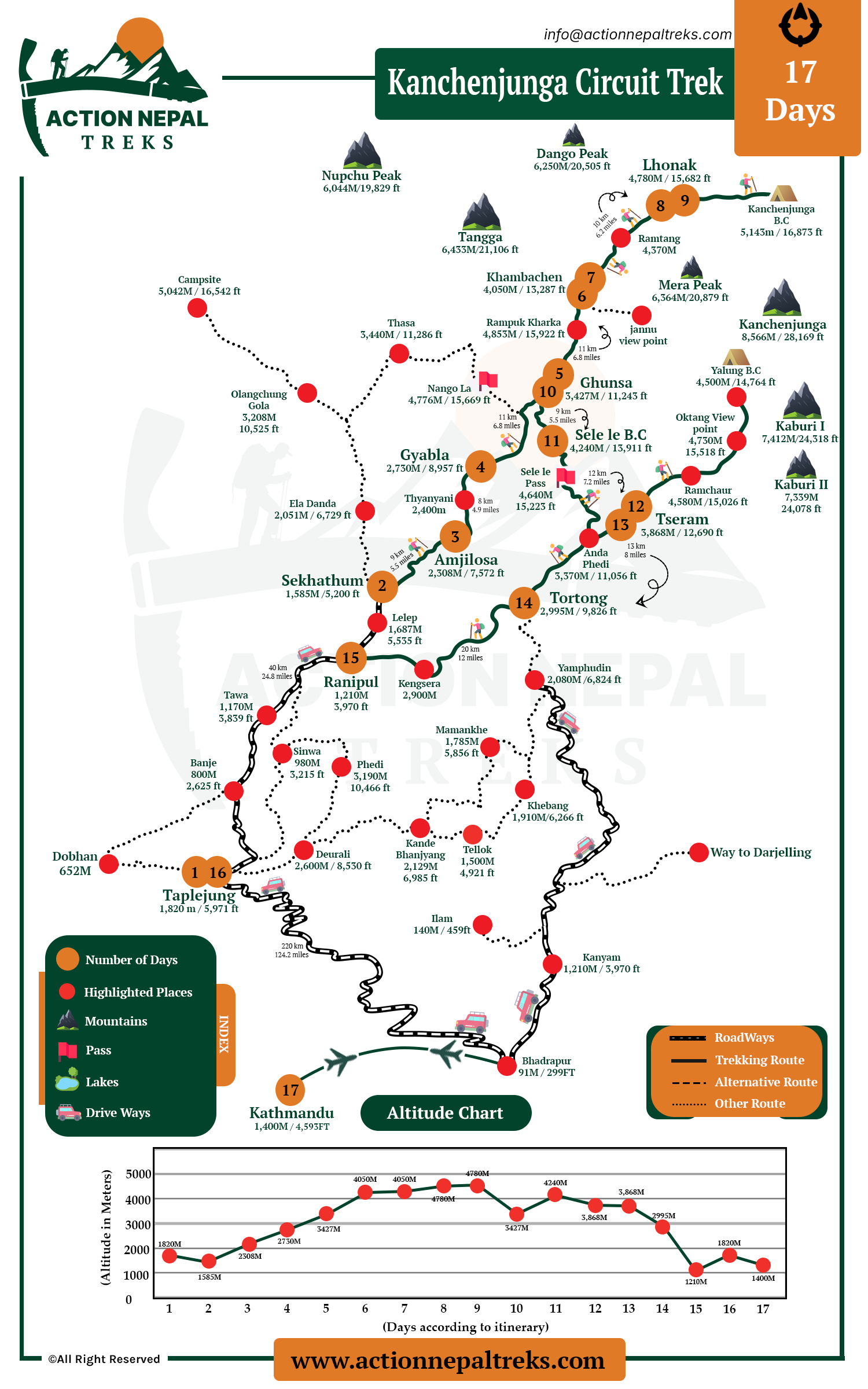
Kanchenjunga circuit trek route map.

Trail
Return Trail

Trip Includes/Excludes

Includes

Excludes

  • Privet vehicles drop pick-up at international and domestic airports to your hotel at kathmandu.
  • kathmandu to Bhadrapur to kathmandu flight tickets.
  • Transportation From Bhadrapur to Ilam, Taplejung,  Sakathum and back to Taplejung Bhadrapur by Sharing Jeep
  • Domestic Airport Drop & Pick up.
  • A highly experienced government license holder, guide, with all his food, accommodation, salary, insurance, transportation, and flight tickets.
  • For two clients, one strong porter. with all his food, accommodation, salary, insurance, transportation and Flights.
  • Porter can carry a maximum weight of 20kg with 10 kg of luggage for each trekker.
  • For more than six clients, one assistant guide.
  • Three meals a day (Breakfast, Lunch, and Dinner) during the trek.
  • Total 17 nights stay in Hotel room, where 4 nights at the attached bathroom. 13 nights simple standard room.
  • For every two clients one room with 2 separate beds.
  • Fresh seasonal fruits every evening after dinner.
  • Lights snack such as Cookies every day.
  • (RAP) Restricted Area permit fees.
  • KCAP) Kanchenjunga Conservation Area Permit Fees.
  • TIMS Card (Trekking Information Management System)
  • All entrance fees in local villages during trek.
  • Water purification tablets.
  • Sleeping Bags, Down Jackets and duffel bags  during the Trek. if you don’t have your own.
  • All government taxes.
  • Assistance for emergency Rescue.
  • First aid kit box for trek.
  • Successful trip certificate from Action Nepal Treks.
  • Farewell dinner after the trip.
  • International flights & Nepal visa fee
  • Personal insurance (must include rescue & evacuation)
  • Kathmandu meals (lunch/dinner), extra hotel nights
  • Trekking personal expenses: snacks, Wi-Fi, showers, battery charging, drinks
  • Optional sightseeing on Day 2
  • Tips for guide & porter

How Does Kanchenjunga Circuit Trek Compare with Manaslu Circuit & Everest Region Treks?

Kanchenjunga, Manaslu, and the Everest Region treks all allow you to see the Himalayan wonders of Nepal. However, each trek gives you a unique experience. The Kanchenjunga trek is extremely remote, with rugged trails, sparse teahouses, and authentic villages, while Manaslu is moderately remote, mixing solitude with reasonably comfortable lodges. The most popular Everest Base Camp has well-developed trails, busy paths, and extensive teahouse infrastructure.

Here are some reasons why the Kanchenjunga trek differs from Manaslu Circuit & EBC Treks:

Trekking Both North and South Base Camps in a Single Loop

The Everest region and the Manaslu Circuit only focus on a single base camp. But the Kanchenjunga Circuit trek differs. You have a rare chance to visit both the North Base Camp (Pang Pema) and the South Base Camp (Oktang) on the same journey.

The northern route offers stark alpine barrens, glaciers, and towering peaks, such as Jannu (Kumbhakarna), Pyramid Peak, and Tent Peak. Meanwhile, the southern route consists of green forests, waterfalls, and the Yalung Glacier, offering stunning views of peaks like Kabru, Yalung Kang, and Rathong. This dual access gives trekkers a diverse perspective on the third-highest mountain in the world, Kanchenjunga.

Mount Kanchenjunga
Mount Kanchenjunga

Crossing High Passes Over 4,500m in Consecutive Days

The Kanchenjunga Circuit involves a thrilling sequence of high passes: Sele Le La, Sinion La, Mirgin La, and Sinelapche La. These passes link the northern and southern loops of the circuit, making this section one of the most challenging and continuous high-altitude routes. Unlike the Everest Base Camp trek, where you gain elevation more gradually, or the Manaslu Circuit, which combines cultural immersion with moderate climbs, here you have to cross them all in just a single day, one after another.

Without a decent fitness level, you won’t be able to pace yourself carefully. Staying resilient in these sections will be hard. Additionally, unpredictable mountain weather and fatigue may make things worse at elevations over 4,500m. This is why you need proper acclimatization and start early to avoid being stuck in the passes section.

Rare Close-Up Views of Ilam Tea Gardens

A fascinating feature of the Kanchenjunga trek is the opportunity to drive through Nepal’s famous tea gardens, which produce some of the world’s finest teas. You’ll have the chance to stop, walk through these green plantations, and taste a freshly brewed cup of local tea, the quality that has earned it international acclaim as the World’s Best Tea in 2024. Not only do you get surrounded by rows of tea bushes, but you can also see the distant Mt. Kanchenjunga and Makalu on the horizon.

Long Days Between Remote Teahouses with Limited Facilities

From Ghunsa to the higher alpine region section, teahouse options become sparse and very basic. Villages like Lhonak, Ramche, and Sele La often offer nothing more than stone shelters with limited food and no electricity, Wi-Fi, or heating. You should be prepared for cold nights, simple meals, and rustic conditions. You’ll need a sleeping bag rated to -20°C (-4°F) for comfortable sleep. This lack of comfort is a challenge, but it also heightens the sense of isolation and adventure during the trek.

Restricted Area Permit Requirements (RAP & KCAP)

This circuit trek lies in a restricted trekking zone and the Kanchenjunga National Park. So, you need to obtain a Restricted Area Permit (RAP) plus a Kanchenjunga Conservation Area Project (KCAP) permit for entry. RAP costs around USD 20 per person (first 4 weeks ), and KCAP costs around USD 15–30, depending on the route.

Compared to Everest or Annapurna permits, the Kanchenjunga and Manaslu region is stricter since you must trek in a group of at least two with a licensed guide. What sets it apart from Manaslu is the higher logistical costs due to the more remote lands. This may feel overwhelming for some.

Cultural Immersion in Tibetan, Limbu, and Rai Villages

Unlike Everest and Manaslu, the Kanchenjunga Circuit offers a broader and more varied cultural experience. The trek passes through diverse communities like Tibetan Buddhist villages in the north and the ancient Limbu and Rai villages in the south. And because of the region’s restricted status, these communities are far less influenced by mainstream tourism. Hence, you witness traditions and lifestyles that haven’t changed much for centuries.

Wild, Untouched Trails with Minimal Trekker Traffic

The Kanchenjunga trek route remains quiet and remote. Most trekkers avoid this trek due to its logistical challenges and strict permit rules, which leave the paths unspoiled and encounters with other groups rare. The solitude you feel on this trek is unmatched, and you get the chance to experience pristine wilderness without distraction and crowds.

Significant Altitude Gains That Demand Extra Acclimatization

The Kanchenjunga Circuit involves sustained climbs to extreme elevations, reaching 5,143 m at Pang Pema and later 4,740 m at Oktang. Trekking to these high points places significant strain on your body. We built in an acclimatization day in Khambachen to manage this risk. Even so, the risk is still there. Therefore, you must move slowly, stay hydrated, and remain alert to signs of altitude sickness to ensure a safe and successful journey.

Dates & Prices

Our fixed departure dates and per-person pricing make it simple for both solo travelers and small groups to join the adventure. It’s a great chance to meet new people and share the experience with other trekkers. Just choose your preferred date, and we’ll take care of the rest.

Kanchenjunga Circuit Trek Departure Date

Start Tuesday

3 Mar

Status

Booking Open

Days

19

Per Person

USD 1,849

Kanchenjunga Circuit Trek

Start Thursday

5 Mar

Status

Booking Open

Days

19

Per Person

USD 1,849

Kanchenjunga Circuit Trek

Start Saturday

7 Mar

Status

Booking Open

Days

19

Per Person

USD 1,849

Kanchenjunga Circuit Trek

Start Tuesday

10 Mar

Status

Booking Open

Days

19

Per Person

USD 1,849

Kanchenjunga Circuit Trek

Start Thursday

12 Mar

Status

Booking Open

Days

19

Per Person

USD 1,849

Kanchenjunga Circuit Trek

Start Saturday

14 Mar

Status

Booking Open

Days

19

Per Person

USD 1,849

Kanchenjunga Circuit Trek

Start Tuesday

17 Mar

Status

Booking Open

Days

19

Per Person

USD 1,849

Kanchenjunga Circuit Trek

Start Thursday

19 Mar

Status

Booking Open

Days

19

Per Person

USD 1,849

Kanchenjunga Circuit Trek

Start Saturday

21 Mar

Status

Booking Open

Days

19

Per Person

USD 1,849

Kanchenjunga Circuit Trek

Start Tuesday

24 Mar

Status

Booking Open

Days

19

Per Person

USD 1,849

Kanchenjunga Circuit Trek

Start Thursday

26 Mar

Status

Booking Open

Days

19

Per Person

USD 1,849

Kanchenjunga Circuit Trek

Start Saturday

28 Mar

Status

Booking Open

Days

19

Per Person

USD 1,849

Kanchenjunga Circuit Trek

Start Tuesday

31 Mar

Status

Booking Open

Days

19

Per Person

USD 1,849

Kanchenjunga Circuit Trek

What Travelers Ask Before the Kanchenjunga Circuit Trek

Trip Reviews

Action Nepal Treks is a reliable trekking company run by a professional guide who has been active in Nepal’s tourism industry for 15 years.

Similar Trips

View Details
Kanchenjunga North Base Camp Trek

 Kanchenjunga North Base Camp Trek