
Sambir
Connect With a Trek Expert(Simbir) +977 9709278526

Gokyo Renjo La Pass Trek

Mountain Icon

Max. Altitude

5,357m/ 17,575ft

Duration Icon

Duration

11 Days

Grade Icon

Grade

Demanding
Region Icon

Trek Region

Everest Region Trek Packages

Season Icon

Best Season

Spring, Autumn

Transportation Icon

Transportation

Flight

Meals Icon

Meals Included

B.L.D
Destination Icon

Destination

Tours & Treks in Nepal

Destination Icon

Group Size

1 - 19

Activity Icon

Activity Per Day

6-7 hrs walking

Start End Icon

Start/End Point

Kathmandu/Kathmandu

Nature Icon

Nature Of Trek

Lodge to lodge trekking

Gokyo Renjo La Pass Trek Overview

The Gokyo Renjo La Pass Trek is one of the most breathtaking trekking adventures in Nepal’s Everest Region. It offers a quieter and more scenic alternative to the classic Everest Base Camp Trek, taking you through stunning Himalayan landscapes, crystal-clear glacial lakes, and traditional Sherpa villages. This trek is ideal for travelers seeking spectacular mountain views, cultural experiences, and a less crowded trail.

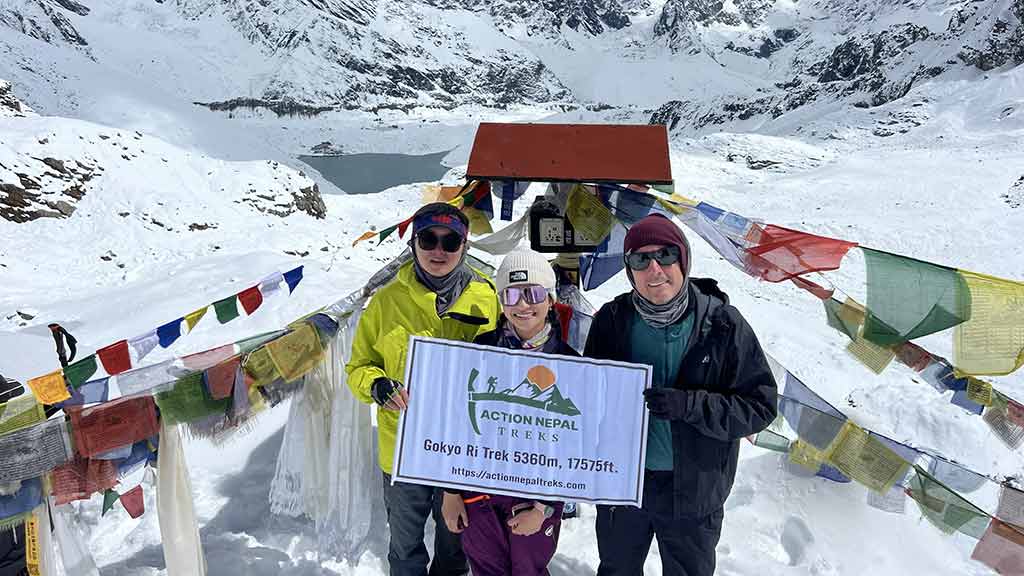
One of the main highlights of the trek is the beautiful Gokyo Lakes, a series of turquoise glacial lakes surrounded by snow-covered peaks. Another unforgettable experience is climbing Gokyo Ri (5,357 m), one of the best viewpoints in the Everest region, where you can enjoy panoramic views of Mount Everest, Lhotse, Makalu, Cho Oyu, and the iconic Ama Dablam. Crossing the Renjo La Pass (5,360 m) adds excitement to the journey, rewarding trekkers with magnificent Himalayan scenery.

The trail passes through the UNESCO-listed Sagarmatha National Park, home to diverse wildlife, including Himalayan tahr, musk deer, colorful pheasants, and, on rare occasions, the elusive snow leopard. Trekkers also walk through picturesque Sherpa settlements, where they can experience the rich traditions, warm hospitality, ancient monasteries, prayer flags, and unique Tibetan Buddhist culture.

Suitable for trekkers with moderate fitness and good stamina, the Gokyo Renjo La Pass Trek typically takes 11 days to complete, depending on the itinerary. The route provides proper acclimatization while allowing plenty of time to appreciate the region’s natural beauty and cultural heritage.

Combining pristine alpine lakes, dramatic mountain passes, breathtaking Himalayan panoramas, and authentic cultural encounters, the Gokyo Renjo La Pass Trek offers an unforgettable adventure. It is one of the finest trekking experiences in the Everest region for those seeking both natural beauty and a rewarding high-altitude journey.

Gokyo Renjo La Pass Trek Itinerary

Day 1: Kathmandu to Lukla, Trek to Phakding

Today marks the beginning of our 11-day journey to Gokyo Valley. Getting up early in the morning, you will have breakfast. One of the guides will come and pick you up. We will then take a short ride towards Tribhuvan Domestic Airport. From there, we will take a short 30-minute flight from Kathmandu to Lukla.

As an alternative, we can also take a short ride towards Manthali, which takes about 3 hours. Upon reaching there, we will take a 20-minute flight to Lukla. After arriving at Lukla, we will have our lunch or breakfast and prepare ourselves for our first day of trekking journey towards Phakding. The trail today is relatively easy. Passing through some remote villages, we will finally reach our first destination, Phakding.

Itinerary Details
Itinerary Fact Details
Meals Icon
Meals
Breakfast, Lunch, Dinner
Accommodation Icon
Accommodation
Lodge with private attached bathroom
Distance Icon
Trek Distance
9 km (5.59miles)
Mountain Icon
Highest Altitude
2,860 m (9,370 ft)
Duration Icon
Trek Duration
3 hours trekking and 30 min (Kathmandu–Lukla), 20 min (Manthali–Lukla) flight
Duration Icon
Drive Duration
3 hours

Day 2: Phakding to Namche Bazaar

After spending a night at Phakding, on the second day, we will embark on a journey towards Namche Bazaar. Starting at 2610m, we will head towards a higher altitude on a relatively difficult route. Throughout the route, we will cross the Dudh Koshi River 5 times through suspension bridges specially Hillary bridge. As we walk, we will see many remote villages and a few viewpoints along the way.

Prior to reaching Manjo Jorsale, we will enter the Sagarmatha National Park, where we are requested to present the entry permit. After entering the national park area, we will continue up towards a steep climb and increasing altitude. We will finally reach Namche bazaar after walking for another hour or two. At Namche, we will be greeted by a bustling market town and friendly locals.

Itinerary Details
Itinerary Fact Details
Meals Icon
Meals
Breakfast, Lunch, Dinner
Accommodation Icon
Accommodation
Lodge with attached bathroom
Distance Icon
Trek Distance
11km (6.84 miles)
Mountain Icon
Highest Altitude
3,440 m (11,280 ft)
Duration Icon
Trek Duration
6-7 hours

Day 3: Acclimatization Day at Namche Bazaar, Hike to Everest View Hotel

Today, we will spend an entire day acclimating before heading toward the higher altitude. To get used to the thin air, we will explore the Namche Bazaar and nearby remote villages nested in Khamjung Valley. After spending a few hours around Namche Bazaar, we will embark on a short hike to Everest View Hotel. From here, we will witness a breathtaking view of the majestic Mount Everest, Lhotse , Amadablam, Thamseku, khagdega and the surrounding landscapes.

After enjoying lunch in the serene surroundings, we will get back to the town slowly by taking the same route. Upon arriving at the town, we will visit some monasteries and museum spend the rest of the day shopping for souvenirs and local handicraft items. We will spend another night at the same lodge.

Itinerary Details
Itinerary Fact Details
Meals Icon
Meals
Breakfast, Lunch, Dinner
Accommodation Icon
Accommodation
Lodge with attached bathroom
Distance Icon
Trek Distance
5.4 km (3.4 miles)
Mountain Icon
Highest Altitude
3,880 m (12,900 ft)
Duration Icon
Trek Duration
3 hours

Day 4: Namche Bazaar to Dole

The next morning, we will wake up early and start following the trail heading to Dole. Today’s journey begins with a climb out of Namche, heading towards Dudh Koshi River valley. Along the way, we will come across multiple vendors and a dense pine forest covered with rhododendron fields to arrive at the village of Mongla. Here, we will take our first halt of the day and enjoy lunch at one of the tea houses.

This short break offers some of the best views of Everest, Lhotse, Ama Dablam, and other mountains. The trail after lunch is a bit tricky, with continuous climbing, which might be stressful. After a few hours of challenges, we will finally reach the village of Dole, preached at 4038m. Stopping here for the night, we will enjoy the views of towering hills, deep gorges, and green terrain.

Itinerary Details
Itinerary Fact Details
Meals Icon
Meals
Breakfast, Lunch, Dinner
Accommodation Icon
Accommodation
Lodge
Distance Icon
Trek Distance
12 km (7 miles)
Mountain Icon
Highest Altitude
4,038 m (13,248 ft)
Duration Icon
Trek Duration
6-7 hours

Day 5: Dole to Machhermo

After spending a restful night at Dole, the next morning we journey towards Machhermo, post breakfast. We will begin on an easy, plain walking path that slowly ascends the hill. As the climbing continues, we will cross the juniper forest and also see beautiful summer settlements.

While taking a strenuous climb, we will be treated with a glimpse of Cho Oyu and other peaks like Kantega and Tamserku. In the evening, we will arrive at Machhermo and spend the rest of the day and night exploring this beautiful village.

Itinerary Details
Itinerary Fact Details
Meals Icon
Meals
Breakfast, Lunch, Dinner
Accommodation Icon
Accommodation
Lodge
Distance Icon
Trek Distance
7 km (4.3 miles)
Mountain Icon
Highest Altitude
4,480 m (14,400 ft)
Duration Icon
Trek Duration
3 / 4 hours

Day 6: Machhermo to Gokyo

The trail from Machhermo to Gokyo is a bit long and tiring, so we will head out early after having a quick breakfast in the morning. As we step out of Machhermo village, a long uphill climb greets us. With every step, the climb continues to get higher; the oxygen level continues to decrease, making it a bit challenging to breathe.

Along the way, we cross razing yak fields and come across the memorials made in honor of the ones who lost their lives in landslides. The famous Ngozumpa glacier, which we pass before reaching Gokyo Valley, can also be seen. Upon reaching the valley, we will explore the village and visit the nearby Gokyo lake. After a tiring day, we spent the night at one of the tea houses.

Itinerary Details
Itinerary Fact Details
Meals Icon
Meals
Breakfast, Lunch, Dinner
Accommodation Icon
Accommodation
Lodge
Distance Icon
Trek Distance
5.7 km (3.5 miles)
Mountain Icon
Highest Altitude
4,790 m (15,885 ft)
Duration Icon
Trek Duration
4 hours

Day 7: Sunrise Summit of Gokyo Ri and High Lakes Exploration

A final hike from Gokyo Valley takes you to the main highlights of the trek, Gokyo Ri. Leaving early in the morning, the trailhead starts at the west side of Ngazumpa glacier and continues upwards along a rough path. After all the hard work, the summit comes into sight. From there, you can enjoy mesmerizing views of the rolling hills and towering peaks like Everest, Lhotse, Makalu, and Cho Oyu.

After taking a few pictures and spending time taking in the serene beauty of nature, we will head back to Gokyo for breakfast. In the evening, we trek to see the stunning 4th Gokyo Lake (Thonak Tsho) and the 5th Gokyo Lake (Ngozumpa Tsho). These lakes are located in the high-altitude wilderness north of the main village and offer serene landscapes, fewer crowds, and an uninterrupted view of the Himalayan giants. After enjoying the peaceful surroundings and taking photographs, we return to Gokyo for the night.

Itinerary Details
Itinerary Fact Details
Meals Icon
Meals
Breakfast, Lunch, Dinner
Accommodation Icon
Accommodation
Lodge
Distance Icon
Trek Distance
10-12 km (6.2-7.4 miles)
Mountain Icon
Highest Altitude
5,357m (17,575 ft)
Duration Icon
Trek Duration
6-7 hours

Day 8: Gokyo to Lungden via Renjo La Pass

Today is another challenging yet rewarding days of the trek. We begin early and head toward the steep ascent of the Renjo La Pass, one of the three major passes of the Everest region. The climb is demanding due to the high altitude. Still, the reward at the top is breathtaking, a sweeping, postcard-perfect view of Everest, Cho Oyu, Makalu, and the entire Gokyo Valley.

After enjoying the scenery, we descend through stone staircases and rugged trails toward the remote settlement of Lungden. The descent is long but offers changing landscapes, from icy high passes to open valleys. We spend the night in Lungden.

Itinerary Details
Itinerary Fact Details
Meals Icon
Meals
Breakfast, Lunch, Dinner
Accommodation Icon
Accommodation
Lodge
Distance Icon
Trek Distance
11-12 km (6.8-7.4 miles)
Mountain Icon
Highest Altitude
5,360m (17,585 ft)
Duration Icon
Trek Duration
7-8 hours

Day 9: Lungden to Thame, Continue to Namche Bazaar

After breakfast, we start descending toward the beautiful village of Thame. It is known for its ancient Dechen Chekhorling Monastery, built in 1667, and as a major stopover for yak caravans that once traveled to Tibet. The trail is relatively easy, passing Sherpa villages such as Mendaphu and Thameteng, mani walls, and peaceful forest sections.

From Thame, we follow a gentle trail just above the meeting point of the Bhote Koshi and Dudh Koshi rivers back toward Namche Bazaar. We move through quiet stretches of pine, juniper, and rhododendron forest and finally reach the heart of the Khumbu region. Here, we will find modern comforts, bakeries, and bustling markets again. We rest and enjoy a comfortable stay before heading back toward Lukla.

Itinerary Details
Itinerary Fact Details
Meals Icon
Meals
Breakfast, Lunch, Dinner
Accommodation Icon
Accommodation
Lodge with attached bathroom
Distance Icon
Trek Distance
18 km (11 miles)
Mountain Icon
Highest Altitude
4,380m (14,370 ft)
Duration Icon
Trek Duration
6-7 hours

Day 10: Namche Bazaar to Lukla

The last day of hiking is from Namche Bazaar to Lukla. Walking along the Dudh Koshi River, we will descend the steep hills and cross Hillary’s Suspension Bridge. We move through familiar villages like Monjo, Phakding, and Chheplung before the last short uphill stretch to reach Lukla.

At Lukla, we will freshen up and get some rest at the lodge. Then, a farewell dinner awaits you in the evening. Bid goodbye to our trekking team since this is going to be our final stop on the route before returning to Kathmandu.

Itinerary Details
Itinerary Fact Details
Meals Icon
Meals
Breakfast, Lunch, Dinner
Accommodation Icon
Accommodation
Lodge with private attached bathroom
Distance Icon
Trek Distance
17km (10 miles)
Mountain Icon
Highest Altitude
3,440m (11,280 ft)
Duration Icon
Trek Duration
7 hours

Day 11: Lukla to Kathmandu

On the final day of the trek, we will leave Lukla and take a flight back to Kathmandu. After this 30-minute flight, we will land at Tribhuvan International Airport (TIA) and get back to the hotel. To spend the day, you can either rest or go shopping on the streets of Kathmandu. After that, with one last goodbye, you end your 11-day journey towards Gokyo Valley. Wish you a safe journey back home.

Itinerary Details
Itinerary Fact Details
Meals Icon
Meals
Breakfast
Duration Icon
Trek Duration
30 min (Kathmandu–Lukla), 20 min (Manthali–Lukla)
Duration Icon
Drive Duration
3 hours

Trip Includes

Includes

Excludes

  • Private airport pick-up and drop-off service between international and domestic airports and your hotel in Kathmandu.
  • Domestic round-trip flight tickets: Kathmandu – Lukla – Kathmandu. (If Lukla flights operate via Manthali Airport, private car or van transfer between Kathmandu and Manthali is included.)
  • A highly experienced government-licensed trekking guide, including all expenses: meals, accommodation, salary, insurance, transportation, and domestic flight costs.
  • One strong porter for every two trekkers, including all expenses: meals, accommodation, salary, insurance, and transportation.
  • For solo trekkers, porter service is not included in the package cost. porter service can be arranged  at an additional charge.
  • Porter service with a maximum luggage allowance of 20 kg total (10 kg per trekker).
  • For groups of more than six trekkers, one additional assistant guide.
  • Three meals per day during the trek (Breakfast, Lunch, and Dinner).  main course included during the trek.
  • Total 10 nights accommodation during the trek, including:
    • 6 nights in rooms with attached bathrooms
    • 4 nights in standard teahouse rooms with shared facilities
  • Twin-sharing accommodation (one room with two separate beds for every two clients).
  • Fresh seasonal fruits served every evening after dinner.
  • Light snacks provided daily (such as cookies).
  • All local village entrance fees during the trek.
  • Sagarmatha National Park Permit fee.
  • Khumbu Pasang Lhamu Rural Municipality Permit fee.
  • TIMS Card (Trekkers’ Information Management System).
  • Water purification tablets during the trek.
  • Complimentary use of sleeping bags, down jackets, duffel bags, Trekking poles and crampons  during the trek (if you do not have your own equipment).   Must be returned after the trek.
  • All applicable government taxes.
  • Assistance and coordination for emergency rescue services (rescue costs and helicopter charges are not included unless covered by insurance).
  • Comprehensive first aid kit carried during the trek.
  • Successful Trip Certificate from Action Nepal Treks.
  • Farewell dinner after completing the trek.
  • International flight tickets.
  • Nepal entry visa fee.
  • All accommodation and meals in Kathmandu, including any extra hotel nights caused by early return from the trek, early arrival, or late departure.
  • Personal expenses such as hot showers, Wi-Fi, battery charging, Hot & cold drinks, alcoholic beverages, additional porters, horse, shopping, snacks, personal clothing, and trekking gear.
  • Travel insurance (strongly recommended and must include emergency evacuation and rescue coverage).
  • Tips for guides and porters (optional but greatly appreciated).

Gokyo Renjo La Pass Trek Route Map

Explore the Trek Route in Google Satellite View for Better Clarity.

Trail
Return Trail

Why Choose the Gokyo Renjo La Pass Trek?

The Gokyo Renjo La Pass Trek combines the highlights of the Gokyo Valley with a crossing of Renjo La, one of the high passes in the Everest region. Compared with the standard Gokyo Valley Trek, this route adds a challenging pass crossing and continues toward the quieter Thame Valley. It is also a way to experience a high Himalayan pass without committing to the full Everest Three Passes Trek.

renjo la pass

The journey takes you through picturesque Sherpa villages, dense rhododendron and pine forests, alpine meadows, and the UNESCO-listed Sagarmatha National Park. Along the trail, you’ll encounter ancient monasteries, colorful prayer flags, suspension bridges, and breathtaking mountain scenery that showcase the region’s rich natural and cultural heritage.

One of the trek’s greatest highlights is the ascent to Gokyo Ri (5,357 m), one of the finest viewpoints in the Himalayas. From its summit, you can enjoy spectacular panoramic views of Mount Everest, Lhotse, Makalu, Cho Oyu, Ama Dablam, and many other Himalayan giants. The trek also features the stunning Gokyo Lakes, Nepal’s highest freshwater lake system, and the impressive Ngozumpa Glacier, the longest glacier in the Himalayas.

Beyond its breathtaking scenery, the Gokyo Valley Trek offers a perfect blend of adventure, culture, and tranquility. Whether you’re a nature enthusiast, photographer, or adventure seeker, this remarkable journey promises unforgettable experiences at every step.

Cross Renjo La Without Doing a Full Everest Three Passes Trek

Renjo La is the main high-pass section of this trek, reaching about 5,360 meters. Crossing the pass involves a demanding ascent and descent at high altitude, but the itinerary focuses on Renjo La rather than linking all three major passes of the Everest region. This makes the route suitable for trekkers who want a high-pass experience while keeping the journey more focused than the complete Three Passes circuit. The pass also connects the Gokyo and Thame areas, adding a different landscape and sense of progression to the trek without extending it into a full three-pass adventure.

Explore the Gokyo Lakes and Gokyo Valley

The trek passes through the Gokyo Valley, known for its chain of glacial lakes surrounded by high Himalayan terrain. Dudh Pokhari is the main lake beside Gokyo village, while other lakes extend farther into the valley.

The route also provides views of the Ngozumpa Glacier and the mountains rising around the valley. The color and appearance of the lakes can vary with sunlight, weather, and season. Walking beside these high-altitude lakes adds a scenic element to the trek, with open valleys, rocky slopes, glaciers, and snow-covered peaks forming the landscape around the trail.

Stand Above the Gokyo Valley at Gokyo Ri

Gokyo Ri offers one of the defining viewpoints of the Gokyo region. The climb from Gokyo village is steep and takes you above the valley and its lakes. From the summit, trekkers can look across the surrounding Himalayan landscape, with views that can include Everest, Lhotse, Makalu, Cho Oyu and other peaks when the weather is clear.

The viewpoint is also useful for understanding the scale and layout of the Gokyo Valley. An early morning ascent is commonly preferred because the cooler conditions can provide clearer mountain views before clouds build later in the day.

See Everest, Lhotse, Makalu and Cho Oyu

The trek can provide views of several major Himalayan peaks, including Mount Everest, Lhotse, Makalu and Cho Oyu. However, mountain visibility depends heavily on weather, cloud cover, haze and atmospheric conditions.

Clear mornings often offer better viewing conditions, but no itinerary can guarantee that every peak will be visible throughout the trek. The best viewpoints along the route allow you to take in several peaks across the Himalayan skyline, making clear-weather periods particularly rewarding for trekkers carrying a camera or simply enjoying the mountain scenery.

How Difficult Is the Gokyo Renjo La Pass Trek?

The Gokyo Renjo La Pass Trek is a demanding high-altitude trek, not a technical mountaineering expedition. The main difficulty comes from walking for several hours at increasing elevations, crossing Renjo La Pass at about 5,360 m, and dealing with steep climbs, cold temperatures, and changing mountain weather.

You can expect long walking days, particularly around the Renjo La crossing. The trail includes steep ascents and descents, rocky and uneven sections, stone steps, and areas where the terrain can become more difficult after snowfall. At higher elevations, even a moderate uphill section can feel strenuous because the air contains less oxygen.

gokyo ri

Weather is another important factor. Cold, wind, snowfall, and poor visibility can make the trail harder and may affect the timing of a pass crossing. Good acclimatization and adequate recovery between walking days are therefore important. A steady pace, sufficient hydration, nutritious meals, and enough sleep can help you manage the physical demands of the trek.

Overall, the trek requires better preparation than a standard lower-altitude trek, but you do not need previous mountaineering experience to complete it under normal trail conditions.

Is Renjo La Pass Technically Difficult?

Renjo La Pass is generally considered a demanding high-altitude trekking challenge, not a technical climbing route. Under normal conditions, trekkers following the established route do not normally need ropes, climbing systems, or other mountaineering equipment simply to cross the pass.

The more significant challenge is the steep ascent at high altitude and the physical effort required to reach the top. Snow and ice can, however, change the character of the trail. After heavy snowfall or during periods of icy conditions, sections may become slippery and more demanding. Your guide can assess the trail conditions and advise whether additional equipment, such as microspikes or crampons, is appropriate.

In simple terms, technical climbing and strenuous trekking are different things. Renjo La demands physical endurance, altitude preparation, and careful footing, but it is not normally a technical climbing objective.

Can a Beginner Do the Gokyo Renjo La Pass Trek?

A beginner can undertake the Gokyo Renjo La Pass Trek, but it is not an ideal first trek for someone with little physical preparation. Previous high-altitude trekking experience can be helpful, but fitness, acclimatization, preparation, and sensible pacing are more important than simply having a long trekking history.

You should be comfortable with walking for several hours on consecutive days and handling steep uphill and downhill sections. Training with regular hiking, stair climbing, uphill walking, and longer walks before the trip can help prepare your legs and cardiovascular system for the terrain.

Acclimatization is particularly important. The itinerary should allow your body time to adjust to increasing altitude rather than rushing toward Renjo La. A gradual pace and properly planned acclimatization days can make a significant difference.

For a first high-altitude trek, going with an experienced local guide can also make the journey easier to manage. A guide can help with pacing, route conditions, weather changes, and recognizing symptoms that may indicate altitude-related problems.

Preparations for Gokyo Renjo La Pass Trek

Physical Preparation

In order to get ready for the Gokyo Renjo La Pass Trek, you will have to be physically fit to a certain level. You will need to build a moderate level of endurance, strength, and stamina to complete the trek without any difficulty. Mild exercises like running, jogging, short hiking, and cycling can help prepare your body for the trek. For an added benefit, you can strengthen your legs, core, and upper body by performing squats and weight training a few times a week. However, it is important to dedicate at least 2-3 months of your time before the trek to these exercises.

Mental Preparation

Mental health is equally important as physical fitness during the Gokyo Renjo La Pass Trek. Being mentally ready for the challenges will help in dealing with them more easily. Throughout the journey, you will have to walk past uncomfortable terrains and adapt to long days and changing weather. So, it is important to face them all with a positive mindset in order to complete the trek. Try visualizing each milestone along the trek. This can help build your resilience and keep you motivated during tougher sections.

How Do You Acclimatize for Renjo La Pass?

Acclimatization for the Renjo La Pass Trek depends mainly on gaining altitude gradually and giving your body enough time to adjust before reaching the 5,360 m Renjo La Pass. A well-planned itinerary normally includes an acclimatization day around Namche Bazaar before continuing toward higher elevations.

  • Gradual ascent: Avoid gaining too much elevation in a single day. The route from Namche to higher villages should be planned so your body has time to adapt to the decreasing oxygen levels.
  • Acclimatization day: Spend an extra day in Namche Bazaar and use it for a short hike to a higher viewpoint before returning to sleep at Namche. This provides exposure to higher altitude without requiring you to sleep there.
  • Stay hydrated: Drink water regularly throughout the day. Dehydration can make headaches, tiredness, and other altitude-related discomforts more difficult to manage.
  • Keep a steady pace: Walk slowly and maintain a comfortable, consistent rhythm, particularly on long uphill sections. There is no benefit in rushing to reach the next village.
  • Pay attention to sleeping altitude: As you move higher, where you sleep matters as much as the daytime elevation you reach. A sensible itinerary limits unnecessary increases in sleeping altitude.
  • Avoid unnecessary rapid gains: Do not add extra high-altitude detours simply to cover more ground. If you develop symptoms of altitude sickness, stop ascending and inform your guide rather than continuing higher.

Good acclimatization does not guarantee that you will avoid altitude sickness, but a gradual itinerary, adequate rest, hydration, and controlled pacing can help your body adjust to the higher elevations of the Renjo La route.

What the Lodges Look Like on the Gokyo Renjo La Pass Trek?

The most common means of accommodation during the Gokyo Lake Trek are lodges or teahouses. During your stay in city areas like Kathmandu, you will be staying in 3-star hotels. As you begin your trek, you will be staying in lodges. In lower altitude places, you will get basic facilities such as beds, blankets, and pillows. Some of the teahouses can also offer you private bathrooms.

everest view hotel
everest view hotel

However, it is very hard to find a private bathroom as you ascend higher. Also, these teahouses offer you a communal dining space where you can have your dinner and interact with fellow travelers. It is very important for you to know that the higher you climb, the more basic the facilities will be, along with an increased price.

Food Variety during the Gokyo Renjo La Pass Trek

If you are planning to trek with us, we offer you a total of 11 days of meals. You will have a total of 11 breakfasts, 10 lunches, 10 dinners with us in your 11-day adventure. With both vegetarian and non-vegetarian options available, each meal can cater to the individual and help to provide energy for the journey. We generally recommend you not to have a non-vegetarian option due to safety concerns. Furthermore, if you have any diet preferences, make sure you inform us prior to your journey.

Meal Options
Breakfast Pancakes, Porridge, Eggs (boiled, scrambled, or fried), Toast, Muesli, Oatmeal, Tibetan Bread, Tea, Coffee, Fresh Juice, Seasonal Fruit
Lunch Dal Bhat (Rice with Lentil Soup), Noodles, Fried Rice, Spaghetti, Vegetable Curry, Dumplings (Momos), Salad, Chicken/Fish Curry, Fresh Seasonal Vegetables
Dinner Dal Bhat Set (with vegetables, pickles, and meat options), Pasta, Pizza, Stir-fried Noodles, Thukpa (Tibetan Noodle Soup), Steamed/Grilled Vegetables, Soup, Roti with Curry

Can You Follow a Vegetarian or Special Diet?

Yes. Vegetarian meals are widely available along the trek, and you can request a special diet when booking. Most teahouses serve dishes such as dal bhat, vegetable curry, noodles, pasta, rice, soup, potatoes, and eggs. If you have specific dietary needs, such as vegan, gluten-free, or dairy-free meals, inform your trekking agency in advance so suitable food can be arranged where possible.

At higher elevations, food choices may become more limited because supplies are transported to remote villages. For strict allergies or dietary restrictions, carry a few suitable snacks and clearly explain your requirements to the guide and lodge staff.

What permits are required for the Gokyo Renjo La Trek?

While trekking to the Gokyo Valley, you will have to gather two different permits: the Khumbu Pasang Lhamu Rural Municipality Permit (KPLRM) and the Sagarmatha National Park Entry Permit. Both of these permits are checked at different locations on the route. So make sure to obtain them and have them in hand throughout the journey.

Khumbu Pasang Lhamu Rural Municipality Permit (KPLRM)

The Khumbu Pasang Lhamu Rural Municipality Permit (KPLRM) is required to get legal access to the Khumbu region, including the villages of Namche Bazaar, Tengboche, and Dinboche. This permit supports rural development and helps maintain the region’s infrastructure. Along with that, a certain part of it also goes to the conservation effort and tourism management in the area.

Nationalities Cost Per Person
Nepali NPR 100
SAARC NPR 2000
Other Nationalities NPR 2000

Sagarmatha National Park Entry Permit

The Sagarmatha National Park Entry Permit is another one you will need during the Gokyo Renjo La Pass Trek. The funds collected through this permit will be used to conserve the environment and protect many endangered species in the region. It also helps to preserve the cultural heritage of the region.

Nationalities Cost Per Person
Nepali NPR 100
SAARC NPR 1500
Other Nationalities NPR 3000

Required Documents

  • Passport-sized photos (2)
  • A copy of your passport
  • A completed application form
  • Payment (fees vary depending on the type of trekker, i.e., individual or group).

When to go for the Gokyo Renjo La Pass Trek?

The best time to trek the Gokyo Valley is during Spring (March to May) and August (September to November). Besides these two seasons, we do not recommend that you trek during summer and winter. Here is a brief description of each season:

Spring
March to May

Spring is always one of the best seasons to embark on a trek to Gokyo Lake. The weather during this time of the year is generally stable, with moderate temperatures and clear blue skies.

Trekking in spring, you can also witness the beautiful blooming rhododendrons and other wildflowers. This will also add vibrant color to the landscapes. Although it’s the peak season, it’s not as crowded as the autumn season, and you can more easily find accommodations that meet your needs.

Summer
June to August

The summer season in Nepal often brings heavy rainfall to the Gokyo valley. Due to this, the weather becomes completely unpredictable, leading to problems like muddy and slippery trails. Similarly, bright sunny days can lead to sunburn and affect your trekking experience.

Despite all these, trekking during summer is still allowed in this region, and you will be rewarded with magnificent views of the towering peaks and rivers around the trail. A few waterfalls can also be seen rushing down during this time of the year.

Autumn
September to November

Autumn in Nepal is one of the most popular trekking seasons. This season offers the best in everything, including the weather, temperature, and views. The skies are generally clear, with warm days and cool nights. You will also have excellent photographic opportunities compared to monsoons or the winter season.

The post-monsoon greenery adds more vibrance to the trek, with colorful leaves and blooming flowers covering the entire route. However, the popularity of Autumn as a trekking season often results in overcrowding, leading to accommodation problems along the route.

Winter
December to February

It is not a popular season to trek in the Everest Region, but you can still opt for this time of the year if you are well prepared. The season offers you snow-covered trails, making the way slippery and difficult to navigate. Furthermore, the season is freezing cold, ranging below -10 degrees.

Thus, if you are not into cold weather, this can definitely not be an option. However, if you have a unique experience with snowfall, then you can opt for this season. We generally recommend you hire a guide for winter trekking. Additionally, having prior experience can add more safety to your journey.

Dates & Prices

Our fixed departure dates and per-person pricing make it simple for both solo travelers and small groups to join the adventure. It’s a great chance to meet new people and share the experience with other trekkers. Just choose your preferred date, and we’ll take care of the rest.

Gokyo Renjo La Pass Trek Departure Date

Start Monday

26 Oct

Status

Booking Open

Days

11

Per Person

USD 1,240

Gokyo Renjo La Pass Trek

Start Friday

30 Oct

Status

Booking Open

Days

11

Per Person

USD 1,240

Gokyo Renjo La Pass Trek

What to Pack for Gokyo Renjo La Pass Trek?

Clothing
sleeping bag
trekking Gear
first-aid
passport
powerbank

Clothing

  • Base Layers (shirt and pants)
  • Mid Layers (fleece jacket or sweater)
  • Outer Layers (waterproof and windproof jacket and pants)
  • Trekking Pants
  • Insulated Jacket
  • Thermal Layers (socks, gloves, hat)
  • Sun Protection (hat, sunglasses, sunscreen)
  • Footwear (trekking boots, camp shoes/sandals)
  • Undergarments (quick-drying)
  • Gaiters

Sleeping Gear

  • Sleeping Bag (rated for -10°C)
  • Sleeping Bag Liner

Trekking Accessories

  • Trekking Poles
  • Water Bottle or Hydration System
  • Headlamp/Flashlight (with extra batteries)
  • Snacks (energy bars, nuts, dried fruits)
  • Camera (with extra memory cards and batteries)
  • Personal Hygiene Items (toothbrush, toothpaste, wet wipes, hand sanitizer)
  • Toilet Paper (small roll and plastic bag)
  • Small Towel (quick-drying)

Health & Safety

  • First Aid Kit (basic medications)
  • Water Purification Tablets or Filter
  • Sunscreen and Lip Balm (high SPF)
  • Personal Medications

Documents & Miscellaneous

  • Passport and Copies
  • Travel Insurance
  • Cash
  • Trekking Permit and TIMS Card
  • Plastic Bags (for dry gear and waste)

Optional Items

  • Camera or GoPro
  • Notebook and Pen
  • Guidebook or Map

Frequently Asked Questions About Gokyo Renjo La Pass Trek

Gokyo Renjo La Pass Trek Reviews

Action Nepal Treks is a reliable trekking company run by a professional guide who has been active in Nepal’s tourism industry for 15 years.

Verified

Solo Journey to Gokyo Lakes

I went solo on the Gokyo Valley Trek, and it was one of the best trips I’ve taken. My guide from Action Nepal Treks made me feel safe and supported all the way. We walked through quiet villages and saw beautiful mountains every day. The Gokyo Lakes were magical. I felt calm and happy just sitting beside them. Climbing Gokyo...

Verified

Solo Journey to Gokyo Lakes

I went solo on the Gokyo Valley Trek, and it was one of the best trips I’ve taken. My guide from Action Nepal Treks made me feel safe and supported all the way. We walked through quiet villages and saw beautiful mountains every day. The Gokyo Lakes were magical. I felt calm and happy just sitting beside them. Climbing Gokyo Ri was hard, but gave a perfect view of Everest. I’m so glad I chose this trek.

Verified

Best Trekking Experience Ever at Gokyo Valley

I’ve done other treks, but Gokyo Valley was my favorite. The lakes were amazing—so clear and blue! We also saw big glaciers and snowy peaks. The trail felt less crowded, which made the trek even more special. The team from Action Nepal Treks was friendly and helpful every day. They checked on us and made sure we were doing well...

Verified

Best Trekking Experience Ever at Gokyo Valley

I’ve done other treks, but Gokyo Valley was my favorite. The lakes were amazing—so clear and blue! We also saw big glaciers and snowy peaks. The trail felt less crowded, which made the trek even more special. The team from Action Nepal Treks was friendly and helpful every day. They checked on us and made sure we were doing well with the altitude. The whole trek was smooth, safe, and full of great memories.

Verified

Peaceful Gokyo Trek with Beautiful Lakes

The Gokyo Valley trek was so beautiful and peaceful. I went with my best friend, and we loved walking beside the blue lakes and seeing the big mountains around us. The trail was quiet, and we felt very close to nature. Our guide was very kind and helped us with acclimatization. We took it slow and had no problems. Climbing...

Verified

Peaceful Gokyo Trek with Beautiful Lakes

The Gokyo Valley trek was so beautiful and peaceful. I went with my best friend, and we loved walking beside the blue lakes and seeing the big mountains around us. The trail was quiet, and we felt very close to nature. Our guide was very kind and helped us with acclimatization. We took it slow and had no problems. Climbing Gokyo Ri for sunrise was the best moment. I will never forget that view!

Similar Trips

Join us on similar trips in the same region

View Details
helicopter flying towards EBC

Everest Base Camp Helicopter Tour

View Details
7 Days Pikey Peak Trek

7 Days Pikey Peak Trek

View Details
14 days mera peak climb-summit mera peak

Mera Peak Climbing

USD 1,240/ pp