
Sambir
Connect With a Trek Expert(Simbir) +977 9709278526

Makalu Base Camp Trek

Mountain Icon

Max. Altitude

4,870m / 15,978ft (Makalu Base Camp)

Meals Icon

Meals Included

All Meals (Breakfast, Lunch & Dinner) during the trek
Accommodation Icon

Accomodation

Teahouse
Activity Icon

Activity

Wilderness Treks

Season Icon

Best Season

Mar, Apr, May, Sept, Oct, Nov

Transportation Icon

Transportation

Domestic flight & Private Jeep

Duration Icon

Duration

16 Days

Destination Icon

Destination

Tours & Treks in Nepal

Destination Icon

Group Size

2 - 20

Grade Icon

Grade

Strenuous
Activity Icon

Activity Per Day

6-7 hrs walking

Start End Icon

Start/End Point

Kathmandu / Kathmandu

Nature Icon

Nature Of Trek

Teahouse to teahouse trekking

Makalu Base Camp Trek Overview

If commercialized trails are not your cup of tea and you want to experience an authentic Himalayan adventure, the Makalu Base Camp Trek is for you. It takes you right at the foothill of Mount Makalu (8,485m), the world’s fifth-highest mountain. The trek is an opportunity to experience the raw wilderness and solitude of the Himalayas.

The Makalu Base Camp is an extraordinary trek journey on a less-traveled but scenic trail in the Makalu region of Eastern Nepal. You will start with a short flight to Tumlingtar and drive to Num, your trailhead. Begin your trek through forests of rhododendrons and pass by beautiful settlements with terrace farms of the Rai ethnic communities. The scenery and landscape change as you move deeper into Makalu’s remote areas. It changes into an alpine meadow and more barren landscapes. With landscapes, there is also a cultural shift. You will come across Sherpa settlements with stone houses, and trek past monasteries, mani walls, chortens, and stupas.

From the village of Seduwa, which comes right after Num, you will enter the Makalu Barun National Park area. Throughout the trek, you will get to witness various flora and fauna, unique to the region. Although it is rare to catch sight of wildlife, you may get one if you are lucky. Navigating the rugged and isolated trails, you will encounter numerous stunning natural landmarks. Right at the beginning, you will cross the Arun River and trek alongside the Barun River in slightly upper areas. Similarly, you will cross two high mountain passes of Shipton La (4,200m) and Keke La (4,170m). 

The highlight and peak of the trek is reaching the Makalu Base Camp (4,870m). A huge sense of accomplishment will overcome you. Surrounded by glaciers, icefalls, and the giant Himalayas, it is the most rewarding part of the journey. You will stand directly below Mount Makalu. Likewise, you can get magnificent views of the world’s highest mountain, Everest, at a distance, and other surrounding peaks like Chamlang, Baruntse, Lhotse, Peak 6, Peak 7, and more.

The Makalu Base Camp Trek demands good fitness and preparation. It is a strenuous journey that is not for the faint of heart. However, those who dare it will be rewarded with an unforgettable experience that they can boast of for a lifetime. It is a rare adventure that is challenging yet authentic, culturally enriching, and spiritually rewarding. Here is your chance to be part of the unique and solitary adventure with Action Nepal Treks’ 16 Days Makalu Base Camp Trek.

What to Expect on the 16-Day Makalu Base Camp Trek

  • Traverse through one of Nepal’s less-traveled and secluded regions, the Makalu region.
  • Begin your adventure with a short flight to Tumlingtar, offering aerial views of the Himalayan peaks.
  • Trek the diverse trail that goes from rhododendron woodlands to alpine meadows and glacier valleys.
  • Explore the pristine Makalu Barun National Park and observe rich flora and fauna.
  • Cross the high and remote mountain passes of Shipton La Pass (4,200m) and Keke La Pass (4,170m).
  • Pass by charming villages like Num, Seduwa, Tashi Gaon, Khongma Danda, Yangle Kharka, and more.
  • Ascend to Makalu Base Camp (4,870m), and witness mesmerizing views of Mount Makalu (8,463m), Everest (8,848m), Baruntse (7,129m), Chamlang (7,319m), Peak 6 (6,739m), Peak 7 (6,185m), and more.
  • Stay at simple yet cozy teahouses while discovering the rich and authentic cultures of Rai and Sherpa.

16 Days Makalu Base Camp Trek Itinerary

Day 1: Fly to Tumlingtar and drive to Num

The Makalu Base Camp Trek journey begins with a domestic flight from Kathmandu to Tumlingtar. It is a scenic flight that takes 45 to 50 minutes. You will fly over the plains of Terai, green forests, settlements, and the Arun Valley. The flight also offers beautiful aerial views of the landscapes and mountain peaks. Then, you will land at the short runway of Tumlingtar Airport. 

Upon landing, you will next take a roadway to reach your destination for the day, Num. It is a 3 to 4-hour drive, following the Arun River Valley. As you drive on the winding, gravel, and dirt road, you will pass by small villages and terrace fields. Similarly, you will pass by riverside forests. Before you reach Num, you will come across at a police checkpoint at Chichila (1,900m). You must show your trek permits to proceed further. The road becomes rougher and bumpier from here. Finally, you will reach Num, where you can get your first glimpse of the Makalu region. Num is a small village that sits on the banks of the Budhi Arun River. You will stay overnight here.

Itinerary Details
Itinerary Fact Details
Meals Icon
Meals
BLD
Accommodation Icon
Accomodations
Teahouses
Mountain Icon
Highest Altitude
1,505m/ 4,937ft

Day 2: Trek from Num to Seduwa

Today marks the beginning of your Makalu Base Camp Trek. After breakfast at Num, you will start with a gradual ascent on the forest trail along the Budhi Arun River. It enters the forest of bamboo and oaks. Along the way, you will pass by traditional stone or mud houses with roofs thatched with straw and wooden windows and doors. Similarly, you can see local villagers working on the fields, herding their cattle, or carrying loads in dokos. After a gradual ascent for about 2 hours, you will start climbing downhill until you reach the Budhi Arun River. It is one of the major rivers in the Makalu region, originating from the glaciers of Makalu.

You will cross the Budhi Arun River on a suspension bridge. It is a thrilling experience crossing the bridge that gently sways in the breeze. From here, you will start your steep ascent towards Seduwa. The landscape also changes from valley to hills. The trekking trail enters the forests of rhododendron, bamboo, oaks, and firs. You will also pass by small settlements, prayer flags, mani walls, and chortens. Likewise, you will cross farms to Seduwa. The village sits on a grassy ridge surrounded by cultivated farms. You can enjoy a spectacular view of the Arun Valley from here, and stay overnight at Seduwa.

Itinerary Details
Itinerary Fact Details
Meals Icon
Meals
BLD
Accommodation Icon
Accomodations
Teahouses
Distance Icon
Trek Distance
8km/ 5miles
Mountain Icon
Highest Altitude
1,530m/ 5,019ft
Duration Icon
Trek Duration
6-7 hrs

Day 3: Trek to Tashi Goan

After breakfast at Seduwa, you will start trekking deeper into the Makalu region. The village is the Gateway to Makalu Barun National Park. You will enter the national park area from here. Just as you leave Seduwa village, there is a checkpost, where you must show your permits. Then, you will start trekking uphill through terrace farms and cardamom plantations. The trail also takes you through traditional settlements of Rai communities. It then ascends along the ridge, passing through a mixed forest of rhododendrons, oaks, and bamboo. You will also pass by the small settlement of Chyaksa Danda.

As you continue on the Makalu Base Camp Trekking route, you will cross a few small wooden bridges over streams. You will come across the Mulgaon village with teahouses and rest spots. From here, the trail becomes steep for a short while. There are also a few stone stairways along the way. While trekking, you can get a glimpse of the Arun River valley. Then, the forest gradually opens up and takes you to Tashi Gaon. It is a beautiful Sherpa village and the last permanent settlement on the route. You will spend the night here.

Itinerary Details
Itinerary Fact Details
Meals Icon
Meals
BLD
Accommodation Icon
Accomodations
Teahouses
Distance Icon
Trek Distance
8km/ 5miles
Mountain Icon
Highest Altitude
2,065m/ 6,774ft
Duration Icon
Trek Duration
5 hrs

Day 4: Trek to Khongma Danda

On day 4, the Makalu Base Camp Trekking trail continues to ascend. As soon as you leave Tashi Gaon, the trail becomes steep. It takes you past small pastures and terrace farms before entering the dense forest of rhododendron, oaks, and pine. You will continue trekking uphill for about two hours until you reach Dhara Kharka. It is a small meadow that the locals use for grazing their cattle. There is a simple rest shelter. From here, the trekking trail continues through forest ridges and becomes steeper. You can see many plant species, including moss-covered trees. The next notable village that you will come across on the way is Unshisa. It is a small shepherd settlement.

You will start to notice a shift in the landscape, and the green forest begins to get thinner. There are occasional uphill and downhill sections along the way. You may also encounter yaks or dzos (yak-cow hybrids) carrying goods. The trail winds along ridges and offers occasional mountain views of Chamlang and Peak 6 on clear days. For the final stretch of today’s trek, you will make a steep and demanding uphill climb through alpine meadows. You will trek along the ridge and pass by several mani walls and colorful prayer flags before reaching the Khongma Danda. It is the last permanent stop before the Shipton La Pass. Located high above the Arun Valley, you can enjoy a stunning view of Mount Makalu, Chamlang, and other surrounding peaks. You will spend the night at Khogma Danda.

Itinerary Details
Itinerary Fact Details
Meals Icon
Meals
BLD
Accommodation Icon
Accomodations
Teahouses
Distance Icon
Trek Distance
11km/ 6.8miles
Mountain Icon
Highest Altitude
3,562m/ 11,686ft
Duration Icon
Trek Duration
6-7 hrs

Day 5: Trek to Dobate

Today is the most challenging day of our Makalu Base Camp Trek, as you will cross two high mountain passes. We will start early and begin climbing through dense rhododendron forest. Often, the forest is covered in mist in the early morning. The trail takes you past yak pastures and colorful prayer flags. You will first cross the Shipton La Pass (4,170m). The trail begins to ascend once again through rocky terrain with some steep stone sections. You will pass by the alpine shrub and take you to the top of the Shipton La Pass. From here, you can witness Mount Makalu and Chamlanga. Similarly, you can get a wide view of Makalu Barun National Park, Arun Valley, and Barun Valley.

After crossing Shipton La, you will start descending to the glacial lake of Kalo Pokhari or “Black Lake”. The lake has spiritual significance to the locals. From the lake, you will head towards your next destination, Keke La Pass (4,150m). It is a steep climb on rugged terrain and stone steps. However, it is relatively less demanding than crossing Shipton La. The trail keeps ascending as you trek through alpine meadows with a few small ponds. Upon reaching the top of the Keke La, a gorgeous panoramic view opens before you. The top is decorated with colorful prayer flags. You can witness Mount Chamlang, Peak 6, and Peak 7.

You will descend from Keke La towards Dobate. The Makalu Base Camp Trekking route follows ridges and alpine meadows. Along the way, you can enjoy spectacular views of Chamlang, Peak 6, and Barun Valley. There are a few scattered rhododendron bushes. It takes you to the small settlement of Dobate. The area falls in the upper Barun Valley, and there are a few teahouses in the village. You will rest and spend the night in Dobate.

Itinerary Details
Itinerary Fact Details
Meals Icon
Meals
BLD
Accommodation Icon
Accomodations
Teahouses
Distance Icon
Trek Distance
10km/ 6.2miles
Mountain Icon
Highest Altitude
3,550m/ 11,646ft
Duration Icon
Trek Duration
5-6 hrs

Day 6: Trek to Yangle Kharka

After the adventurous crossing of two high mountain passes the previous day, we will head towards Yangle Kharka. You will begin with a steep descent towards the Barun River Valley. There is a change from an alpine landscape to a subtropical one. The Makalu Base Camp route passes through forests of rhododendrons and junipers. You can see various species of wild orchids, hanging ferns, and moss-covered trees. The trail continues to descend and follow the Barun River on rocky terrain. Along the way, you will cross several wooden bridges over streams. You will also come across cascading waterfalls down the cliffs.

The area becomes more isolated, and there are no villages. So, there are very few people on the route. After reaching the Barun River Valley, the trail gradually opens up at a ridge point. You will get a distant glimpse of Mount Chamlang and other surrounding peaks. Although there are no settlements, you will come across yak herder shelters. It takes you to the viewpoint near Thelam. The trail begins to get gentler and opens up to open meadows and forests. Likewise, the vegetation also turns into green pastures. You will reach Yangle Kharka, which translates into “Pasture Ground of Yaks.” It will be your overnight stop and give you a glimpse at Tibetan influence in the region.

Itinerary Details
Itinerary Fact Details
Meals Icon
Meals
BLD
Accommodation Icon
Accomodations
Teahouses
Distance Icon
Trek Distance
12km/ 7.5miles
Mountain Icon
Highest Altitude
3,610m/ 11,843ft
Duration Icon
Trek Duration
7-8 hrs

Day 7: Trek to Langmale Kharka

On day 7, the Makalu Base Camp Trek route gradually climbs up the Barun Valley, following the Barun River. You will leave Yangle Kharka and gradually begin to ascend. The trail passes through juniper shrubs and green pastures. You will cross wooden bridges and follow the river on your left. Along the way, you will pass by high cliffs and waterfalls. After trekking for some time, you will reach a small seasonal yak herder settlement, Merek. From here, you can get clear views of Peak 6 and Peak 7. The trekking trail continues to ascend through open meadows. The area is rich in Himalayan herbs like Yarsagumba.

Following the trail, you will cross a few streams and reach Jhak Kharka. The vegetation becomes more sparse, and you can enjoy the views of Mount Chamlang. For the final stretch of today’s trek, you will begin a steady climb along the Barun River’s glacial moraine. The valley narrows, and the landscape appears barren. You will come across mani walls and some scattered cairns. After trekking for about two hours, you will arrive at Langmale Kharka. It will be your overnight stop for the next two nights.

Itinerary Details
Itinerary Fact Details
Meals Icon
Meals
BLD
Accommodation Icon
Accomodations
Teahouses
Distance Icon
Trek Distance
10km/ 6.2miles
Mountain Icon
Highest Altitude
4,510m/ 14,796ft
Duration Icon
Trek Duration
7-8 hrs

Day 8: Acclimatization Day

Today, you will take an acclimatization day and rest. It will help your body to adapt to the thin air and low oxygen level to minimize the risk of altitude sickness. It is necessary to stay active, so after breakfast, you will explore around the Barun Valley. Similarly, you can take short hikes to the ridges and viewpoints around Langmale Kharka.

The short hike also aligns with the golden rule of “climb high, sleep low.” You can take an uphill climb to the ridge above Langmale Kharka (4,700-4,800m). The ridge offers gorgeous panoramic views of Mount Makalu, Chamlang, Peak 6, and Peak 7. Likewise, you can see the wide view of the glacial Barun Valley. After the short hike, you will return to Langmale Kharka. In the evening, you can explore the area or enjoy the tranquil atmosphere to your heart’s content. You will stay overnight at Langmale Kharka.

Itinerary Details
Itinerary Fact Details
Meals Icon
Meals
BLD
Accommodation Icon
Accomodations
Teahouses

Day 9: Trek to Makalu Base Camp

Finally, today is the day when you will ascend to Makalu Base Camp. You will leave Langmale Kharka and start with a gentle climb along the Barun River. It gradually ascends through alpine meadows, and the terrain becomes rockier. There are a few small wooden bridges along the way. You can also see glacial moraines on both sides of the trail. Along the way, prayer flags on small rock cairns mark the trail. You will traverse several yak shelters made of stones. The vegetation becomes increasingly sparse, limited to moss and alpine lichens. As you get closer to Shershong, the valley begins to widen. It forms into a gentle basin, and the trail follows the north side of the Barun River. The path is not steep, but it gradually goes uphill.

You will traverse through moraines, ridges, and alpine tundra. Right before you reach Shershong, you will get your first sight of Mount Makalu’s south face. From here, the route starts to ascend steeply along the rocky moraine ridge. You can see glacial ice walls and icy slopes. For the final stretch, the trail becomes narrow and rugged. You must trek mostly on loose gravel and rock slabs. After ascending through the glacial plain, you will reach Makalu Base Camp. The base camp is situated beside the Barun Glacier. The area is decorated with prayer flags, and there is a cluster of stone huts and teahouses.

Itinerary Details
Itinerary Fact Details
Meals Icon
Meals
BLD
Accommodation Icon
Accomodations
Teahouses
Distance Icon
Trek Distance
8km/ 5miles
Mountain Icon
Highest Altitude
4,870m/ 15,977ft
Duration Icon
Trek Duration
6-7 hrs

Day 10: Explore Makalu Base Camp

You will spend an entire day exploring the Makalu Base Camp today. If you feel adventurous, you can take a side hike to Upper Barun Glacier Viewpoint (5,300m) or to the ridge above the base camp (5,100m). 

To get to the Upper Barun Glacier Viewpoint, you must trek on a narrow and rocky trail to the north. The trail goes along the lateral moraine of the Barun Glacier. You must ascend on a rugged terrain of gravel, scree, and ice boulders. There are also several small glacial ponds with turquoise water along the way. It takes about two hours to reach the viewpoint. You can get a stunning view of Makalu’s south face. On clear days, you can also witness Mount Everest and Lhotse.

Another option for a short hike is the ridge above the base camp. It takes two to three hours to get there. The trail takes you to the southwest of the base camp. It is a gentle climb on a gravelly slope. The ridge is also an excellent viewpoint that offers a grand view of the Makalu basin. Likewise, you can enjoy spectacular panoramas of Chamlang, Peak 6, and Peak 7. You can also see the entire view of Barun Glacier below. After the short hikes, you will return to the Makalu Base Camp and stay overnight.

Itinerary Details
Itinerary Fact Details
Meals Icon
Meals
BLD
Accommodation Icon
Accomodations
Teahouses
Mountain Icon
Highest Altitude
4,870m/ 15,977ft

Day 11: Trek to Yangle Kharka

You will have breakfast at Makalu Base Camp and start your descent. You will leave the gorgeous basin and begin your steep downhill climb. Descending is relatively easier than ascending, but still challenging. You will trek over glacial moraine and rocky debris, following the familiar path. Along the way, you will cross small streams. The alpine tundra gradually changes into green pastures. You will trek for another two hours to reach Langmale Kharka.

The trekking route continues to descend along the Barun River. You will once again pass by yak pastures and traditional stone huts. Retracing your steps, you will continue descending through forests of rhododendron and pine. Then, you will arrive at Yangle Kharka, where you will spend the night.

Itinerary Details
Itinerary Fact Details
Meals Icon
Meals
BLD
Accommodation Icon
Accomodations
Teahouses
Distance Icon
Trek Distance
12km/ 7.5miles
Mountain Icon
Highest Altitude
3,610m/ 11,843ft
Duration Icon
Trek Duration
6-7 hrs

Day 12: Trek to Dobate

You will have breakfast in the serene atmosphere of Yangle Kharka. Then, you will begin with a gentle ascent along the Barun River. You can see tall cliffs and waterfalls as you enter forests of rhododendron, fir, and birch. After trekking for some time, the trail becomes steeper and narrower. You will climb towards Mumbuk. The Makalu Base Camp Trekking trail continues ascending steeply.

The forest thins out and opens into alpine terrain, and the trail begins to descend gently. You will trek along ridges and on rocky terrain. Crossing the alpine pastures, you will come across the beautiful scenery of yaks grazing and prayer flags. The mountain view becomes distant as you continue moving forward. After descending for about an hour, you will reach Dobate. You will stay here for the night.

Itinerary Details
Itinerary Fact Details
Meals Icon
Meals
BLD
Accommodation Icon
Accomodations
Teahouses
Distance Icon
Trek Distance
10km/ 6.2miles
Mountain Icon
Highest Altitude
3,550m/ 11,646ft
Duration Icon
Trek Duration
6 hrs

Day 13: Trek to Khongma Danda/ Danda Kharka

On this day, you will continue retracing your steps back. After breakfast at Dobate, you will resume your trek with a gradual uphill climb. Following the winding Makalu Base Camp trail, you will again reach Kalo Pokhari. Once again, you will cross the high mountain passes of Keke La and then Shipton La. You can once again experience the thrill and enjoy the magnificent views.

After crossing the passes, you will begin your steep descent on the familiar path. The landscape also becomes greener and more vibrant. You will continue descending for a few hours until you finally reach Khongma Danda or Danda Kharka. It will be your overnight stop for the day.

Itinerary Details
Itinerary Fact Details
Meals Icon
Meals
BLD
Accommodation Icon
Accomodations
Teahouses
Distance Icon
Trek Distance
11km/ 6.8miles
Mountain Icon
Highest Altitude
3,562m/ 11,686ft
Duration Icon
Trek Duration
6-7 hrs

Day 14: Trek to Seduwa

The trail today continues to descend. You can also see the shift from subtropical forests to tropical cardamom fields and terrace farms. The trail descends through forest trails and stone steps. There are some steep sections, and you will pass by familiar settlements like Tashi Gaon. You can take a short rest here and continue your descent.

The trail descends through villages, terrace farms, and bamboo forests. You will cross the familiar wooden bridges and reach the Arun Valley. The trail offers a stunning view of green hillsides and distant ridges. For the final stretch, a gentle winding trail will take you to Seduwa, your overnight stay.

Itinerary Details
Itinerary Fact Details
Meals Icon
Meals
BLD
Accommodation Icon
Accomodations
Teahouses
Distance Icon
Trek Distance
13km/ 8miles
Mountain Icon
Highest Altitude
1,530m/ 5,019ft
Duration Icon
Trek Duration
6-7 hrs

Day 15: Trek to Num and drive to Tumlingtar

Day 15 marks the final day of the Makalu Base Camp trekking. You will enjoy breakfast at Seduwa’s teahouse, taking in the view and the serene atmosphere. It is a steep descent through a familiar path once again. You will trek through forest ridges while passing by Rai and Sherpa villages. It takes you across the bridge over the Arun River. Then, you will make one last steep ascent to Num. It is the ending point for the journey.

From Num, you will hop on a vehicle and drive back to Tumlingtar. It is a rocky and bumpy ride on a winding mountain road. You will pass by hillside villages, valleys, and farms. The forest slopes gradually change to terraced farmland and banana groves. Driving on the dirt road, you will reach Tumlingtar. It will be your overnight stop, so you can explore around the town in the evening..

Itinerary Details
Itinerary Fact Details
Meals Icon
Meals
BLD
Accommodation Icon
Accomodations
Teahouses
Distance Icon
Trek Distance
8km/ 5miles
Mountain Icon
Highest Altitude
518m
Duration Icon
Trek Duration
6-7 hrs

Day 16: Fly back to Kathmandu

Today marks the final day of your Makalu Base Camp Trek. You will fly from Tumlingtar to Kathmandu. Flying back to the capital city, you will get one last glimpse of the beautiful Himalayan landscapes and panorama. Upon arriving at the airport, you will be dropped off at your accommodation.

You can celebrate the success of the trek adventure with the remaining time. You can go sightseeing or stroll around the city leisurely. Similarly, you can shop for souvenirs around the Thamel area or enjoy the nightlife.

Itinerary Details
Itinerary Fact Details
Meals Icon
Meals
BLD
Accommodation Icon
Accomodations
Hotel
Mountain Icon
Highest Altitude
1,400m/ 4,592ft

Trip Includes/Excludes

Includes

Excludes

  • Airport pickup and drop service for both international and domestic flights
  • Flight from Kathmandu to Tumlingtar, and return.
  • Private transportation for more than 4 clients. otherwise sharing jeep   during the trek.
  • Accommodation during the trek.
  • Meals (Breakfast, lunch, and dinner) during the trek.
  • A government-licensed and first-aid-trained English-speaking guide
  • Salary, food, insurance, transportation, accommodation and trekking equipment for the guide and porter.
  • For two clients, one strong porter. (additional cost for solo clients requiring a porter)
  • Porter can carry a maximum weight of 20kg with 10 kg of luggage for each trekker.
  • Barun National Park trekking permit.
  • Makalu Rural Municipality Permit.
  • TIMS Card permit.
  • Sleeping bag, Down Jackets, Duffel bags, trekking pole if you don’t have your own.
  • First aid kit with basic medication and an oximeter & thermometer.
  • Company’s T-shirt, trek map, and water purification tablet.
  • Fresh seasonal fruits every evening after dinner.
  • Lights snacks such as Cookies every day.
  • For more than six clients, one assistant guide.
  • All local and government taxes and VAT.
  • Assistance for emergency Rescue.
  • Successful trip certificate from Action Nepal Treks.
  • Farewell dinner after the trip.
  • International flight tickets
  • Visa fees
  • All accommodation and meals in Kathmandu and extra accommodation in Kathmandu due to early return from the trek, early arrival, or late departure.
  • Travel insurance (must include high-altitude trekking, emergency helicopter rescue, and evacuation)
  • Extra Porter fees
  • Personal expenses during the trek (snacks, beverages, bottled water, hot tea & coffee bottle  water, internet, battery charging, etc.)
  • Tips for the guide and porter

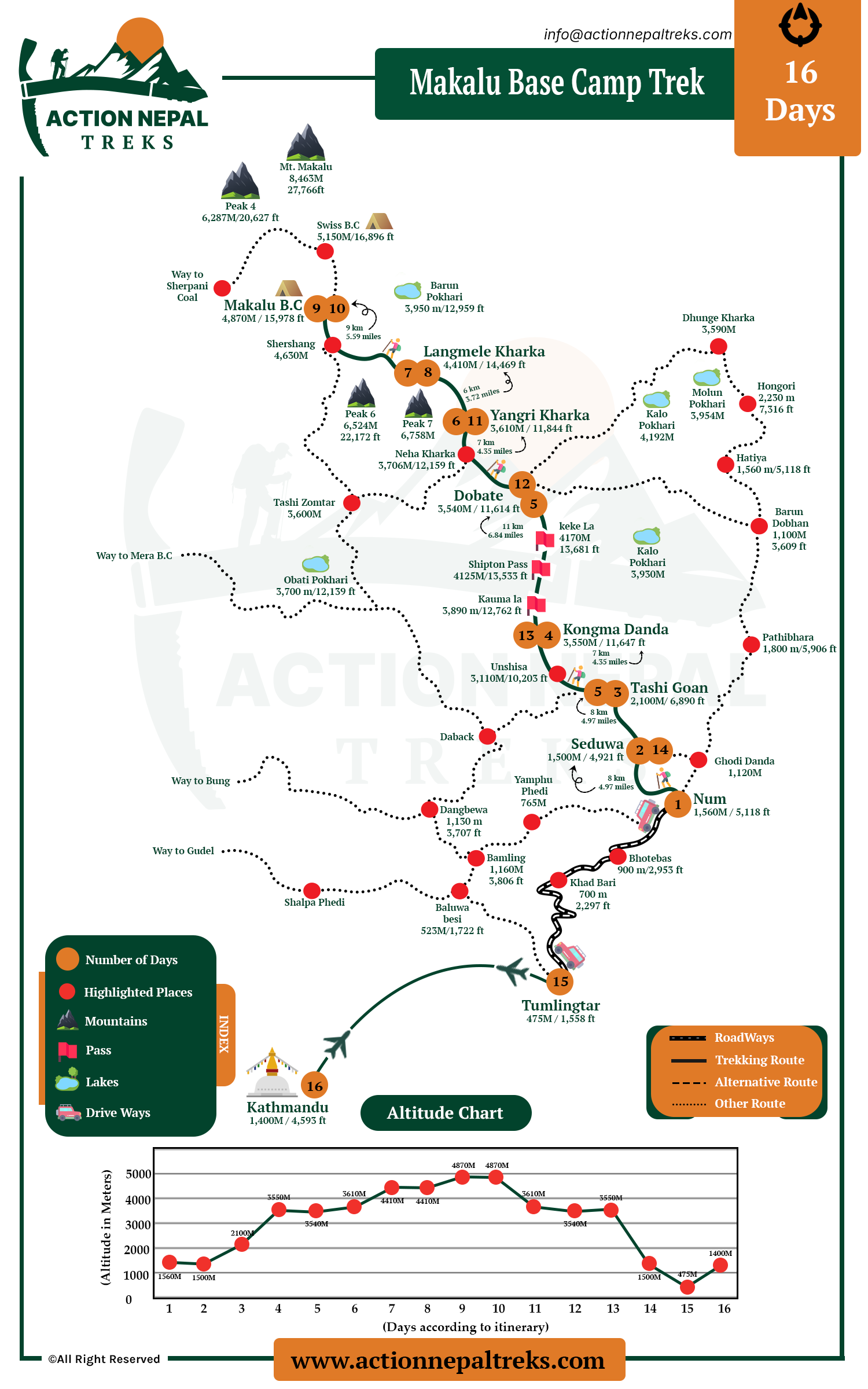
Makalu Base Camp trek Route Map

Trail
Return Trail

Explore the Raw Makalu-Barun Wilderness to Makalu Base Camp

The Makalu Base Camp is among those trekking destinations that remain hidden and untouched by commercialization. Unlike the Everest Base Camp Trek or the Annapurna Base Camp Trek, they are less known to mass tourism circles. But it also has its perks. The nature is unspoiled and untouched. Similarly, the trekking trail still retains an atmosphere of raw adventure and tranquility. The winding trail of Makalu goes through diverse landscapes, offering changing scenery each day and new thrills.

Throughout the Makalu Base Camp Trek, you will explore the Makalu Barun National Park. The trek starts from lush subtropical valleys, shifting to alpine meadows, green pastures, and then to icy alpine glaciers. You will also go through a wide range of ecosystems. The lower section of the trail is thriving with forests of rhododendron, bamboo, oak, fir, and birch. Similarly, you will cross suspension bridges over streams and trek along the narrow ridgelines. As you enter deeper into the Manaslu region, the area becomes more remote. The settlements also thin out, and you will mostly see stone huts or shelters for herders. A sense of isolation and raw wilderness will slowly hit you.

Along with the growing altitude and challenges, the air also becomes thinner. You will cross the remote twin high mountain passes of Shipton La and Keke La on the way to the Makalu Base Camp. The further you go, the more rugged the terrain becomes. Every step becomes both demanding and rewarding. The mountain views also become closer. Finally reaching the base camp, the most beautiful and raw alpine beauty unfolds before you. It sits in a glacial amphitheater surrounded by towering mountain giants and icefalls. You will stand at the foot of Mount Makalu, the fifth-highest mountain in the world, and admire its sheer size and beauty. There are only a few treks in Nepal that actually offer such an up-close and grand view of an 8,000m peak.

For those who want to witness and experience the true Himalayan wilderness, the Makalu Base Camp Trek will not disappoint. It is a trek of authenticity, self-reliance, discovery, and connection with nature. You will explore one of the lesser-traveled and remote trails that will teach you what the true spirit of adventure in the heart of the Himalaya is like.

From Jungles to Glaciers: Experience Five Climate Zones

The Makalu Base Camp Trek is among the few trekking routes that showcase a wide range of ecological diversity. You will experience not one, not two, but five climatic zones. Within the span of 16 days, you will start from the warm tropical climatic zone to the icy arctic zone where the base camp sits. It is truly a unique and extraordinary experience. Here is what the five climatic zones of the Makalu region are like:

  • Tropical Zone (Up to 1,00m): You will start the Makalu Base Camp Trek from the tropical zone of the lush Arun Valley. The area of Tumlingtar, Num, and Seduwa falls under this climatic zone. It is hot and humid here. The region is filled with banana trees, cardamom farms, terraced fields, and dense sal forests. The Rai and Limbu communities reside in this area.
  • Subtropical Zone (1,000m to 2,000m): The area from Seduwa to Tashi Gaon. The temperature is cooler here, so you can see green forests of oak, chestnut, maple, and terrace farms. You will enter the Makalu-Barun National Park from here. The Rai and Sherpa ethnic communities live along the route.
  • Temperate Zone (2,000m to 3,000m): This climatic zone can be experienced from Tashi Gaon to Khongma Danda. You will see dense forests of rhododendrons, firs, and pines. The temperature is cool, and due to the elevation gain, the air becomes thinner. It is the starting point of a steep climb towards the high mountain passes.
  • Subalpine/ Alpine Zone (3,000m to 4,000m): You can experience the cold and harsh weather of the subalpine or alpine zone from Khongma Danda to Nehe Kharka. The vegetation becomes sparse, and you can mostly see scrub juniper. There are exposed ridges with steep ascents and descents. You will come across yak herders’ camps rather than permanent settlements.
  • Arctic/ Glacial Zone (4,000m and above): The section from Nehe Kharka to Makalu Base Camp and above experiences the arctic or glacial zone. The vegetation is mostly sparse, and the landscape is filled with glaciers and moraine fields. Similarly, the terrain is also rocky and icy. The temperature is freezing cold here, and the oxygen level drops to 60% of sea level. Hence, there is the risk of altitude sickness. The weather is also unpredictable.

Rai and Sherpa Cultural Crossroads of the Trail

The Makalu Base Camp is a challenging trek that is also a rich and immersive cultural experience. You will experience two unique Himalayan cultures of the Rai and Sherpa ethnic groups. The Makalu Base Camp Trekking trail is a unique cultural intersection where different communities coexist. It is also a fine example of Nepal’s cultural diversity, harmony, and religious tolerance.

The Rai communities mostly reside in the lower valleys and hilly areas. They are an indigenous ethnic group of eastern Nepal. The Rai people follow animist and shamanistic practices. There is also some influence of Buddhism and Hinduism. They worship nature and ancestral spirits. Similarly, they celebrate festivals like Sakela, which mark the seasonal cycles. As you trek along the lower trails, you will pass by terrace farms and traditional houses made of stone or mud brick with thatched straw roofs and wooden beams. The traditional occupation of the Rai people is agriculture and animal husbandry. They also have a long history of serving in British and Indian Gurkha regiments. The Rai people are renowned for their warm and hospitable nature.

As you move to higher altitude regions, you will also notice a cultural shift. There is more influence of the Sherpa culture, and you will come across prayer flags, small monasteries, mani walls, and chortens. They are scattered along the barren trail, alpine ridges, and high passes. You will also come across traditional houses built with stone, timber, and mud with flat stone roofs. Tibetan Buddhism heavily influences the Sherpa culture.

The Sherpa people are famous for their mountaineering skills and exceptional adaptation to high altitude. They are genetically adapted to low oxygen and can even perform strenuous activity at high elevations. Sherpa people practice various Buddhist rituals and pray to Buddhist and mountain deities. They celebrate festivals like Losar, the Tibetan New Year. Sherpas are mostly herders who raise yaks, goats, and sheep. Likewise, some also follow traditional high-altitude farming. The Sherpa people are also famous for their welcoming hospitality to their guests.

Makalu Base Camp Trek FAQs