


On average, the Manaslu Circuit Trek costs between USD 900 and USD 1,800, depending on the package, group size, and the comfort level you choose. The costs cover permits, guide and porter wages, transport, food, and accommodation. You have to pay extra for things like hot showers, charging your devices, drinks, snacks, and tips.
The trek costs more than some other routes because Manaslu is a restricted area, the roads are rough, and supplies have to be carried to remote villages near Manaslu (8,163 m), the eighth-highest mountain in the world. Still, the price is reasonable compared with other major Himalayan treks in Nepal.
Many trekkers see different prices for the Manaslu Circuit Trek and feel confused about what is fair and what is actually included. Some packages look cheap at first, but add extra charges for permits, porters, or meals later on. To help you calculate the Manaslu Region Trek Cost, we have composed this blog. This blog breaks the total cost into clear sections, so you can see exactly where your money goes and decide where you want to spend more or save.
Why Manaslu Circuit Trek Is Worth Every Penny
When you compare the Manaslu Route with busy trekking routes like the Everest Base Camp Trek or the Annapurna Region, the difference becomes easy to notice. The Manaslu trek trail is still much quieter, so you walk through villages and monasteries without large crowds. You get to experience local life more closely instead of only seeing mountains from a distance. Plus, many villages along the route have strong Tibetan cultural influence, and you will see chortens, mani walls, and old monasteries in places like Samagaun and Lho. And since the Manaslu region is less crowded and more preserved, many trekkers feel the cost of the Manaslu Trek is fully justified and is worth every penny.
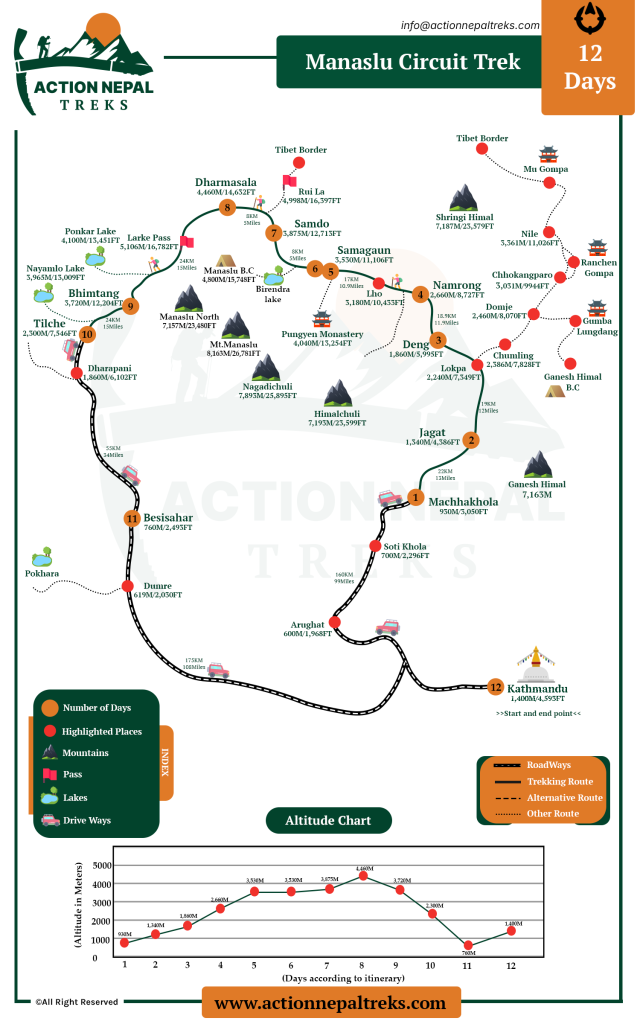
Likewise, one of the biggest highlights of the Manaslu Circuit trek is crossing Larke Pass at 5,106m. And to reach the top of this high mountain pass, you need proper planning, experienced guides, and careful logistics. These things definitely add up to the total cost of the Manaslu Circuit, but they also make the trek safer and more organized.
The fees collected from permits are also used for good purposes. A portion of the permit fees is used for conservation and to support local communities within the Manaslu Conservation Area. Respective authorities use this money to maintain trails, protect wildlife, and support villages along the route. So, it gives you peace of mind that you are not only trekking there but also contributing to area development.
That said, you are not paying for luxury on this trek. Instead, you are paying for access to one of the most peaceful and authentic high-altitude trekking routes in Nepal, where the experience feels more personal and less commercial than other famous trails. As someone who has been there, I would describe Trek around Manaslu as the right balance of challenge, remoteness, and cultural experience compared to more popular trails.
Understanding the True Cost of the Manaslu Circuit Trek
Many trekkers only care about the total price of the Manaslu Trek. So, they often overlook expenses that make up that overall cost. Let me clear you: The Manaslu region is a restricted trekking area, which means permits, licensed guides, and booking through a registered trekking agency are compulsory. Because of these rules, the total cost includes more than just food and accommodation.
The typical Manaslu trek expenses you need to bear are as follows:
- Manaslu Restricted Area Permit (RAP) fees
- Manaslu Conservation Area Permit (MCAP) and Annapurna Conservation Area Permit (ACAP) fees
- Licensed trek guide and porter wages
- Road transportation cost from Kathmandu to the starting point of the trek (usually Machhikhola) and back
- Teahouse accommodation and meals during the trek
- Personal expenses such as WiFi, gears, charging devices, hot showers, snacks, drinks, tips for guide and porter, travel insurance, and emergency funds
When traveling with the trekking company, most guided Manaslu Circuit Trek packages already include permits, transport, accommodation, and three meals a day during the trek. They also cover the guide’s and porter’s salary, food, and lodging. However, you usually need to pay separately for the personal expenses mentioned above.
A good way to plan your Manaslu Trek budget is to first know about your package price, then keep some extra money for daily personal spending. On the Manaslu trekking budget, setting aside about USD 15 to USD 25 (NPR 2,000 to NPR 3,500) per day for extra items such as hot drinks, internet, and showers is usually enough for most trekkers.
Cost Comparison by Package Type
You can think of Manaslu Circuit Trek cost in three broad package levels:
| Package Type | Approx Cost Range in USD (per person) | What’s Included | Best For |
|---|---|---|---|
| Budget Option | 800 – 1,100 | Basic teahouse rooms, meals, local transport (bus/shared jeep), guide, porter, permits | Someone who prioritizes cost and accepts simpler lodges and less flexibility |
| Standard Option | 1,100 – 1,400 | Better lodge choices where available, private jeep transfer in one or both directions, guide, porter, permits, meals | Someone who wants a balance of comfort, safety, and value without overspending |
| Luxury Option | 1,400 – 1,800 | Private transport both ways, extra acclimatization days, more comfortable rooms where possible, higher staff‑to‑client ratio | For those who prefer added comfort, flexible pacing, and more support |
Note: We evaluated this price by looking at different budgets for Manaslu trips between 2025 and 2027. Your actual cost will depend on the number of people in your group, the number of acclimatization days, and any special private services you request.
Food and Accommodation Cost in the Manaslu Region
Accommodation in the Manaslu region is in small teahouses. A basic room normally costs between USD 5 and USD 10 (NPR 700 and NPR 1,400) per night.Likewise, the most common trekking meal is dal bhat, which usually costs about USD 4 to USD 7 (NPR 600 to NPR 1,000) per plate. Breakfast items such as porridge, eggs, toast, or pancakes come in a similar price range. But tea, coffee, and soft drinks add small extra costs throughout the day.

Food and accommodation costs in the Manaslu region increase as you move from lower villages like Soti Khola and Machha Khola to higher places such as Samdo and Dharmasala. It is because all food, gas, and supplies have to be carried to these remote areas by mule or porter. In higher villages, the menu also becomes limited.
If you are paying for food and accommodation separately instead of choosing a full-board package, you should plan to spend about USD 20 to USD 30 (NPR 3,000 to NPR 4,500) per day on meals and USD 5 to USD 10 (NPR 700 to NPR 1,400) on accommodation. But if your trekking package includes full board, the cost of meals and accommodation is already included in the total price. That said, it is still a good idea to carry extra cash for personal items. Things like chocolate, bakery snacks, soft drinks, or energy drinks are usually not included in standard meal plans. So, keep a small daily budget for these extras.
Transportation and Logistics Cost Breakdown
The Manaslu Larke Pass Trek starts from Soti Khola or Machha Khola, which can be reached by road from Kathmandu in about 7–8 hours. There are three transport modes to reach the trailhead, which are private jeep, shared jeep, and local bus.
A private jeep is the most comfortable option. The cost from Kathmandu to Soti Khola or Machha Khola in a private jeep is around USD 200 (NPR 30,000) per vehicle. The jeep can accommodate 6 to 7 people. So, if the cost is shared between four people, the price comes to about USD 50 (NPR 7,000) per person one way. If only two people share the jeep, the cost becomes around USD 100 (NPR 14,000) per person for the same journey.
A shared jeep is a cheaper option and costs about USD 20 to USD 30 (NPR 2,600 to NPR 3,900) per person from Kathmandu to Machha Khola. These jeeps carry 7 to 8 passengers, so the price stays lower, but the ride can be less comfortable than a private jeep.
The cheapest option is the local bus, which costs around NPR 800 to NPR 1,500 (USD 5 to USD 10) per person, depending on the type of bus. This option takes longer and may not be as comfortable, but it is suitable for trekkers who want to save money.
After completing the trek, you return from Dharapani or Besisahar, which connects to the Annapurna road. Transport back to Kathmandu, or Pokhara, works the same way, with private jeeps costing more and shared vehicles costing less but taking more time. Many recent Manaslu trekking cost guides mention that using private jeeps for both the start and return can add about USD 100 to USD 150 (NPR 14,000 to USD 23,000) per person to the total budget when traveling in a small group.
Guide and Porter Cost for Manaslu Circuit Trek
Guides cost around USD 25 to USD 35 (NPR 3,500 to NPR 5,000) per day, while porters cost about USD 22 to USD 28 (NPR 3,000 to NPR 4,000) per day. These rates usually include the guide and porter’s food, accommodation, and insurance during the trek.

Guides help in navigation, and porters help carry loads of 20–25 kg. If you have heavy gear, cameras, or climbing equipment, you might need more than one porter. Plus, regulations require that you trek with a licensed guide in the restricted section of Manaslu, so you should not treat the guide cost as optional. Many trekkers also tip their guide and porter at the end of the journey to show their appreciation. Plan to budget USD 100 to USD 150 (NPR 14,000 to NPR 20,000) to show appreciation for their support throughout the trek.
Permits Cost for Manaslu
Permits make up a significant part of the Manaslu Circuit trekking budget because the region is protected and restricted. To trek here, you must obtain three special permits: the Restricted Area Permit (RAP), the Manaslu Conservation Area Permit (MCAP), and the Annapurna Conservation Area Permit (ACAP).
The cost of a Restricted Area Permit varies by season. During peak season (September–November), RAP costs USD 100 per person for the first 7 days, plus USD 15 for each additional day beyond the first week. During the off-season (December–August), it costs USD 75 per person for the first 7 days, plus USD 10 for each extra day after the first week. Meanwhile, the cost of the Manaslu Conservation Area Permit (MCAP) and the Annapurna Conservation Area Permit (ACAP) is USD 25 (NPR 3,000).
This way, for a typical 14-day Manaslu Circuit Trek in October, which falls in peak season, non-SAARC nationals should budget around USD 210 for permit fees, while SAARC nationals pay a reduced total of about USD 94.
Likewise, the Department of Immigration enforces strict rules for obtaining these permits. You cannot apply for them independently. Here are the rules you need to follow:
- You must have at least two trekkers in your group to apply for the RAP.
- A registered Nepalese trekking agency must process all applications officially.
- You must hire a licensed guide for the duration of the trek, and your guide’s details are linked to your permit.
- You need to provide your passport, a valid Nepal visa, and passport-sized photos to your agency for the permit application.


Full Guided Trek vs Semi-Independent Trek: Which Suits You Best?
As already mentioned, the Manaslu region is a restricted area, so completely independent trekking is not legally allowed. You must hire a licensed guide and a registered agency to obtain your permits. Your choice is actually between a Full Package (everything included) and a Minimal Support arrangement (agency only handles permits and the required guide).
So, which one should you choose? Choose a Full Package if you want a stress-free experience. Having pre-booked lodges and structured safety plans often saves you both time and money in the long run. Meanwhile, choose Minimal Support if you are an experienced trekker on a tight budget. You gain more freedom but carry more responsibility for your own safety and comfort.
Here’s the difference between a full guided Manaslu Circuit Trek and a minimal support trek:
| Feature / Factor | Full Guided Trek | Minimal Support (Semi-Independent) |
|---|---|---|
| Support & Leadership | Continuous support. The agency manages pace, safety, and decisions. | You must still have a guide, but you handle more daily decisions. |
| Route Planning | Experts optimize your itinerary for altitude and rest. | You have more flexibility on itinerary. |
| Permits & Logistics | Agency handles all paperwork and transport. | Agency manage permits but you manage your own transport. |
| Accommodation Booking | The agency pre-books rooms to avoid full lodges during peak season. | You find and book rooms as you go. |
| Porter Support | Agency arranges and supervises porters. | You may choose to carry your own gear to save money. |
| Cost | Higher headline price with fewer surprises on trail. | Lower initial price with unpredictable daily costs. |
| Flexibility & Freedom | Less spontaneous changes, but smoother logistics. | More day‑to‑day choices with higher responsibility. |
| Local Knowledge & Culture | Guide explains monasteries, festivals, and local customs. | You depend more on your own research. |
| Responsibility | Agency shares responsibility for safety and decision. | You carry more personal responsibility for planning and adjustments. |
| Risk Management | Structured altitude and weather response plans. | You and your guide must adapt to fewer backup arrangements. |
| Time Efficiency | No time wasted on admin or logistics. | You spend more time solving problems. |
Cost of Trekking the Manaslu Circuit with an International Tour Operator
If you book the Manaslu Trek through an international tour operator, the price for a 14 to 18 days itinerary usually ranges from USD 2,000 to USD 3,500 (NPR 296,000 to NPR 518,000) per person. Many trekkers choose international operators because they offer support in their own language, familiar payment methods, and the comfort of booking with a well-known company.
However, there are some drawbacks to trekking with an international tour operator. The first one is that most international packages include only the land cost in Nepal, which means international flights are usually not part of the price, even if the total looks high. The second drawback is that packages may offer less flexibility for changing travel dates, adding extra acclimatization days, or customizing the itinerary. The third drawback is that currency exchange rates and foreign transaction fees can increase the final amount you pay, so the total cost may exceed the advertised price.
Cost of Trekking the Manaslu Circuit with a Local Tour Operator
Most local trekking agencies in Nepal offer Manaslu Circuit packages in the range of USD 850 to USD 1,500 (NPR 125,000 to 220,000) per person. The cost varies with group size, itinerary length, and service level. Nonetheless, it’s clear that choosing a local operator is the most cost-effective option.
The cost is lower because these companies are based in Kathmandu and manage guides, porters, transport, and permits directly without overseas office expenses. They also have better knowledge of seasonal trail conditions, road access, and lodge availability, which allows them to adjust the plan quickly if weather, landslides, or transport delays affect the route.
At Action Nepal Treks, packages for the Manaslu region cost half as much as those of international operators. Our standard Manaslu Circuit Trek package for 12 days is priced between USD 830 and USD 950, depending on group size. For those interested in other treks in the This Himalayan trek, we are happy to share that we offer various treks in the Manaslu region, which are as follows:
| Trek package | Duration | Price Range (USD) | Price Range (NPR) |
|---|---|---|---|
| Tsum Valley Trek | 11 days | 770 – 870 | 110,000 – 130,000 |
| Manaslu Circuit & Tsum Valley Trek | 17 days | 1,120 – 1,299 | 165,000 – 193,000 |
Note: Prices in Nepalese Rupees are calculated at an exchange rate of 1 USD = 148 NPR.
Smart Ways to Reduce Your Trek Cost
The above mentioned prices may have overwhelmed you. But the good thing is you can keep the Larke Pass Trek cost under control without compromising safety or the overall experience. Below are some ways to reduce your Manaslu Circuit Trek cost:
- Travel in a group: We say this because when you travel in a small group (4 to 6 people), the costs for guides, porters, and vehicles are shared between you, so the price per person can drop significantly. Sometimes, the price drops by more than half compared to trekking alone.
- Book in advance: Always book a trek a few months before the main trekking season. This helps you get better prices. Agencies can arrange transport and accommodation earlier, which often means fixed rates and better lodge availability. Last-minute bookings during busy months always result in higher prices.
- Choose the shoulder seasons: The most expensive months for Manaslu are usually October and April, when demand is highest. So, trek in the shoulder months, like March, May, or November, to reduce costs. These shoulder months still offer favorable conditions for trekking and don’t pose much difficulty on the Manaslu Circuit Trek.
- Bring your own gear: While you can buy or rent gear in Kathmandu at an affordable price, renting them in the trailhead is expensive. So, buy your own essentials such as a sleeping bag, down jacket, trekking poles, and boots while in Kathmandu. You can save up to USD 100 to USD 200 with this trick.
- Purify water:At higher altitudes, bottled water becomes expensive and can cost USD 3 to USD 5 per bottle. So, you can carry a reusable bottle with water purification tablets or a filter to save more than USD 100 during the trek. This also reduces plastic waste in the mountain environment.
- Avoid unnecessary luxury odd-Ons: Some packages include extra services such as private vehicles every day or upgraded accommodation where simple lodges are already comfortable. If your goal is to stay within a mid-range budget, choose shared transport and standard teahouse lodging.
- Compare multiple quotes: Before booking, it is wise to request written quotations from two or three different trekking agencies. Compare what is included in each package and choose the one that suits you. However, note that a lower price does not always mean better value, so take time before you make a final decision.
Best Time to Trek Manaslu and How Season Affects Cost
The best time to trek the Manaslu Circuit is during the autumn (September to November) and spring (March to May) seasons. During these months, the weather is usually stable, and the views of Mount Manaslu are clearer. So, many trekkers trek to Manaslu Trek during this time. And because of high demand, the cost of guides, porters, transport, and accommodation can be higher, and it is often necessary to book lodges and jeeps in advance to avoid last-minute price increases. This means that during the best trekking time, the trekking cost is higher.

Meanwhile, in the off-season, such as winter and the monsoon period, prices may be lower. But the trekking condition is unfavorable. Winter brings colder temperatures and possible snow on Larke Pass, while the monsoon season can cause heavy rain, landslides, and road delays that affect travel plans.
Furthermore, the shoulder months, just before or after the peak seasons, can be a good middle option. You may find slightly lower costs and fewer trekkers, while still having reasonable weather, if you prepare with proper clothing and stay flexible with your schedule. Permit prices also change depending on the season, as the Restricted Area Permit costs more in peak months and less in off-season, which can slightly affect the total cost of the trek.
| Season | Cost | Conditions |
|---|---|---|
| Spring (March to May) | High | Best weather |
| Autumn (September to November) | High | Clear views |
| Winter (December to February) | High | Cold, fewer trekkers |
| Monsoon/Summer (June to August) | Low | Rain, chances of landslides |
How to Compare Manaslu Trekking Packages Before Booking?
Comparing Manaslu trekking packages based only on the advertised price can be misleading. Different agencies may include different things in their packages, such as permits, transport, accommodation, meals, and guide or porter services. A package that looks cheaper at first may end up costing you more because some important expenses are not included.
Before you pay, go through these 10 points and make sure you know exactly what you’re getting.
- Are all the required permits included?
- Is the guide licensed and experienced?
- Is a porter included?
- What transportation is included?
- Are meals included?
- Is travel insurance included?
- What happens if the itinerary changes?
- What is the cancellation policy?
- Is emergency support available?
- Is the price per person or per group?
Cost Comparison with Other Popular Treks in Nepal
Let’s compare the cost of the Manaslu Circuit Trek with other popular treks in Nepal:
| Trek Route | Typical Cost (USD) | Typical Cost (NPR) | Why the Price Differs |
| Manaslu Circuit | 900 – 1,800 | 162,800 – 266,400 | Expensive restricted area permits, a less developed road network, higher logistics costs, and a mandatory guide. |
| Everest Base Camp | 1,250 – 2,500 | 185,000 – 370,000 | High cost of Lukla flights, high demand, and premium lodge prices. |
| Annapurna Circuit | 800 – 1,400 | 118,400 – 207,200 | No restricted area permit, larger lodge network, cheaper permits, and easy road access to trailheads. |
| Langtang Valley | 700 – 1,100 | 103,600 – 162,800 | Short distance from Kathmandu and no special permits required. |
| Upper Mustang | 1,500+ | 222,000+ | Very high restricted area permit (USD 50 per day). |
From the above table, it’s clear that the Manaslu trek is more expensive than the Annapurna and Langtang Valley Treks. However, it is often cheaper than the Everest. You pay a premium for Manaslu in permit fees, but you get a much quieter trail with fewer crowds than Everest or Annapurna.
Note: Prices in Nepalese Rupees are calculated at an exchange rate of 1 USD = 148 NPR.
Plan, Budget, and Start Confidently
Now that you know how much the Manaslu Circuit Trek costs and what expenses are included in the trek package, you can plan your trek with more confidence. The Trek around Manaslu will not disappoint you. The trek offers a very real Himalayan experience. The trail is quieter than popular routes and passes through remote villages, high mountain landscapes, and traditional culture, which makes the journey feel special. With good planning, the Manaslu Region Trek is possible for many trekkers.

Nonetheless, if you want exact price details, updated permit costs, or a custom plan, you can contact Action Nepal Treks for a quotation based on your travel date, group size, and service level. It is always a good idea to get this information before booking to make your trek easier and avoid unexpected costs later.

