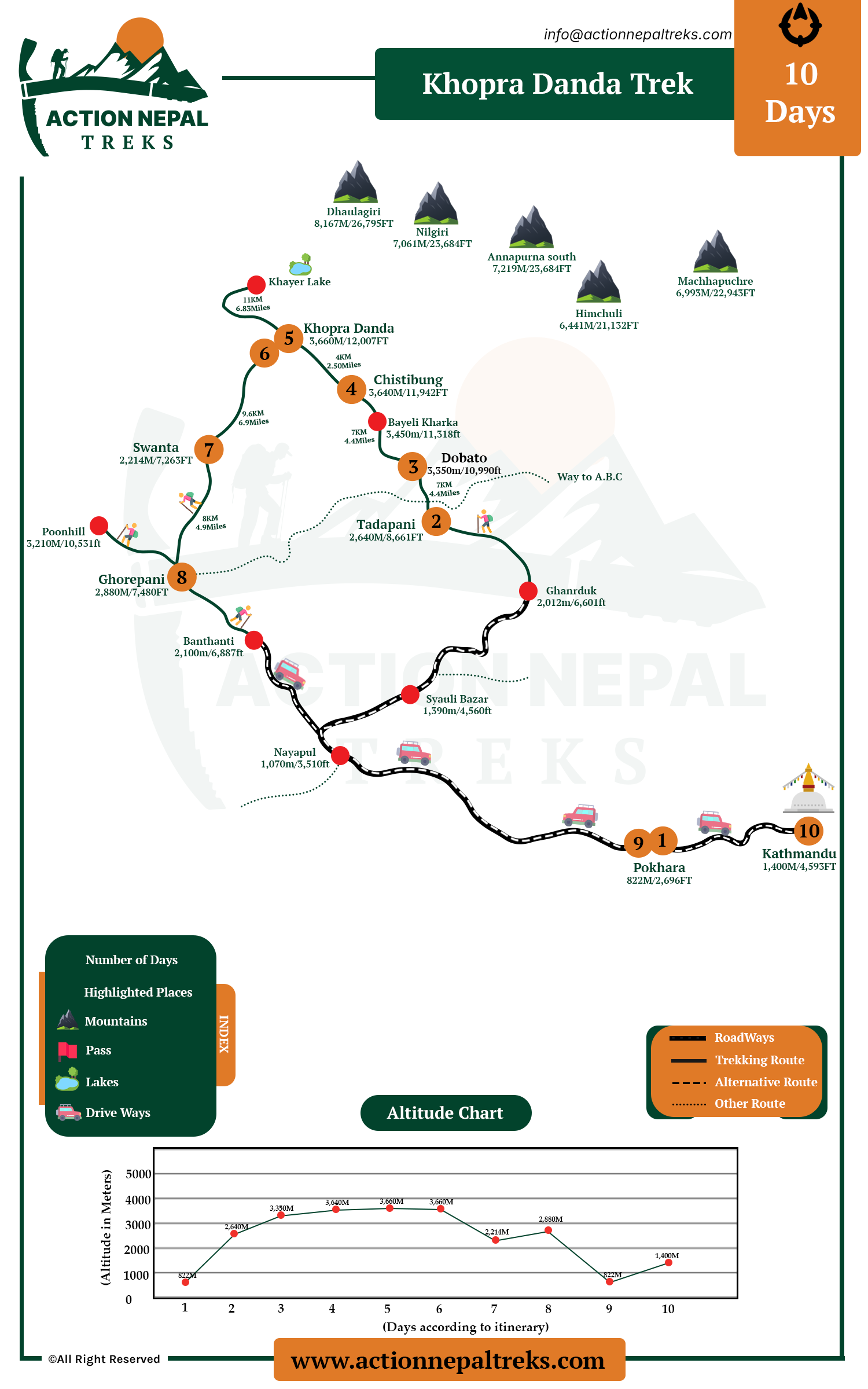
The Khopra Danda Trek is considered a moderate trek in Nepal. You’ll walk 5–6 hours a day with regular climbs and descents. It’s more challenging than the Ghorepani–Poon Hill loop (max 3,210 m) but less demanding than the Annapurna Circuit or remote Nar Phu Valley. You’ll get significant viewpoints and peaceful trails, without committing to the extreme distances or passes of higher routes.
Two Brutal Days: Climbing 1,600 m in 48 Hours
This section is the most demanding part of the trek. From Chistibung, you will ascend approximately 660 m to reach Khopra Ridge at 3,660 m. The very next day, you will undertake a steep ascent of nearly 940 m to the sacred Khayer Lake. The lake is situated at 4,660 m, the highest point of the trek.
The Khayer Lake climb is a long, exposed ascent over rocky paths, yak pastures, and open ridges with no tea houses or shelters en route. The thin air makes every incline harder, and the weather can shift from calm sunshine to biting wind and fog in minutes. Wind speeds above 40 km/h are common on the ridge, adding to your fatigue. You have to make gradual ascents to avoid altitude sickness (AMS).
The Staircase Marathon: 1,000m Gains and Losses Daily
The Tadapani to Ghorepani section has a mix of steep climbs and descents. You’ll tackle many long stone staircases (sometimes up and sometimes down), especially around Ghorepani and Ulleri. Here, 3,000–3,700 uneven stone steps challenge your endurance and knees. It moves between narrow, rocky ridges and muddy forest paths that get slippery during the monsoon season. Using trekking poles will help you keep your balance and take some pressure off your legs, especially on the steep climbs and tricky sections.
Varied Weather Conditions on Khopra Danda Trek
In this high-altitude trek, the weather is unpredictable. In spring and autumn, you’ll enjoy clear, sunny days with temperatures between 10–18°C at high spots, but nights can get chilly, dropping to around –4°C. Monsoon season (June–August) brings heavy rains, muddy, slippery trails, and even landslides, especially in the lower forests. The views are blocked due to fog, making trekking more challenging. Similarly, winter is harsh, with nights dropping below –10°C above 4,000m, and snow blocks the trail.
Long Stretches Without Support Between Dobato and Khayer Lake
Once you pass Tadapani, the trekking route becomes quieter, with fewer stops. Between Dobato, Khopra Ridge, and Khayer Lake (8–12km apart), tea houses and snack spots are rare or nonexistent for hours. Thus, you’ll need to carry enough water and snacks for 3-5 hours of the climbs. Mobile phone signals are also patchy, so don’t expect to be constantly connected. The peaceful isolation can be a welcome break from crowded trails, but it also means you have to be self-reliant and prepared.
Challenges for Khopra Danda Trek Preparation
If you’re new to hiking, stuck at a desk all day, or haven’t worked out much lately, preparing for the Khopra Danda trek itself will push you. You’ll need to build your cardio, leg strength, and core muscles to handle the steep climbs and constant elevation changes. You need to hike 3–4 hills or stair workouts per week for at least 4–6 weeks to prepare your body. More importantly, you have to be mentally prepared for long days on quiet, remote trails, which demand patience and focus. It won’t be easy, but the payoff is totally worth it.