Sambir
Connect With a Trek Expert(Simbir) +977 9709278526

Kanchenjunga Circuit Trek

Mountain Icon

Max. Altitude

5,143m/16,873ft (Pang Pema - North Base Camp)

Duration Icon

Duration

17 Days

Grade Icon

Grade

Strenuous
Activity Icon

Activity

Wilderness Treks

Season Icon

Best Season

Mar-May & Sept-Nov

Transportation Icon

Transportation

Domestic flight & Private Jeep

Meals Icon

Meals Included

Breakfast in Kathmandu; Breakfast, Lunch & Dinner during trek
Destination Icon

Destination

Tours & Treks in Nepal

Destination Icon

Group Size

1 - 12

Activity Icon

Activity Per Day

6-9hrs walking

Start End Icon

Start/End Point

Kathmandu / Kathmandu

Nature Icon

Nature Of Trek

Guided Tea House Trek

Overview of Kanchenjunga Circuit Trek

The Kanchenjunga Circuit Trek in Nepal is a remote and challenging adventure around the world’s third-highest mountain, Mt. Kanchenjunga (8,586m/ 28,169ft). This trek in remote eastern Nepal is strenuous and takes you to both the Kanchenjunga North Base Camp Trek  (Pang Pema, 5,143m/ 16,873ft) and the Kanchenjunga South Base Camp (Oktang, 4,730m/ 15,518ft). The entire route spans 17 days. More importantly, it is less crowded than the Everest or Annapurna Base Camp Treks and offers wild landscapes and deep cultural immersion.

The restricted Kanchenjunga Base Camp trek route ranges from lush, subtropical forests in the lower valleys to high alpine meadows, glacial rivers, and towering gorges. In between them, villages like Taplejung, Ghunsa, Lhonak, and Tseram give you a unique cultural experience. The trek also crosses four high mountain passes: Sele Le La, Sinion La, Mirgin La, and Sinelapche La. Each of them offers the panorama of Kanchenjunga, Jannu, Yalung Kang, and the Twins, and also distant giants like Makalu, Lhotse, and Everest. Accommodation is basic, giving you a real taste of life in isolated Tibetan Buddhist villages.

Overall, the Kanchenjunga circuit trek itinerary is not for beginners or independent trekkers due to its remoteness and difficulty. It demands solid trekking experience, proper preparation, and excellent fitness to handle steep climbs, high altitude, and unpredictable weather. In addition, as it lies in the restricted Kanchenjunga Conservation Area, you must trek with the proper permits and a licensed guide. These rules ensure your safety and let you experience the Himalayan legends and folklore that make this journey truly unforgettable.

Detailed Itinerary of 17 Days Kanchenjunga Circuit Trek

Day 1: Flight from Kathmandu to Bhadrapur, Drive to Taplejung

The day starts with a short domestic flight from Kathmandu to Bhadrapur, a bustling city in the lowlands of eastern Nepal. From here, a private jeep takes you on a long, scenic drive that steadily climbs into the hills. The route follows the Tamor River and winds past the famous emerald tea gardens of Ilam. Along the drive, you also see quiet rural villages nestled in the hillsides and ridgelines.

As the jeep goes up the hills, the paths are unpaved and rough. On the sides, you see terraced farmlands filled with crops and seasonal vegetables. By late afternoon, you arrive at Taplejung, the administrative hub of the region. Here, you check into a local guesthouse, enjoy a warm meal, and rest well before the Kanchenjunga Circuit trekking adventure begins.

Itinerary Details
Itinerary Fact Details
Meals Icon
Meals
Breakfast, Dinner
Accommodation Icon
Accommodation
Hotel
Mountain Icon
Highest Altitude
1,820m (5,971ft)
Duration Icon
Trek Duration
~40 min Flight
Duration Icon
Drive Duration
~244 km (151 miles)
Duration Icon
Drive Duration
~8-9 hrs Drive

Day 2: Drive from Taplejung to Sekathum

From Taplejung, you take another jeep ride. This section has a more rugged mountain road that only a sturdy 4WD can handle. You pass cardamom and maize fields, through thick subtropical forests, and above deep river valleys, where the Tamor and its tributaries sparkle far below. On clear days, you enjoy the fleeting views of Kanchenjunga and Jannu at a distance. You also see traditional wooden houses, stone walls, and prayer flags fluttering in the Limbu and Rai villages.

At a point, the road narrows, and you see a checkpoint that marks the entry to the Kanchenjunga Conservation Area. The drive stops here to show permits before taking the final stretch to Sekathum. You feel the remoteness of the Kanchenjunga region of Nepal, with unpaved tracks clinging to cliffs and the sound of rivers flowing. At the teahouse, the services are basic, but enough to rest and recharge. The Limbu, Sherpa, and Tibetan-origin communities live side by side here, so you experience a mix of cultures and lifestyles.

Itinerary Details
Itinerary Fact Details
Meals Icon
Meals
Breakfast, Lunch, Dinner
Accommodation Icon
Accommodation
Teahouse
Mountain Icon
Highest Altitude
1,820m (5,971ft)
Duration Icon
Drive Duration
~70-75 km (43-46 miles)
Duration Icon
Drive Duration
~5-6 hrs

Day 3: Trek from Sekathum to Amjilosa

On Day 3, the actual Kanchenjunga Circuit trek begins. You start with a gradual climb and cross several suspension bridges over the Ghunsa Khola. Next, you pass through dense bamboo, oak, and rhododendron forest before the terrain changes into steep climbs, rocky sections, and narrow cliffside paths that allow you to see the entire valley. Along the way, you may spot small to big waterfalls, river gorges, and Himalayan wildlife such as langurs and various birds.

Then, you trek past small settlements like Jonggim, Ghaiyabari, and Solima, where Limbu and Rai communities farm cardamom and rear livestock. Finally, you reach Amjilosa, where you find basic teahouse accommodations with solar lighting, pay-per-use hot water, and limited facilities. Here, you may also sample fresh yak milk or yak cheese.

Itinerary Details
Itinerary Fact Details
Meals Icon
Meals
Breakfast, Lunch, Dinner
Accommodation Icon
Accommodation
Teahouse
Distance Icon
Trek Distance
~10-15 km (6-9 miles)
Mountain Icon
Highest Altitude
2,498m (8,195ft)
Duration Icon
Trek Duration
~5-6 hrs

Day 4: Trek from Amjilosa to Gyabla

Today’s trek begins with a short but rewarding climb from Amjilosa. This climb leads over a ridge, then into dense forests of bamboo, rhododendron, oak, and birch. Walking ahead, you cross small waterfalls and streams, which serve as both scenery and refreshing stops. Then, the path passes through untouched forest zones without any human settlements nearby. You get a true sense of wilderness, and if you are a wildlife enthusiast, you may be lucky enough to spot the rare red panda here, though chances are low.

Finally, the forest path ends, and you reach summer grazing pastures and alpine clearings. After a short walk, you arrive at Gyabla (Kyapra), a small Sherpa village nestled on forested slopes. Here also, the teahouses are basic. However, they have their own rustic charm, and you experience genuine local hospitality. More importantly, you can go to the meadows and adjacent slopes to enjoy first glimpses of Jannu (Kumbhakarna), parts of the Kanchenjunga massif, and Ghunsa Peak.

Itinerary Details
Itinerary Fact Details
Meals Icon
Meals
Breakfast, Lunch, Dinner
Accommodation Icon
Accommodation
Teahouse
Distance Icon
Trek Distance
~12 km (7 miles)
Mountain Icon
Highest Altitude
2,725m (8,940ft)
Duration Icon
Trek Duration
~5-6 hrs

Day 5: Trek from Gyabla to Ghunsa

From Gyabla, the Kanchenjunga Circuit trek route has steep, winding forest paths. You cross small streams and minor waterfalls again on this path. The forest ground is often covered with soft moss, which can become slippery near streams and waterfalls, and also during the monsoon season. Then, the path gradually opens to alpine meadows, and you see a closer view of the north face of Jannu (Kumbhakarna) and a portion of the vast Kanchenjunga massif.

Within some minutes, you arrive at Ghunsa. This village is a Sherpa settlement with wooden houses adorned with prayer flags, mani walls, and chortens. The language and culture reflect its Tibetan Buddhist heritage. As you walk into the village, you get a sense of their daily life, which centers around yak herding and subsistence farming. Moreover, this village hosts a health post, a Kanchenjunga Conservation Area office, and better teahouse facilities, including electricity and basic internet. So, you are more comfortable here.

Itinerary Details
Itinerary Fact Details
Meals Icon
Meals
Breakfast, Lunch, Dinner
Accommodation Icon
Accommodation
Teahouse
Distance Icon
Trek Distance
~9 km (5 miles)
Mountain Icon
Highest Altitude
3,415m (11,207ft)
Duration Icon
Trek Duration
~4-5 hrs

Day 6: Trek from Ghunsa to Khambachen

Today, the trek starts in an open alpine meadow dotted with colorful wildflowers. You see yaks grazing and playful marmots. Then, the trail slowly climbs up, moving through juniper and pine groves. Occasionally, you pass by chortens and fluttering prayer flags reflecting the local Sherpa culture. This section has rocky moraines and scree sections, so this day may feel moderately challenging.

Here, you keep an eye out for high-altitude wildlife, including blue sheep. Some trekkers mention that they can see snow leopards on distant slopes on rare occasions. You see the dramatic Mt. Jannu (Kumbhakarna) dominating the skyline from the cliffside as you approach Khambachen. It is a small, windswept yak-herding settlement with stone-built teahouses. You are back to basic shelter, limited heat, and other facilities, which is a more authentic Himalayan experience.

Itinerary Details
Itinerary Fact Details
Meals Icon
Meals
Breakfast, Lunch, Dinner
Accommodation Icon
Accommodation
Teahouse
Distance Icon
Trek Distance
~10-11 km (6 miles)
Mountain Icon
Highest Altitude
4,145m (13,599ft)
Duration Icon
Trek Duration
~5-6 hrs

Day 7: Acclimatization and Rest Day in Khambachen

Since you are now above 4,100m, Day 7 is reserved for acclimatization. At this altitude, mild signs of altitude sickness may appear, so it is essential to rest and let your body adjust. You can take a short hike to nearby ridgelines or viewpoints, or choose an optional trek to a beautiful high-altitude lake.

The most popular option is a hike to the Jannu Viewpoint, offering stunning views of Mt. Jannu, Kanchenjunga’s north face, and the Jannu Glacier. Alternatively, you can trek to Nupchu Pokhari, a high-altitude lake surrounded by peaks like Ghabur and Pholesobi and the Lhonak Glacier. In both hikes, you pass high-altitude pastures, yak herders, and seasonal shelters. After the return, you dedicate the remainder of the day to rest.

Itinerary Details
Itinerary Fact Details
Meals Icon
Meals
Breakfast, Lunch, Dinner
Accommodation Icon
Accommodation
Teahouse
Distance Icon
Trek Distance
Optional ~5-8 km (3-4 miles)
Mountain Icon
Highest Altitude
4,145m (13,599ft)
Duration Icon
Trek Duration
Optional ~3-4 hrs

Day 8: Trek from Khambachen to Lhonak

After a full day of rest and acclimatization, you continue your trek across a stony moraine plateau and then into scree-covered terrain above the treeline. You feel the clean mountain air as the path gets more and more rugged as you near the Khando Waterfall (≈4,381m). Shortly after, you pass Ramtang Gompa, which provides a spiritual and cultural waypoint amidst the rocks.

Then you walk along Kanchenjunga Glacier’s rocky moraines and occasional snow patches, with impressive views of peaks like Jannu (Kumbhakarna) and Tent Peak, and other summits of the Kanchenjunga massif itself. The final stretch climbs steeply to Lhonak, a remote village on a plateau. You stay in a more basic teahouse, where the only warm place is a shared space. The day immerses you in the raw beauty and isolation of the high mountains.

Itinerary Details
Itinerary Fact Details
Meals Icon
Meals
Breakfast, Lunch, Dinner
Accommodation Icon
Accommodation
Teahouse
Distance Icon
Trek Distance
~10.5 km (6.5 miles)
Mountain Icon
Highest Altitude
4,792m (15,721ft)
Duration Icon
Trek Duration
~6-7 hrs

Day 9: Hike to Kanchenjunga North Base Camp - Pang Pema, Return to Lhonak

On Day 9 of the Kanchenjunga Circuit trip, you do a pre-dawn hike to the Kanchenjunga North Base Camp. You trek along the Kanchenjunga Glacier moraine again, while staying above 4,700m all day. The trail is of moderate challenge, but the thin air and rocky paths make it slow and tiring. The weather remains unpredictable here, so strong winds and sudden cold can hit you anytime. You pass yak pastures and herders’ shelters along the way.

As you near Pang Pema (North Base Camp) at 5,143m, the landscape opens into a vast amphitheater of peaks. You see the north face of Kanchenjunga towering above, surrounded by Wedge Peak, Nepal Peak, Tent Peak (Kirat Chuli), Gimmigela Chuli (The Twins), and distant Jannu. Prayer flags flutter and spread strength, goodwill, and compassion among the trekkers. You spend 30-60 minutes here taking photos and admiring the views from the Pang Pema Viewpoint before retracing your steps to Lhonak.

Itinerary Details
Itinerary Fact Details
Meals Icon
Meals
Breakfast, Lunch, Dinner
Accommodation Icon
Accommodation
Teahouse
Distance Icon
Trek Distance
~15 km (9 miles) round trip
Mountain Icon
Highest Altitude
5,143m (16,873ft)
Duration Icon
Trek Duration
~7-9 hrs

Day 10: Trek from Lhonak to Ghunsa

Today’s trek retraces the familiar path back to Ghunsa via Khambachen. It is a long day with a descent of nearly 1,400m. At first, the trail begins with rocky paths, then scree slopes, exposed edges, and eventually high pastures where the wind feels sharp against the skin. You pass by mani walls carved with Tibetan prayers, huts for yak herders, and small streams that glisten in the sun. The towering snow peaks that dominated the horizon now slowly start to fade behind you with every step down.

As you continue, the terrain shifts into dense rhododendron and pine forests. The air feels thicker and warmer compared to the barren highlands above. During the walk in the forest, the sound of birdsong and rushing water replaces the sounds of wind in the alpine zone. After hours of steady descent, you arrive in the comfort of Ghunsa village.

Itinerary Details
Itinerary Fact Details
Meals Icon
Meals
Breakfast, Lunch, Dinner
Accommodation Icon
Accommodation
Teahouse
Distance Icon
Trek Distance
~21 km (13 miles)
Mountain Icon
Highest Altitude
4,792m (15,721ft)
Duration Icon
Trek Duration
~6-7 hrs

Day 11: Trek from Ghunsa to Sele Le Base Camp

Continuing on the trek, you leave Ghunsa. It starts climbing up through dense forests of birch, pine, and rhododendron, which bloom in the spring. First, the path narrows into uneven stone steps, then mossy juniper and larch groves. After that, you walk along exposed alpine ridges with mani walls and small chortens. Then, you pass yak pastures and herders’ huts. Animals like musk deer, Himalayan monals, or even the elusive red panda may be spotted in peak trekking seasons, the autumn and spring. Note: The chances of seeing a red panda are low.

While resting, you look from the ridges to see the massive bulk of Jannu still dominating the skyline. The climb ends at Sele Le Base Camp (4,240m/13,910ft) with a total elevation gain of over 800m. This base camp only houses a couple of stone teahouses or tents with limited food and no comforts. But the isolation has its own reward, and with zero light pollution, the night sky is perfect for stargazing.

Itinerary Details
Itinerary Fact Details
Meals Icon
Meals
Breakfast, Lunch, Dinner
Accommodation Icon
Accommodation
Teahouse/Camp
Distance Icon
Trek Distance
~11 km (6.8 miles)
Mountain Icon
Highest Altitude
4,240m (13,910ft)
Duration Icon
Trek Duration
~5-6 hrs

Day 12: Trek from Sele Le Base Camp to Tseram

Day 12 is the most challenging day of the entire Kanchenjunga Circuit trek. It starts with a steep climb out of Sele Le Base Camp across multiple high passes: Sele Le La (~4,290m/ 14,074ft), Sinion La (~4,660m/ 15,288ft), Mirgin La (~4,480m/ 14,698ft), and Sinelapche La (~4,645m/ 15,239ft). The trail is rocky and exposed, and the weather can change quickly, often into snowstorms. From the summits, you can take in the views of Kanchenjunga, Makalu, even Everest, Lhotse, Chamlang, and Baruntse, with nearby peaks like Kabru, Rathong, Talung, and Jannu on clear days.

After these passes, you descend into the Simbua Khola Valley. You pass by alpine meadows and yak pastures, and may also see Lammergeiers, vultures, and blue sheep grazing on the lower slopes. In Tseram, teahouses are basic but warmer, and the air is easier to breathe. It provides a pleasant rest after a long day at a high altitude.

Itinerary Details
Itinerary Fact Details
Meals Icon
Meals
Breakfast, Lunch, Dinner
Accommodation Icon
Accommodation
Teahouse
Distance Icon
Trek Distance
~18 km (11 miles)
Mountain Icon
Highest Altitude
~4,290m (14,074ft)
Duration Icon
Trek Duration
~7-8 hrs

Day 13: Hike to Kanchenjunga South Base Camp - Oktang Viewpoint, Return to Tseram

From Tseram, the trail starts with a gradual climb through alpine meadows and along the Simbua Khola Valley. You pass yak pastures and moraines, then reach Ramche ( ≈4,580m/ 15,026ft), a high camp with stone shelters and seasonal teahouses. Once you get here, the trail shifts into rocky moraines and glacial flats that lead you to Oktang, where the dramatic Kanchenjunga South Base Camp is located.

You see the Yalung Glacier below, framed by Kabru North, Kabru South, Kabru Dome, Rathong, and Talung peaks. Prayer flags decorate the Yalung South Base Camp Viewpoint, too. After taking in the scenery, you return the same way to Tseram. Though the descent feels easier, you need to keep a steady pace. Trekking for this long at high altitude can cause fatigue and increase the risk of altitude sickness (AMS).

Itinerary Details
Itinerary Fact Details
Meals Icon
Meals
Breakfast, Lunch, Dinner
Accommodation Icon
Accommodation
Teahouse
Distance Icon
Trek Distance
~12 km (7.4 miles) round trip
Mountain Icon
Highest Altitude
4,730m (15,518ft)
Duration Icon
Trek Duration
~6-7 hrs

Day 14: Trek from Tseram to Tortong

Now that you have seen both the North and South Base Camps of Mount Kanchenjunga, you begin your descent, leaving the high alpine zone behind. The trail goes through pine, rhododendron, and juniper forests, and it often has rocky paths and stone steps. Occasionally, you walk through steep stretches, wooden bridges, and streams. These sections offer you views of Rathong and Kabru peaks fading behind as if bidding goodbye.

You also pass yak grazing clearings and shepherd huts, with chances to spot Himalayan monal and other pheasants in the undergrowth. Then, you arrive at Tortong, a cozy forested valley settlement with a few teahouses. Though the shelter and meals are basic, you are more comfortable here. You are now at a lower altitude after completing all the major sections of the Kanchenjunga Circuit Trek journey.

Itinerary Details
Itinerary Fact Details
Meals Icon
Meals
Breakfast, Lunch, Dinner
Accommodation Icon
Accommodation
Teahouse
Distance Icon
Trek Distance
~13 km (8 miles)
Mountain Icon
Highest Altitude
3,868m (12,690ft)
Duration Icon
Trek Duration
~6 hrs

Day 15: Trek from Tortong to Ranipul

On Day 15, you continue descending from the subalpine forests into subtropical valleys, following the Tamor Khola downstream. The path still consists of a brief climb over a ridge before it drops toward the lower valleys. You go through a mixed path of steep stone steps and rocky paths with gentler forest stretches. You pass smaller streams, waterfalls, and suspension bridges that break up the route. Terraced fields and distant villages hint at a return from the remote section to more inhabited areas.

The forests are lush with rhododendron, pine, chestnut, and bamboo, alive with langurs, barking deer, and vibrant birdlife. You pass Sherpa, Limbu, and Rai villages, often greeted with warm hospitality, local tea, or fresh fruit. By the end of a long but rewarding descent, you reach Ranipul, a small riverside settlement by the Tamor River that marks the final point of the trekking portion of this journey. Though it is mostly descents, your knees can strain, and adjusting to the humid lowlands can be a new challenge after the high, dry mountains.

Itinerary Details
Itinerary Fact Details
Meals Icon
Meals
Breakfast, Lunch, Dinner
Accommodation Icon
Accommodation
Teahouse
Distance Icon
Trek Distance
~20 km (12 miles)
Mountain Icon
Highest Altitude
2,980m (9,776ft)
Duration Icon
Trek Duration
~8-9 hrs

Day 16: Drive from Ranipul to Taplejung

From Ranipul, a jeep follows the Tamor River upstream, ascending through cardamom-cultivated hillsides back toward Taplejung Phungling Bazaar. The road is a mix of unpaved dirt tracks and winding asphalt, passing through Limbu and Rai villages with roadside stalls and local markets. The ride is short compared to the long trekking days behind you, and the familiar road feels like a gentle transition back to civilization.

By midday, you arrive at Taplejung, where you check into a proper hotel for the first time since Day 1. The town has better facilities than the remote teahouses of the trail. You can enjoy a warm shower, a fuller meal, and a comfortable bed. You use the afternoon to rest, reflect on your journey, and prepare for the final leg home the next morning.

Itinerary Details
Itinerary Fact Details
Meals Icon
Meals
Breakfast, Lunch, Dinner
Accommodation Icon
Accommodation
Hotel
Mountain Icon
Highest Altitude
1,820m (5,971ft)
Duration Icon
Drive Duration
~35 km (21.7 miles)
Duration Icon
Drive Duration
~3-4 hrs

Day 17: Drive from Taplejung to Bhadrapur, Flight to Kathmandu

The final day begins with an early morning jeep departure from Taplejung, retracing the long scenic road back down to Bhadrapur. The drive winds past the same terraced hills, riverside valleys, and tea garden-draped ridgelines you passed on Day 1, only now they feel like a fond farewell. The road is long, so an early start around 5-6 AM is essential to reach Bhadrapur comfortably in time for the afternoon flight.

From Bhadrapur Airport, a short domestic flight carries you back to Kathmandu. This flight offers one last aerial glimpse of the Himalayan foothills. Once back in the city, you can relax at your hotel or wander the lively streets of Thamel to pick up souvenirs. It is the perfect moment to reflect on the past 17 days of challenge, beauty, and discovery on the Kanchenjunga Circuit before heading home.

Itinerary Details
Itinerary Fact Details
Meals Icon
Meals
Breakfast, Lunch
Accommodation Icon
Accommodation
Teahouse in Yamphudin
Mountain Icon
Highest Altitude
1,820m (5,971ft)
Duration Icon
Trek Duration
~40 min Flight
Duration Icon
Drive Duration
~244 km (151 miles)
Duration Icon
Drive Duration
~8-9 hrs

Trip Includes/Excludes

Includes

Excludes

  • Private airport pick-up and drop-of service  between international and domestic airports and your hotel in kathmandu.
  • Domestic  flights tickets kathmandu to Bhadrapur to bhadrapur to  kathmandu.
  • Transportation From Bhadrapur to Ilam, Taplejung,  Sekathum and return transportation  Ranipul to Taplejung Bhadrapur by Shared Jeep.
  • A highly experienced government license holder, guide, with all his food, accommodation, salary, insurance, transportation, and flight tickets.
  • One strong porter for every two trekkers including  all meal, accommodation, salary, insurance, transportation and flight costes.
  • Each porter  carries a maximum of 20kg (up to 10 kg per trekker).
  • For solo trekkers, porter service is not included in the package cost. porter service can be arranged  at an additional charge.
  • One assistant guide for groups of more than six trekkers.
  • Three meals per day (Breakfast, Lunch, and Dinner) main course included during the trek.
  • Total 16 nights of accommodation:  4/5 nights in rooms with private attached bathroom. 9/1o nights in standard teahouse/lodge accommodation.
  • Twin-sharing accommodation (one room with two separate beds every two trekkers.
  • Fresh seasonal fruits  served after dinner each evening.
  • Lights snack such as cookies during the trek..
  • Restricted Area permit (RAP) fees.
  • Kanchenjunga Conservation Area Permit (KCAP) Fees.
  • TIMS Card (Trekking Information Management System)
  • Local entrance fees  during trek in Temple, Monastery.
  • Sleeping bag, down jacket, duffel bag for porter, hiking poles and crampons. (if required). Must be returned after the trek.
  • Water purification tablets.
  • All government taxes and official service chaeges.
  • Assistance with emergency Rescue coordination.
  •  Comprehensive first aid kit for trek.
  • Trip  completion certificate from Action Nepal Treks.
  • Farewell dinner after  completing the trip.
  • International airfare and Nepa entry visa fees.
  • Personal travel insurance (must include high-altitude trekking, emergency rescue and helicopter  evacuation coverage).
  • lunch and dinner in kathmandu, and any additional hotel nights outside the itinerary.
  • Personal trekking  expenses: including  snacks, Wi-Fi, showers, battery charging, hot and cold and drinks and laundry.
  • Optional sightseeing activities in kathmandu.
  • Tips for guide & porters.

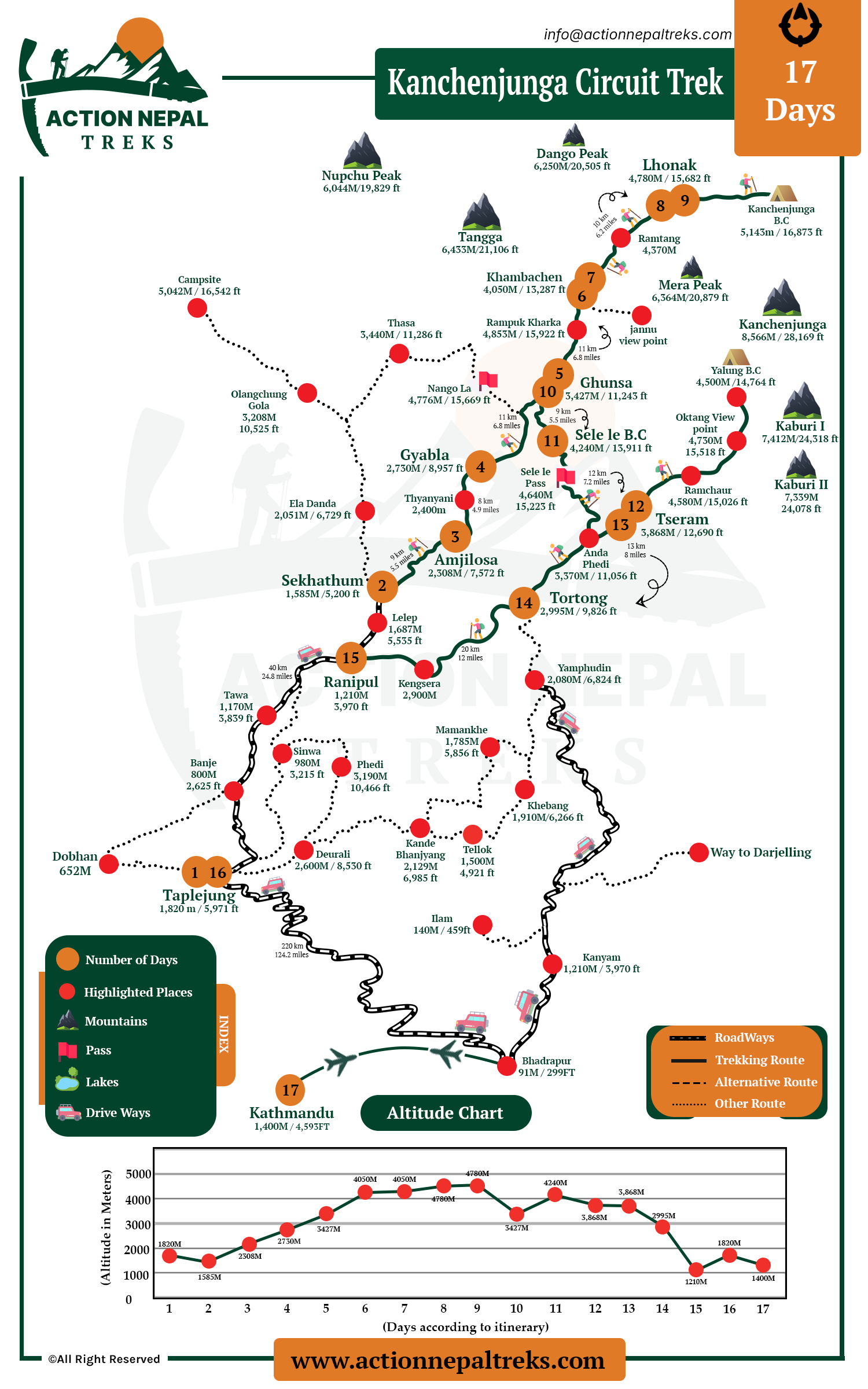
Kanchenjunga circuit trek route map.

Explore the Trek Route in Google Satellite View for Better Clarity.

Trail
Return Trail

Is Kanchenjunga Circuit Trek Right for You?

The Kanchenjunga Circuit Trek is one of the most strenuous treks in Nepal, suited only for trekkers with prior high-altitude trekking experience and excellent fitness. The trek presents steep ascents, multiple high passes, and long walking days (6-9 hours on average) in remote terrain, requiring both strong mental and physical preparation. Therefore, consider this trek only if you are confident in your fitness level and prepared for its physical and psychological demands.

Besides fitness, other factors to consider are time and cost. The full trek takes 17 days, so you need to dedicate a significant amount of time to it. It is also one of the most expensive treks in Nepal, with costs covering flights to Bhadrapur, accommodation in remote villages, and the fees for a licensed guide. You should only undertake this trek if you are financially prepared for these expenses and can commit to the full 17-day itinerary. Additionally, anyone with pre-existing heart or lung conditions should consult a doctor first, as altitudes over 5,000m can cause significant strain.

Nonetheless, for experienced trekkers ready for its challenges, the Kanchenjunga Circuit offers some of the most untouched Himalayan landscapes and deepest solitude found anywhere in Nepal. The views of Kanchenjunga, Jannu, and countless lesser-known peaks make the journey feel truly wild, remote, and unforgettable.

What Makes the Kanchenjunga Circuit Trek So Special?

The Kanchenjunga Circuit Trek feels completely different from most trekking routes in Nepal. As one of the best remote trekking experiences in the country, it takes you deep into the Kanchenjunga Conservation Area, a restricted trekking region in eastern Nepal that receives only a small number of visitors each year. Unlike the crowded Everest and Annapurna trails, this is a true off-the-beaten-path Himalayan journey where wilderness, isolation, and raw mountain scenery still dominate the experience.

Here’s what makes it stand out.

Trekking Both North and South Base Camps in a Single Loop

Most Himalayan treks lead to just one base camp. The Kanchenjunga Circuit is one of the rare treks where you visit two completely different base camps in a single continuous route: North Base Camp at Pangpema (5,143m/ 16,873ft) and South Base Camp at Oktang (4,730m/ 15,518ft).

The northern side feels stark, rugged, and alpine, with views of the Kanchenjunga Glacier and peaks like Jannu (Kumbhakarna), Pyramid Peak, and Tent Peak. The southern route, in contrast, passes through greener forests, waterfalls, and the Yalung Glacier, with views of Kabru, Yalung Kang, and Rathong. Experiencing both sides in one trek gives you a far more complete perspective of Kanchenjunga and its surrounding landscapes.

Remote Himalayan Wilderness Without Crowds

The Kanchenjunga region sees only a fraction of the trekkers who visit Everest or Annapurna each year. Since it is a restricted permit area, trekkers need both a Restricted Area Permit and conservation permits before entering, which naturally keeps visitor numbers low. On many sections of the trail, especially beyond Ghunsa, you may go hours or even days without meeting another trekking group.

As you move higher into the alpine sections, teahouses become fewer and much more basic. Villages such as Lhonak and Sele Le Base Camp often provide only simple stone shelters with limited food options. That lack of comfort can be challenging, but it is also part of what makes the trek feel so remote, raw, and genuinely adventurous compared to Nepal’s more commercial trekking routes.

A Trek Filled with Diverse Landscapes and Cultures

Few Himalayan treks offer as much variety as the Kanchenjunga Circuit. In just 17 days, you’ll have seen subtropical forests filled with bamboo and rhododendron, cardamom-covered valleys, alpine meadows, glacial moraines, and high-altitude plateaus above 5,000m. Even the food changes with the terrain. Fresh vegetables and dal bhat in lower villages gradually give way to simple noodle soups, potatoes, and tsampa in the upper alpine settlements.

Similarly, the route passes through Limbu, Rai, Sherpa, and Tibetan-origin villages, each with distinct traditions, languages, and lifestyles. Because the region remains restricted and sees very little tourism compared to Everest or Annapurna, many of these communities still preserve ways of life that have remained largely unchanged for generations.

Wild, Untouched Trails with Minimal Trekker Traffic

The Kanchenjunga Circuit crosses four major high passes: Sele Le La, Sinion La (4,660m/ 15,288ft), Mirgin La, and Sinelapche La. They link the north and south base camp routes through some of Nepal’s most isolated mountain terrain. Because of the trek’s logistical difficulty and restricted permit system, very few trekkers attempt the full circuit each season.

That remoteness is exactly what keeps the trails so untouched. Long stretches feel completely wild, with no crowds, no traffic, and often no other trekking groups in sight. Crossing each pass feels earned in a way that busier Himalayan routes rarely manage anymore, a true off-the-beaten-path trekking experience in Nepal.

Rare Close-Up Views of Ilam Tea Gardens

Before the trek even begins, the drive from Bhadrapur to Taplejung becomes part of the experience itself. The road winds through the famous Ilam tea gardens. These rolling green hills covered in tea plantations are known across Nepal and beyond. Many trekkers stop along the way to walk through the fields and enjoy freshly brewed local Ilam tea.

On clear days, distant views of Kanchenjunga and Makalu rise above the tea-covered ridges. In spring and autumn, the best trekking seasons for Kanchenjunga, tend to offer the clearest mountain views during this drive. It is a surprisingly beautiful and exceptionally unique transition from Nepal’s lowland hills into the high Himalayas.

Kanchenjunga Circuit Trek Difficulty

The Kanchenjunga Circuit Trek is graded strenuous and sits among the most demanding treks in Nepal. High altitude, remote terrain, long walking days, and very limited rescue access make it a serious undertaking. But that doesn’t mean it’s out of reach. It just needs the right preparation and mindset. If you do that, you can accomplish the trek successfully, even if you’re a first timer or a beginner trekker in remote regions.

How First-Time Remote Trekkers Can Still Complete It

Even if you’ve never done a remote or restricted-area trek before, the Kanchenjunga Circuit is still achievable. It looks intense, and it is, but it doesn’t require technical climbing, rope work, or glacier travel. What it really demands is preparation, patience, and a steady mindset that respects altitude and distance, rather than rushing through them.

Here is how you can trek successfully even as a first-time trekker in a remote restricted region:

  • Train 2-3 months before departure: Build cardio endurance, do long hikes with a loaded backpack, and strengthen your legs to handle 6-9-hour walking days.
  • Follow the itinerary as designed: The gradual altitude gain and acclimatization day at Khambachen (4,145m/ 13,599ft) are there for a reason. Don’t rush them.
  • Keep a slow, steady pace on the trail: At high altitude, consistency matters more than speed or fitness alone.
  • Eat and drink regularly: Appetite drops above 4,000m, but staying fueled and hydrated is essential to maintain energy.
  • Never ignore altitude symptoms: Headache, nausea, or dizziness are warning signs. Stop, rest, and communicate early.
  • Trust your guide: They manage pacing, monitor your condition, and make safety decisions so you don’t have to carry that pressure alone.
  • Let your porter carry the heavy load: With the weight off your shoulders, you save energy where it matters most and can focus fully on the simple rhythm of the trail, one step at a time.

With the right preparation and support, the trek becomes less about difficulty and more about endurance and awareness. Many first-time remote trekkers complete it, and they call it one of the most meaningful journeys of their lives.

Best Time for the Kanchenjunga Circuit Trek

The best time for the Kanchenjunga Circuit Trek in eastern Nepal is spring (March-April) and autumn (October-November). These two windows offer the most stable weather, clearest mountain views, and safest trail conditions. The trek is possible outside these seasons, but winter cold and monsoon rains make it significantly harder and riskier.

Autumn Season (October-November)

Autumn is widely regarded as the best season for the Kanchenjunga Trek because the weather in eastern Nepal becomes dry, stable, and crystal clear after the monsoon. Skies open up fully, giving you uninterrupted views of peaks like Kanchenjunga and Jannu. Trekking trails stay firm and predictable, which is crucial in such a remote circuit. October is the best month, with balanced temperatures, clear skies, and ideal trekking conditions. In late November, the air gets colder, especially above 4,000m. Additionally, early snowfall can make the high passes difficult to cross.

Spring Season (March-April)

Spring is the second-best time for the Kanchenjunga trek, with weather that offers a softer, more colorful landscape. During this time, the weather is generally stable. Temperatures are warmer, and visibility improves as March transitions into April. Rhododendron forests bloom heavily in the lower valleys, making this season visually striking. April stands out as the most balanced month, with clear skies, manageable temperatures, and safer high-pass crossings. On the other hand, March still carries winter residue at altitude, while May slowly shifts toward haze and pre-monsoon instability.

Month-by-Month Weather Guide

Month Season Avg. Temperature Conditions Recommended?
January Winter -10°C to 5°C Heavy snow, extreme cold above 4,000m, makes passes inaccessible Not recommended
February Winter -8°C to 8°C Cold but improving, some clear days at lower elevations Not recommended
March Spring -2°C to 14°C Mild temperatures, residual snow on passes, rhododendrons beginning to bloom Possible
April Spring 5°C to 18°C Best spring month, clear skies, stable trails, ideal conditions Ideal
May Pre-monsoon 8°C to 20°C Warming up, cloud building, hazy views, early monsoon signs Possible but declining
June Monsoon 12°C to 22°C Heavy rain begins, leeches on lower trails, slippery paths, poor visibility Not recommended
July Monsoon 13°C to 23°C Peak monsoon, trail flooding, landslide risk, extremely difficult Not recommended
August Monsoon 13°C to 22°C Heavy rain continues, high passes are dangerous, and the conditions are poor Not recommended
September Post-monsoon 10°C to 20°C Rain easing by late month, trails still wet but clearing, views improving Late September possible
October Autumn 2°C to 16°C Best month overall, dry, clear, stable, outstanding mountain views Ideal
November Autumn -4°C to 10°C Still excellent early month, cold nights, snow possible by late November Good
December Winter -8°C to 5°C Cold setting in rapidly, high passes increasingly risky Not recommended

Note: Temperatures vary significantly with altitude. Values above reflect average daytime highs and nighttime lows across the full trail elevation range (1,500m/ 4,921ft – 5,143m/ 16,873ft).

Why Choose Kanchenjunga Over Everest or Annapurna?

Everest Base Camp is iconic, but it’s also busy. It is packed with thousands of trekkers and teahouses. This trail that rarely feels like a secret anymore. Similarly, Annapurna Circuit offers comfort and variety, but road access has changed parts of the experience, making it more developed and less remote than it once was. Kanchenjunga, on the other hand, sits in a different category entirely. Protected by a restricted area permit that naturally limits crowds, it gives you what the other two have slowly lost: real silence, space, and wilderness that still feels untouched.

Moreover, the Kanchenjunga Circuit Trek also stands out because it doesn’t just take you to one base camp. It takes you to both sides of a giant: Pang Pema (5,143m/ 16,873ft) in the north and Oktang (4,730m/ 15,518ft) in the south. Between them, you cross high passes, walk through rhododendron forests, yak-grazing valleys, and raw glacial terrain. The cultural experience is just as rich, with Limbu, Rai, Sherpa, and Tibetan-origin villages that still hold onto older ways of life, far less shaped by mass tourism.

Factor Kanchenjunga Circuit Everest Base Camp Annapurna Circuit
Difficulty Strenuous Moderate to strenuous Moderate
Duration 17 days 10-14 days 14-21 days
Max Altitude 5,143m/ 16,873ft 5,364m/ 17,598ft 5,416m/ 17,769ft
Crowds Very few Very busy Busy
Remoteness Extremely remote Well-developed Moderately developed
Permit Type Restricted area permit Standard permits Standard permits
Base Camps Two (North & South) One None
Accommodation Basic teahouses Comfortable teahouses Comfortable teahouses
Culture Limbu, Rai, Sherpa, Tibetan Sherpa dominant Gurung, Manangi
Best For Solitude seekers First-time high-altitude trekkers Variety & comfort

So Everest is for those who want the name, Annapurna is for those who want variety, and Kanchenjunga is for those who want space, the kind of silence where the mountains don’t compete for attention.

Kanchenjunga Circuit Trek Permits

You need two main permits to enter the Kanchenjunga National Park / Conservation Area and complete the Kanchenjunga Circuit Trek. Both must be arranged in Kathmandu through a registered trekking agency before the trek begins. You cannot obtain them independently on the trail.

Restricted Area Permit (RAP)

The RAP is the key permit for this restricted region and is issued by Nepal’s Department of Immigration through a licensed agency.

  • Cost: USD 20 per person per week (first 4 weeks), then USD 25 per person per week after
  • Requirement: A licensed trekking guide is mandatory throughout the trek
  • Solo trekking update: As of March 2026, solo trekkers can now obtain the RAP (no longer a strict two-person minimum)

Kanchenjunga Conservation Area Permit (KCAP)

This permit allows entry into the Kanchenjunga National Park / Conservation Area, managed by the National Trust for Nature Conservation (NTNC).

  • Cost: USD 20 for foreigners; NPR 500 for SAARC nationals
  • Validity: One-time fee covering the entire trek duration
  • Where issued: Nepal Tourism Board (NTB) in Kathmandu or designated entry checkpoints

TIMS Card

A TIMS card is not officially required for the Kanchenjunga Circuit Trek, as the RAP already covers registration and tracking requirements in this restricted area. However, at Action Nepal Treks (ACT), we include the TIMS card as part of your complete permit package, ensuring you are fully covered at every checkpost and removing any administrative uncertainty during the trek.

  • Cost: USD 20 per person for agency trekkers
  • Documents needed: Valid passport, one passport-sized photo, and trekking agency endorsement
  • Issued by: Nepal Tourism Board (NTB) office in Kathmandu or Pokhara

Required Documents for Permit Processing

We arrange all permits before your arrival so your trek starts smoothly without any last-minute hassle. To process them, we will typically need:

  • Passport with at least 6 months’ validity
  • Valid Nepal tourist visa
  • 2 passport-size photos (digital & physical copies)
  • Travel insurance covering helicopter evacuation up to 6,000m
  • Confirmed itinerary and agency authorization letter

These permits regulate access to the Kanchenjunga region, helping preserve its remoteness while ensuring safety and controlled trekking flow.

Accommodation, Food & Logistics on the Kanchenjunga Circuit

One of the biggest concerns trekkers have about the Kanchenjunga Circuit is logistics. How remote it actually feels, what you’ll eat, and how you even reach the trailhead. While this route is far less developed than Everest or Annapurna, a well-planned trek is still very manageable. Teahouses are available along the entire route, food is basic but steady, and access to the region is straightforward once everything is arranged in advance.

Teahouses vs Camping: What to Expect

Teahouse trekking is the standard on the Kanchenjunga Circuit, and most trekkers rely on it instead of full camping. From Taplejung up to the higher valleys, teahouses are available along the main trail, but comfort decreases steadily with altitude and depends on season and crowd levels.

  • Mitlung to Ghunsa: Wooden rooms with 2-3 beds, basic blankets, and simple facilities. Ghunsa is the most developed village on the route and the only one with attached bathrooms in some lodges.
  • Khambachen and Lhonak: A few reliable teahouses, including well-known stops like Kanchenjunga White House (Khambachen) and Kanchenjunga Guest House (Lhonak), often with solar charging available.
  • Selele High Camp: Limited but functional teahouses (now a couple of options), typically the most expensive rooms on the route (~NPR 1,000), with very basic outdoor toilets.
  • Pangpema (North Base Camp): There’s only one small teahouse. It may close during winter or festivals. Always confirm in advance if you’re traveling in the off-season.
  • Ramche (South Base Camp): The most basic stop on the circuit, with very limited rooms and minimal facilities.
  • Camping option: Full camping support is available with cook teams and porters for trekkers wanting flexibility or when teahouse space runs out.
  • Electricity & charging: Mostly free in the lower sections up to Ghunsa. Beyond that, solar charging is common, so you need to pay for charging any device. That too is unreliable. A power bank is essential.

During peak seasons like October-November and April, higher-altitude teahouses like those in Amjilosa or Khambachen can fill up, so advance planning and booking through your agency is important. Otherwise, you’ll end up sleeping in dining areas or temporary tents set up for support staff.

Food & Water on the Kanchenjunga Trek

Food on the Kanchenjunga Circuit is simple, hearty, and fully focused on keeping you going, not on variety or comfort. Do not expect international dishes, continental breakfasts, or restaurant-style menus. Everything is carried up by porters and mules, so as altitude increases, choices shrink and prices steadily rise. Above Ghunsa, especially, the menu becomes very limited, and most trekkers rely on the same few reliable meals every day.

Meal / Item What to Expect Availability Approx. Cost
Breakfast Porridge, eggs (boiled/fried/scrambled), toast, Tibetan bread, tsampa; above Ghunsa, mostly porridge, eggs, or instant noodles Taplejung to both base camps NPR 150-400
Lunch & Dinner Dal bhat, noodle soups, momos, chapati, vegetable curry; dal bhat is the most reliable with unlimited refills; no proper international menu above Ghunsa Entire route NPR 200-800
Drinks Black tea, milk tea, hot lemon Entire route NPR 50-150
Boiled / Hot Water Safest drinking option provided by teahouses All teahouses NPR 50-150 per litre
Bottled Water Available up to Ghunsa; above 4,000m becomes expensive and unreliable Taplejung to Ghunsa (limited higher up) NPR 100-150 below Ghunsa; USD 1-3 above 4,000m

How to Get to the Kanchenjunga Trek Start Point

The trek officially begins at Taplejung (1,820m) in eastern Nepal. There are three main ways to reach it, each offering a different balance of cost, comfort, time, and overall travel experience.

Option 1: Fly & Drive (Recommended)

Fly from Kathmandu to Bhadrapur in about an hour, then continue by jeep through eastern Nepal’s hills, tea gardens, and river valleys to Taplejung in around 5-6 hours. This is the most commonly used route for guided groups because it reduces travel fatigue and keeps the journey relatively smooth before the trek begins.

  • Flight (Kathmandu → Bhadrapur): USD 100-130 per person
  • Shared jeep (Bhadrapur → Taplejung): USD 50-75 per person

Option 2: Full Overland

You travel the entire route from Kathmandu to Taplejung via Ilam and Phidim. It is a long 16-18 hour journey by bus or shared jeep. The road is winding and slow, but it offers a real look at eastern Nepal’s landscapes and remote hill life before you even start trekking.

  • Bus (Kathmandu → Taplejung): USD 20-25 per person
  • Shared jeep (Kathmandu → Taplejung): USD 30-50 per person

Option 3: Fly to Suketar (When Available)

Alternatively, you can also fly to a small airstrip at Suketar, near Taplejung. It has direct flights from Kathmandu in about an hour, cutting out the long road journey completely. However, it operates only occasionally, with flights limited and weather-dependent. Your flights can be delayed or canceled without notice, so this option should never be your only plan.

  • Flight (Kathmandu → Suketar): USD 150-200 per person

Important Notes

  • During monsoon season (June-August), the Bhadrapur-Taplejung road is prone to landslides and delays, so always keep buffer time in your itinerary
  • For groups of four or more, a private jeep from Bhadrapur (around USD 250-300 total) is often the most comfortable and cost-effective option compared to shared transport
  • Always confirm Suketar flight availability in advance, especially if you want to build your itinerary around it.

Essential Preparation Tips Before You Go

The Kanchenjunga Circuit is not a trek you can walk into underprepared. Its remoteness, altitude, and length demand solid physical, mental, and logistical readiness. That said, with the right preparation, even first-time remote trekkers can complete it safely and successfully.

Physical Fitness

  • Start training at least 2-3 months before departure. Expect 6-9 hours of walking per day on steep, uneven terrain, so your focus should be endurance, not just basic fitness.
  • Build cardio endurance (running, cycling, stair climbing) at least 4x a week
    Do long hikes (4-6 hours) with a loaded backpack (8-10 kg) to simulate real trekking conditions
  • Strengthen legs and knees using squats, lunges, and step-ups for steep ascents and descents
  • If you live at a low altitude, arrive in Kathmandu 2-3 days early to begin natural acclimatization

Altitude Preparation

The trek reaches 5,143m at Pang Pema, where altitude sickness becomes a real risk even for fit trekkers.

  • Consult a doctor about Diamox (acetazolamide) before the trek if needed
  • Learn AMS symptoms: headache, nausea, dizziness, fatigue, loss of appetite
  • Follow ascent limits (300-500m gain per day above 3,000m). The itinerary is designed for this, so don’t rush it
  • If symptoms worsen, descend immediately. Safety always comes first

Mental Preparation

This trek is as mentally demanding as it is physical. Above Ghunsa, conditions become quiet, basic, and often isolating.

  • Accept cold rooms, simple food, and limited facilities as part of the experience
  • Be ready for long stretches with no internet or mobile signal (especially above Lhonak and Ramche)
  • Bring small comfort items like a book, a journal, or downloaded podcasts
  • Trust your guide’s pacing. Rushing is one of the biggest causes of problems at altitude

Health and Medical Preparation

There are risks from contaminated food and water in rural and remote areas, not from trekking itself.

  • Visit a travel clinic 4-6 weeks before departure for recommended vaccines (Hepatitis A, Typhoid, Tetanus)
  • Carry a personal first aid kit: blister care, painkillers, ORS, antihistamines, altitude meds, basic wound care
  • If you have heart, lung, or blood pressure conditions, get medical clearance before committing to the trek

Pre-Trek Admin Checklist

  • Travel insurance: Must cover helicopter evacuation and emergency rescue above 5,000m
  • Permits: Your agency handles RAP and KCAP, but confirm everything is issued before leaving Kathmandu
  • Cash: Carry enough Nepali rupees from Kathmandu (ATMs are not reliable beyond cities). Budget ~USD 20-30/day for extras
  • Gear: We usually provide sleeping bags, jackets, and duffel bags. Confirm pickup before departure.

Why Book Your Kanchenjunga Circuit Trek With Us?

Kanchenjunga isn’t the type of trek you should cut corners on just because the cost is low. This is a remote, high-altitude expedition in a restricted region where safety, logistics, and real mountain experience matter far more than saving a little upfront. At Action Nepal Treks, we have built everything around making sure your trek is not just completed, but done right.

  • 15+ years of real Himalayan experience: We’re a locally based, hands-on team that actually operates in Nepal’s trekking regions, not a reseller or middleman platform.
  • End-to-end trek management: From permits and domestic travel to accommodation, meals, and logistics, everything is fully organized and coordinated in-house.
  • Safety-first planning: We design itineraries with proper acclimatization, realistic pacing, and backup planning for remote conditions where flexibility matters.
  • Experienced restricted-area guides: You trek with government-licensed guides trained in high-altitude trekking, AMS monitoring, and emergency decision-making in remote terrain.
  • Transparent all-inclusive pricing: Our package includes permits, transport, accommodation, meals, a guide, a porter, and essential gear, all upfront with no hidden costs later.

Packing Essentials for Kanchenjunga Circuit Trek

Clothing
boot
sleeping bag
trekking Gear
sunscreen (1)
bottle
passport

Clothing

  • Moisture-wicking base layers (top and bottom), 2 sets
  • Insulating mid-layer (fleece or light down jacket)
  • Heavyweight down jacket for high camps (provided)
  • Waterproof, windproof outer shell jacket and trousers
  • Trekking trousers, 2 pairs
  • Warm hat, sun hat, and buff/neck gaiter
  • Lightweight gloves & heavyweight insulated gloves
  • Wool/synthetic trekking socks, 5-6 pairs
  • Camp shoes or sandals for teahouse evenings

Footwear

  • Sturdy waterproof trekking boots with ankle support (broken in before the trek)
  • Gaiters for snow and mud on high passes

Backpack & Sleeping Gear

  • Daypack (20-25L) for essentials
  • Trek duffel bag (provided) for porter load
  • Sleeping bag rated to -15°C (provided)

Trekking Equipment

  • Trekking poles (highly recommended for passes and descents)
  • Headlamp with spare batteries
  • Sunglasses (UV400 protection)
  • Power bank (20,000 mAh minimum, charging is limited above Ghunsa)
  • Offline maps on phone (Maps.me or Gaia GPS)
  • Camera with spare batteries/memory cards

Personal Items & Toiletries

  • High-SPF sunscreen & SPF lip balm
  • Hand sanitizer & wet wipes
  • Toilet paper & small trowel (above treeline sections)
  • Toothbrush, toothpaste, biodegradable soap
  • Microfibre towel
  • Prescription medicines (if any)
  • Diamox (only if prescribed)
  • Painkillers, ORS, antihistamines
  • Blister care kit (moleskin, antiseptic, bandages)

Food & Hydration

  • Water bottles (minimum 1L each, carry two)
  • Water purification tablets or a filter bottle (provided in group kit)
  • Energy bars, nuts, dried fruit, chocolate, electrolyte sachets (Stock up in Taplejung, no shops above Selele)

Miscellaneous

  • Passport (required at all checkpoints)
  • Travel insurance documents with an emergency contact
  • USD cash & Nepali rupees (no ATMs beyond Taplejung)
  • Emergency contact card (guide & agency details)
  • Universal travel adapter
  • Small padlock for teahouse rooms
  • Dry bags / zip-locks for electronics and documents

Dates & Prices

Our fixed departure dates and per-person pricing make it simple for both solo travelers and small groups to join the adventure. It’s a great chance to meet new people and share the experience with other trekkers. Just choose your preferred date, and we’ll take care of the rest.

Kanchenjunga Circuit Trek Departure Date

Start Wednesday

2 Sep

Status

Booking Open

Days

17

Per Person

USD 1,849

Kanchenjunga Circuit Trek

Start Monday

7 Sep

Status

Booking Open

Days

17

Per Person

USD 1,849

Kanchenjunga Circuit Trek

Start Friday

11 Sep

Status

Booking Open

Days

17

Per Person

USD 1,849

Kanchenjunga Circuit Trek

Start Wednesday

16 Sep

Status

Booking Open

Days

17

Per Person

USD 1,849

Kanchenjunga Circuit Trek

Start Monday

21 Sep

Status

Booking Open

Days

17

Per Person

USD 1,849

Kanchenjunga Circuit Trek

Start Friday

25 Sep

Status

Booking Open

Days

17

Per Person

USD 1,849

Kanchenjunga Circuit Trek

Start Wednesday

30 Sep

Status

Booking Open

Days

17

Per Person

USD 1,849

Kanchenjunga Circuit Trek

FAQs for the Kanchenjunga Circuit Trek

Trip Reviews

Action Nepal Treks is a reliable trekking company run by a professional guide who has been active in Nepal’s tourism industry for 15 years.

Verified

5/5 – next time again!

Our trekking experience was absolutely fantastic – and a big part of that was thanks to the amazing people who guided us along the way. Rick led us through the first few days and immediately created a great atmosphere. With his positive, relaxed attitude and great sense of humor, he fit perfectly with the group and made the start of...

Verified

5/5 – next time again!

Our trekking experience was absolutely fantastic – and a big part of that was thanks to the amazing people who guided us along the way. Rick led us through the first few days and immediately created a great atmosphere. With his positive, relaxed attitude and great sense of humor, he fit perfectly with the group and made the start of the trek incredibly enjoyable. For the rest of the trek, Umesh took over seamlessly and continued in exactly the same spirit. He was always in a great mood, attentive, and ready with a joke. You could really tell that he genuinely cared about the group and our overall experience. He picked up the group dynamic effortlessly and carried it forward in the best way. A big thank you as well to Simbir for the excellent organization. Everything was smooth, professional, and at the same time very easygoing. The price was especially impressive – compared to other providers, it was unbeatable without compromising on quality. Overall, a highly recommended experience – especially thanks to such an incredible team!

Verified

Group Kanchenjunga Trekking Adventure in the East

I joined a small group for the Kanchenjunga North trek, and it was a true adventure. The trek was long, but we took our time. Action Nepal Treks planned everything well, and our guide and porters were amazing. We reached the base camp after days of walking through forests, rivers, and rocky trails. The view of the mountains at the...

Verified

Group Kanchenjunga Trekking Adventure in the East

I joined a small group for the Kanchenjunga North trek, and it was a true adventure. The trek was long, but we took our time. Action Nepal Treks planned everything well, and our guide and porters were amazing. We reached the base camp after days of walking through forests, rivers, and rocky trails. The view of the mountains at the end made all the effort worth it. We were tired but proud. I’m so glad we chose this hidden gem in Nepal.

Verified

Solo Kanchenjunga Trek in Peaceful Mountains

I did this trek last May, and it was one of the best experiences of my life. The mountains were huge, and nature was untouched. We didn’t see many other trekkers, which made it feel special. My guide was very caring and explained a lot about the local people and places. It was hard at times, but I felt safe...

Verified

Solo Kanchenjunga Trek in Peaceful Mountains

I did this trek last May, and it was one of the best experiences of my life. The mountains were huge, and nature was untouched. We didn’t see many other trekkers, which made it feel special. My guide was very caring and explained a lot about the local people and places. It was hard at times, but I felt safe and happy all the way to the base camp. This trek gave me peace and strength.

Similar Trips

View Details
Kanchenjunga North Base Camp Trek

Kanchenjunga North Base Camp Trek 

View Details
Trekkers at larke la pass

Manaslu Circuit Trek

View Details
15 Days Annapurna Circuit Trek via Tilicho

15 Days Annapurna Circuit Trek via Tilicho