


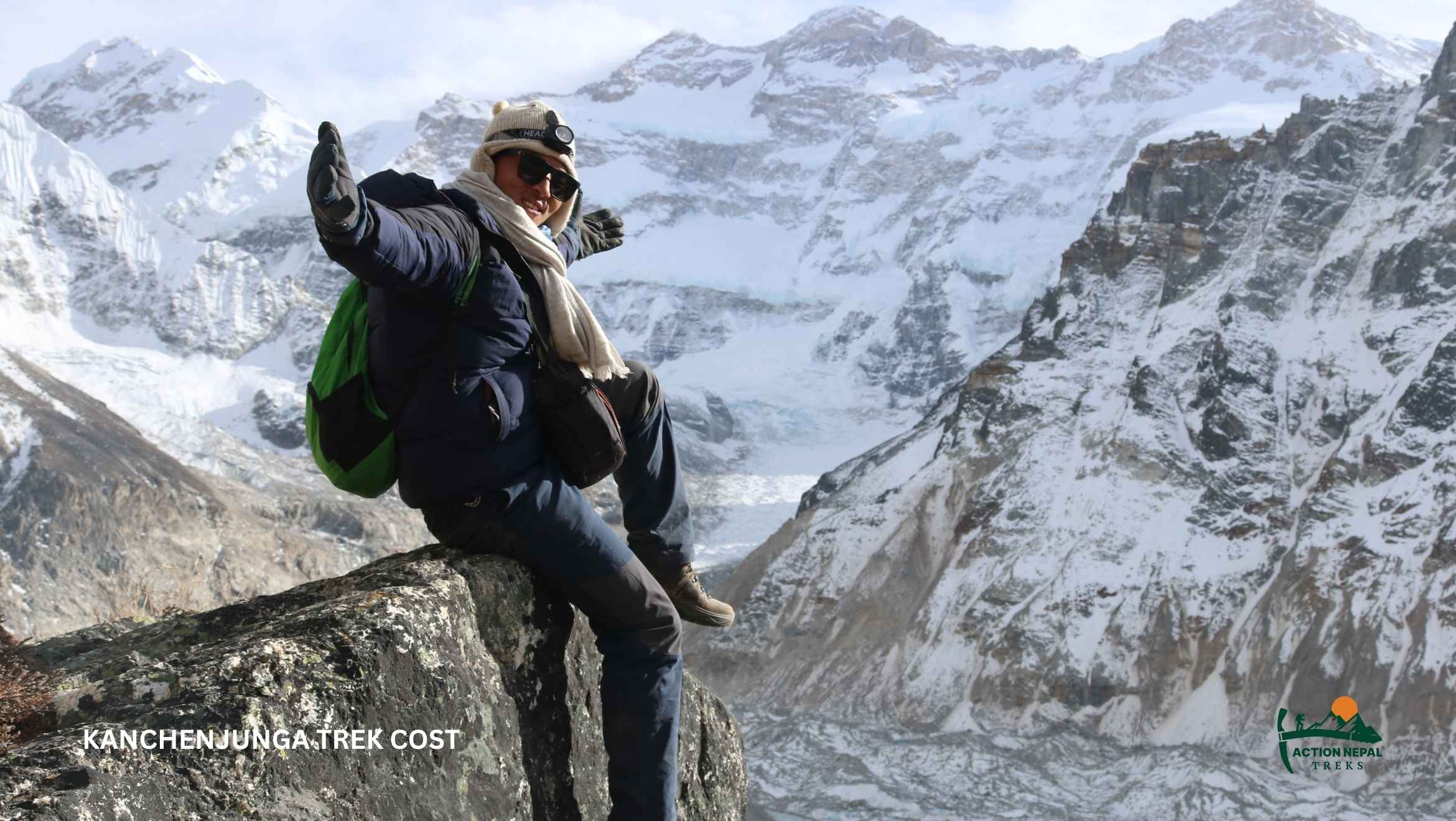
A fully guided Kanchenjunga Trek cost typically range between USD 1,500 and 2,500 per person. The final price depends on three main factors: your group size, service level (budget vs. deluxe), and whether you trek to both base camps or only one. Why does it cost more than popular treks like Everest and Annapurna when it is not even as popular? The main reason is that Kanchenjunga is a restricted border region where independent trekking is not allowed. You must obtain special permits and hire a licensed guide through a registered agency to trek here.
The Kanchenjunga region is also very remote. Unlike the Everest and Annapurna regions, which attract large numbers of trekkers, Kanchenjunga sees relatively few visitors each year. As a result, transportation, accommodation, food, and trekking services cost more to operate. Thus, the trek cost reflects the region’s remoteness and regulations rather than luxury facilities.
Quick Cost Overview of the Kanchenjunga Trek
At Action Nepal Treks, we offer two Kanchenjunga trek packages: a 14-day trek to the North Base Camp and a 17-day full circuit covering both base camps. The circuit package costs more because it’s longer and covers more ground, but the per-day difference is smaller than most people expect.
| Category | Estimated Cost (USD) | Key Notes |
|---|---|---|
| Typical Fully Guided Trek | USD 1,500-2,500 | Standard range for a fully guided Kanchenjunga Trek. Final price depends on group size, route, and service level. |
| 14-Day Kanchenjunga North Base Camp | USD 1,320-1,499 | Includes permits, licensed guide, teahouse accommodation, meals, and transport. Final price depends on group size. |
| 17-Day Kanchenjunga Circuit Trek | USD 1,800-2,500 | Covers both North and South Base Camps. Higher cost reflects the longer itinerary. Final price depends on group size. |
| Permits | USD 55-95 | RAP and KCAP permits required. |
| Guide and Porter | USD 45-60/day | Licensed guide is mandatory, porters are optional. Tips are not included in the package. |
| Transportation | USD 270-350 | Flights and jeep transfers to the trailhead. |
| Accommodation | USD 3-10/night | Basic teahouses. Prices increase with altitude. |
| Meals | USD 5-13/meal | Food becomes more expensive higher on the trail. |
| Travel Insurance | USD 150-400 | Should cover high-altitude trekking and evacuation. |
| Gear and Equipment | USD 100-300 purchase or USD 3-8/day rental | Depends on what you already own. |
| On-Trail Personal Expenses | USD 10-20/day | Showers, charging, snacks, drinking water, etc. |
| Nepal Entry Visa | USD 50 | Standard 30-day tourist visa. |
One update for 2026: Solo trekkers can now enter the trek to Kanchenjunga Base Camp with a licensed guide. You don’t need a minimum of two trekkers now.
Where Does the Kanchenjunga Trek Cost Go?
The cost of the Kanchenjunga Trek package mainly goes to permits, guide, accommodation, meals, and transport to the trailhead. Your total cost can still go higher with personal expenses on the trail, gear, insurance, and tips.
Below is a breakdown of individual cost factors for both our packages: 14-day trek to the North Base Camp and a 17-day full circuit trek.
Permit costs for the Kanchenjunga trek
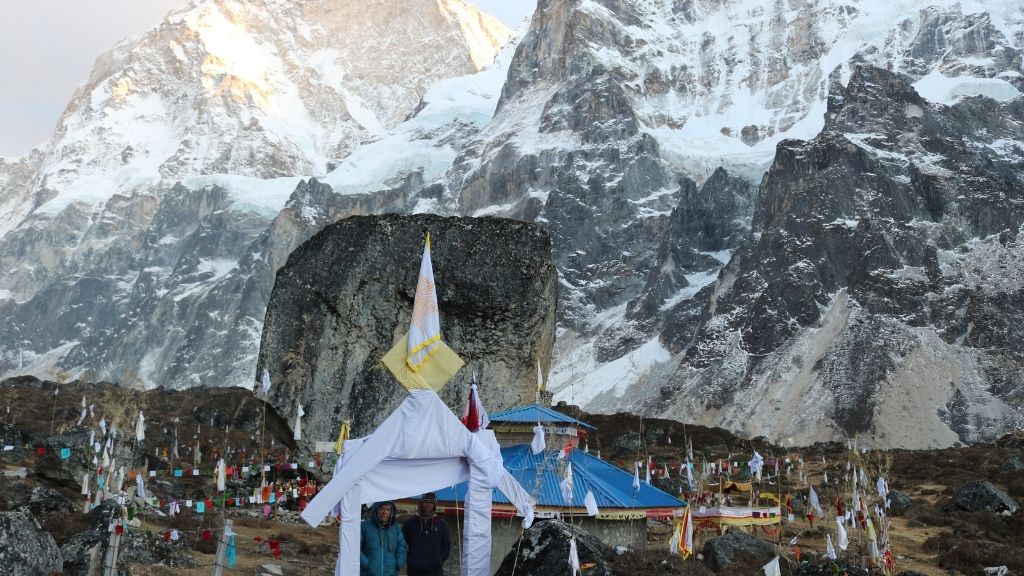
Kanchenjunga lies in a restricted border zone in eastern Nepal near Tibet and Sikkim. It is also a conservation area. Thus, you need two trek permits for Kanchenjunga: the Restricted Area Permit and the Conservation permit.
Restricted Area Permit (RAP)
The RAP is the main permit for Kanchenjunga’s restricted zone. You can’t apply for the permit by yourself. It must be arranged through a registered trekking agency. The permit is checked at points like Chiruwa, Lelep, and Ghunsa, so you need printed copies with you.
- Cost: USD 20 per person per week (≈ USD 40-60 for 14 days, USD 60-80 for 17 days)
Kanchenjunga Conservation Area Permit (KCAP)
The KCAP covers entry into the 2,035 sq km protected area along the route.Most agencies arrange it in Kathmandu before departure, though it can also be issued at the trailhead.
- Cost: NPR 2,000 (~USD 15) fixed fee
Guide and porter costs
A licensed guide is mandatory for the Kanchenjunga trek. This isn’t optional but a criterion for the Restricted Area Permit (RAP) journey. Unlike Everest or Annapurna, where independent trekking is still possible, Kanchenjunga legally doesn’t allow it. That said, a guide here is genuinely valuable. The trails are less marked, teahouses are sparse at higher altitudes, and navigating a 5,000m+ trek safely needs local experience.
We include all guide and porter costs in our packages, including food, accommodation, and insurance, so there are no separate payments on the trail. Tipping is still expected and not included.
Here’s a full table breakdown of guides, porters, and tipping costs for both of our packages:
| Service | Daily Rate | 14-Day Total | 17-Day Total |
|---|---|---|---|
| Licensed trekking guide | USD 25-35/day | USD 350-490 | USD 425-595 |
| Porter | USD 20-25/day | USD 280-350 | USD 340-425 |
| Guide + porter combined | USD 45-60/day | USD 630-840 | USD 765-1,020 |
Transportation costs
Getting to the Kanchenjunga trailhead is a trip on its own. It is also the most expensive transport section of the whole trek. Unlike Everest, where a short flight drops you at Lukla, you need to take a long flight to Bhadrapur, followed by a long jeep ride to Taplejung. If you’re in a group, a private jeep is the better option. If you’re a solo trekker, shared jeeps are more practical, but they take a bit longer. The drive itself, however, is scenic and makes the experience more memorable.
Note that flights to Bhadrapur are weather-dependent and can get delayed, especially in peak trekking seasons. Keep an extra USD 50-100 as a buffer for unexpected overnight stays in Kathmandu.
| Transport Segment | One Way | Round Trip | Duration |
|---|---|---|---|
| Kathmandu → Bhadrapur (flight) | USD 120-150 per person | USD 240-300 per person | 45-60 min each way |
| Bhadrapur → Taplejung (private jeep, total vehicle) | USD 250-300 | USD 500-600 | 8-10 hours |
| Bhadrapur → Taplejung (shared jeep, per seat) | USD 15-25 per person | USD 30-50 per person | 10-12 hours |
| Kathmandu hotel buffer night | USD 20-60 | – | – |
Gear, Insurance, and Extra Costs People Forget
These costs aren’t included in any package, but they can add up more than people expect, especially on longer, high-altitude treks like Kanchenjunga. Travel insurance is the big one you shouldn’t cut corners on. A helicopter rescue from Kanchenjunga altitude can cost USD 3,000-6,000, and most agencies require proof of coverage before your departure. So, make sure your policy explicitly covers trekking above 5,000m and emergency evacuation.
For gear, pack your broken-in waterproof trekking boots, thermals, socks, headlamp with spare batteries, power bank, UV sunglasses, and water purification. These directly affect safety and can’t be rented. Everything else is easy to rent in Thamel. Sleeping bag costs USD 3-5/day, down jackets USD 3-5/day, and trekking poles USD 1-2/day.
| Cost Item | Approx. Amount |
|---|---|
| Nepal visa (30 days on arrival) | USD 50 |
| Travel insurance (must cover up to 6,000m + heli evacuation) | USD 150-400 |
| Gear rental in Kathmandu (sleeping bag, down jacket, poles) | USD 3-8/day total |
| Personal gear purchase (boots, thermals, headlamp, gloves) | USD 100-300 (if buying new) |
| Water purification (drops/tablets vs bottled water) | USD 10-15 total |
| Hot shower on trail (gas or bucket heated) | USD 2-5 per shower |
| Wi-Fi/device charging (limited, often solar-powered) | USD 2-5 per charge |
| Snacks and personal items (chocolate, toilet paper, wet wipes) | USD 5-15/day |
| Guide tip (14-day/17-day trek) | USD 40-70/USD 50-80 |
| Porter tip (14-day/17-day trek) | USD 25-45/USD 30-50 |
| Weather delay buffer (extra food/lodging cash) | USD 100-150 |
Accommodation and Food Costs During the Trek
If you do a guided trek, your room and three daily meals are already included in the package price. However, you’ll still need cash for on-trail extras like boiled water, hot showers, charging devices, and snacks, usually about USD 10-20 per day.
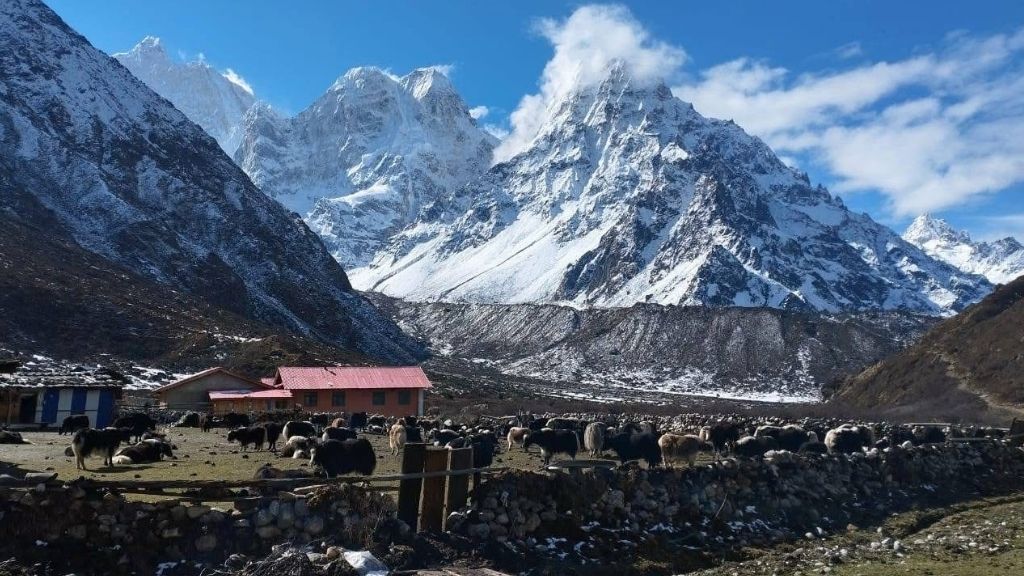
Teahouses here are very basic: simple twin beds, shared toilets, and thin wooden walls. This is remote terrain, so don’t expect luxury. Food is simple but filling, and dal bhat (refillable rice and lentils) is available everywhere and gives the best value.
Above Ghunsa, choices get limited to just one or two teahouses per stop, so you eat where you sleep. Prices also rise with altitude because everything is carried in by porters or mules.
Below is a clear breakdown of the cost of accommodation and food during the trek:
| Trekking Stage | Altitude | Room (Per Night) | Meal (Dal Bhat) | Daily Extras (Water/Shower/Charge) | Total Real Daily Cost |
|---|---|---|---|---|---|
| Lower Valley (Taplejung-Chirwa) | 1,800m-2,200m | USD 3-5 | USD 5-7 | USD 5-8 | USD 20-30 |
| Mid-Altitude (Chirwa-Ghunsa) | 2,200m-3,600m | USD 4-6 | USD 6-9 | USD 8-12 | USD 26-40 |
| High Alpine (Ghunsa-Pangpema) | 3,600m-5,100m | USD 6-10 | USD 9-13 | USD 12-18 | USD 40-60 |

Kanchenjunga Circuit Trek

Kanchenjunga North Base Camp Trek
Why Guided Trekking is Worth the Cost?
Yes. A guide isn’t just required here, it’s what makes the trek possible in the first place. Legally, you can’t enter the Kanchenjunga restricted area without a licensed guide, since permits must be issued through a registered agency and checked at multiple military and police points along the trail. So part of what you’re paying for is simply access to one of Nepal’s most protected and remote regions.
But the real value shows up on the ground. This is not a well-marked or highly serviced route like Everest or Annapurna. There are no rescue hubs, very limited communication, and long stretches where help is hours or even days away. A guide becomes your safety system, monitoring altitude symptoms, managing navigation in poor weather, and coordinating emergency evacuation if something goes wrong above 5,000 meters.
On top of that, they handle the invisible logistics that make or break the trek: securing scarce teahouse rooms, arranging food in villages with only one or two lodges, and bridging language gaps in remote communities. Without that, the same journey quickly shifts from “challenging adventure” to “logistical chaos.” In that sense, the cost of a guide isn’t extra. It’s what holds the entire experience together.
Budget vs Standard vs Luxury Trip Cost Comparison
While Kanchenjunga is more expensive than most Nepal treks due to permits and mandatory guide rules, you still have real control over how much you spend. The biggest cost differences come down to transport choices, group size, and how much support you want on the trail. No matter the budget level, everyone walks the same wild trails and sees the same massive Himalayan peaks.
A budget style works best for small groups who want to keep things lean, like handling food and lodging themselves while hiring only a guide and permit support. A standard package is the most common option, where an agency covers flights, meals, teahouse stays, a guide, and porters for a smooth, all-in experience. A luxury expedition in this region doesn’t mean hotels but private tented camping, a full support crew, a chef, and maximum flexibility in remote terrain.
Trekking Styles Comparison
| Feature | Budget Style | Standard Package | Luxury Expedition |
|---|---|---|---|
| Average Cost | USD 1,350 – 1,600 | USD 1,700 – 2,500 | USD 2,600 – 4,500+ |
| Transport | Public buses & shared jeeps | Flights + private/shared jeeps | Flights + private jeeps/heli options |
| Accommodation | Basic teahouses (pay yourself) | Pre-booked teahouses included | Private tented camps |
| Meals | Dal bhat, paid locally | Three meals included | Private chef, full menu |
| Guide & Crew | Basic guide | Experienced guide + porters | Full expedition team |
| Comfort Level | Rough, independent | Balanced, hassle-free | Highest comfort & support |
North vs South vs Circuit route: Does it change the trip cost?
Yes, the Kanchenjunga Base Camp Trek route you choose directly affects the overall cost. They have different trek itineraries and durations, which directly affect permit, guide, accommodation, and food costs.
The North Base Camp trek (14 days) is the standard package. If you are comparing Kanchenjunga north vs south, you’ll find that the South Base Camp trek is slightly cheaper or similar in base pricing, but still sits in the same range because logistics are almost identical. Lastly, the Circuit trek costs the maximum because it adds several extra days (usually three) to reach the North and South Base Camps.
Route Comparison
| Route | Duration | Approx. Cost | Difficulty |
|---|---|---|---|
| Kanchenjunga North Base Camp (Pangpema) | 14 days | USD 1,320-1,499 | Hard |
| Kanchenjunga South Base Camp (Oktang) | 14-16 days | USD 1,300-1,499 | Moderate-Hard |
| Full Circuit (NBC + SBC) | 17 days | USD 1,649-1,849 | Hard – Very Hard |
The price gap between the North Base Camp trek and the full circuit comes from about three extra trekking days. adding guide fees, food, accommodation, and extra permit time. For most trekkers with enough time, the circuit is worth the upgrade for the full Kanchenjunga experience.
How to lower the cost of the trek without cutting safety?
You don’t need to cut corners on safety or legality to reduce the cost of a Kanchenjunga trek. Skipping a proper guide or insurance might look cheaper, but it’s a risky move in such a remote region. The smarter way is to reduce costs through logistics and daily spending, not essentials.
Here are safe, effective ways to bring the price down:
- Book directly with a local Nepali trekking agency: This helps you avoid platform commissions and save around USD 100-300 on your trek package.
- Trek in a group and share the cost: Split guide fees and jeep costs to save around USD 300-500 per person.
- Use hybrid transport: Fly to Bhadrapur, then take a shared jeep instead of a private one.
- Carry a power bank: Charge during the day to avoid paying for teahouse electricity.
- Purify drinking water: Use tablets or a UV purifier instead of buying bottled water.
- Rent heavy gear in Kathmandu: Sleeping bags and down jackets cost just USD 3-5 per day.
These small choices don’t affect the experience. What they can do is significantly lower your total budget.
Conclusion
The Kanchenjunga trek costs depend on group size, route, and logistics. A 14-day guided trek typically ranges from USD 1,320 – 1,499 per person, with larger groups paying less and solo trekkers paying more due to shared guide and transport costs. It is more expensive than the Everest Base Camp Trek because the region is remote, restricted, and harder to access. Packages usually include permits, a licensed guide, accommodation, meals, and transport, while travel insurance, tips, and personal expenses are separate.

