
Sambir
Connect With a Trek Expert(Simbir) +977 9709278526

Three High Passes Trek with Lobuche Peak Climbing

Mountain Icon

Max. Altitude

6,119m / 20,075ft

Duration Icon

Duration

20 Days

Grade Icon

Grade

Strenuous
Activity Icon

Activity

Trekking

Season Icon

Best Season

Mar, Apr, May, Sept, Oct, Nov

Transportation Icon

Transportation

Flight & Private Vehicle

Meals Icon

Meals Included

All Meals (Breakfast, Lunch & Dinner) during the trek
Accommodation Icon

Accommodation

Teahouse, Tent
Region Icon

Trek Region

Everest Region Trek Packages

Destination Icon

Destination

Tours & Treks in Nepal

Destination Icon

Group Size

1 - 10

Activity Icon

Activity Per Day

5-8hrs walking

Start End Icon

Start/End Point

Kathmandu / Kathmandu

Nature Icon

Nature Of Trek

Lodge & Camping

Three High Passes Trek with Lobuche Peak Climbing Overview

The Everest Three High Passes Trek with Lobuche Peak Climbing is one of the most complete adventures in the Everest region. Designed for trekkers seeking a greater challenge, this 20-day journey combines the three high passes of Kongma La (5,535m/ 18,159ft), Cho La (5,420m/ 17,782ft), and Renjo La (5,360m/ 17,585ft) with the ascent of Lobuche East (6,119m/ 20,075ft). Instead of booking separate trekking and climbing trips, you experience both in a single itinerary while exploring some of the most spectacular landscapes in the Khumbu.

The journey follows a carefully planned acclimatization schedule through key stops such as Namche Bazaar and Chhukung, where your body adjusts to the increasing altitude. Along the way, you will visit Everest Base Camp (5,364m/ 17,598ft), cross glacial valleys, explore the Gokyo Lakes, and tackle three high mountain passes. The expedition reaches its highest point on Lobuche East, where you climb under the guidance of experienced climbing Sherpas using fixed ropes and mountaineering equipment.

Beyond the physical challenge, this route offers a deeper exploration of the Everest region than the classic base camp trek. From remote valleys and traditional Sherpa settlements to high-altitude glaciers and panoramic viewpoints, each stage of the journey reveals a different side of the Khumbu and the Sherpa people. Thus, this peak climbing package creates a well-rounded circuit through the Everest region, linking together major highlights of the region.

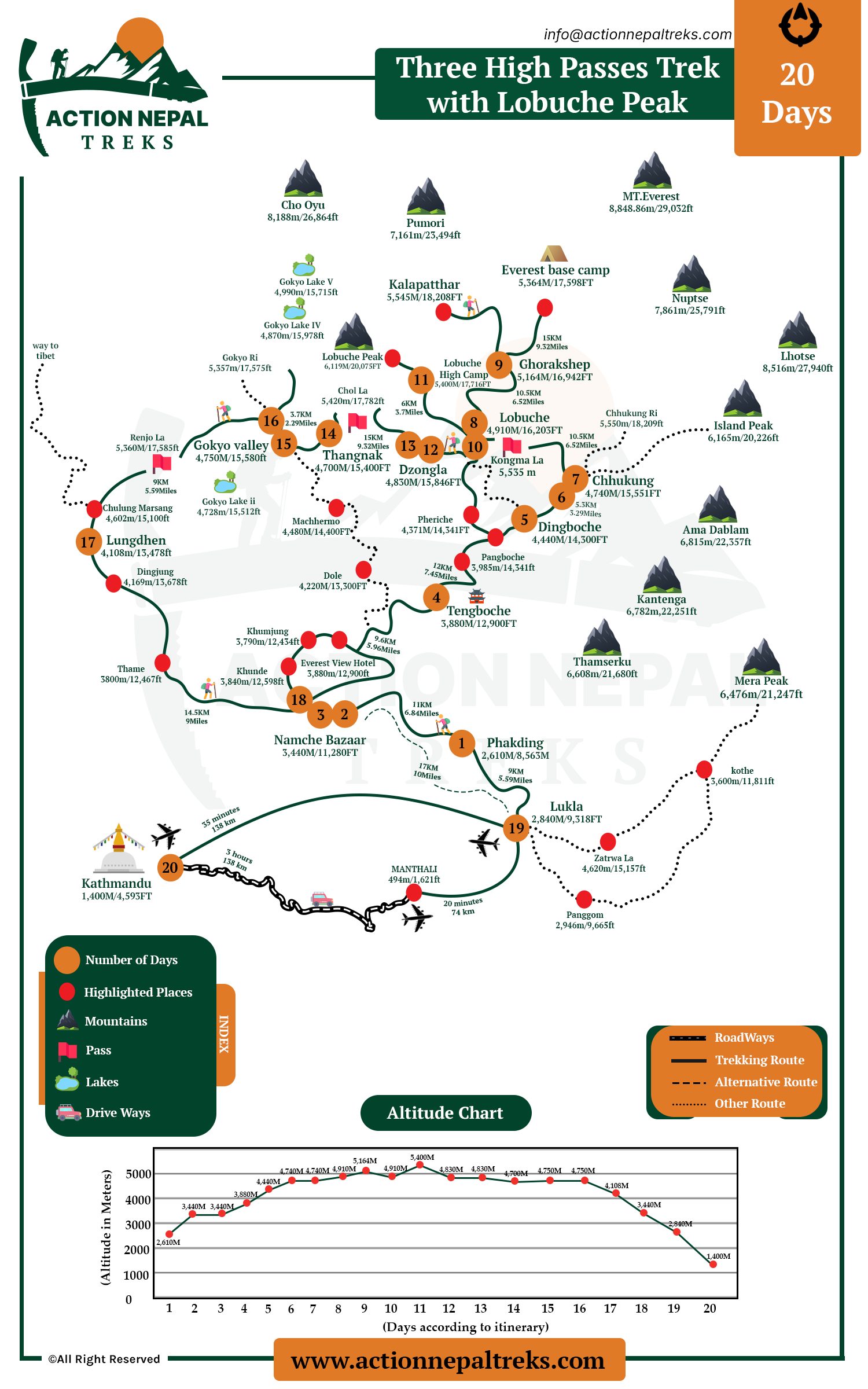
Three High Passes Trek with Lobuche Peak Climbing Itinerary

Day 1: Fly from Kathmandu to Lukla, trek to Phakding

The Everest Three Passes Trek with Lobuche Peak Climbing begins much like the classic Everest Base Camp trek, starting with a flight to Lukla. Here, you can take a short break and enjoy breakfast while the guide divides the gear loads among the porters. After that, the trek officially begins. You pass the Pasang Lhamu Memorial Gate before descending along stone-paved paths through the Dudh Koshi Valley. Then, you reach Chheplung and cross several suspension bridges decorated with colorful prayer flags.

Yak caravans and dzopkyos (yak-cattle hybrids) are common on this section of the trail. When they approach, step to the mountainside and let them pass for safety. A little later, you reach another village, Thado Koshi. From here, the route follows the Dudh Koshi River downstream before a short climb leads to the riverside village of Phakding. This is by far the gentlest day, helping your body settle into the trek before the steady ascent to Namche Bazaar.

Itinerary Details
Itinerary Fact Details
Meals Icon
Meals
Lunch, Dinner
Accommodation Icon
Accommodation
Teahouse
Distance Icon
Trek Distance
8km / 5miles
Mountain Icon
Highest Altitude
2,860m / 9,383ft
Duration Icon
Trek Duration
3hrs trekking and 35 min (Kathmandu–Lukla) flight

Day 2: Trek from Phakding to Namche Bazaar

The trail continues through pine forests and small Sherpa settlements, following the Dudh Koshi River. It leads you to Monjo, where your guide completes the formalities for entering Sagarmatha National Park. From here, the route crosses several suspension bridges before arriving at the famous Larja Dobhan, where you pass by the dramatic “Twin Bridges”. After crossing this high suspension bridge above the river gorge, the trail begins the long ascent to Namche Bazaar.

This section is often considered one of the most demanding parts of the lower Everest region. The climb features a series of steep switchbacks, so you need to maintain a slow, steady pace. About halfway up, you can take a short break at Top Danda viewpoint, where you might just get your first distant glimpse of Mount Everest, depending on how clear the day is. After 1 to 1.5 hours of uphill trekking, you finally arrive at Namche Bazaar.

Itinerary Details
Itinerary Fact Details
Meals Icon
Meals
Breakfast, Lunch, Dinner
Accommodation Icon
Accommodation
Teahouse
Distance Icon
Trek Distance
11km / 6.8miles
Mountain Icon
Highest Altitude
3,440m / 11,286ft
Duration Icon
Trek Duration
6hrs

Day 3: Acclimatization at Namche Bazaar, hike to Everest View Hotel and Khumjung Valley

Day 3 is dedicated to acclimatization, an important part of any high-altitude trek in the Everest region. While there is no long-distance trekking today, this is far from a rest day. After breakfast, you begin a steep climb above Namche Bazaar, passing the Syangboche airstrip on the way to the famous Everest View Hotel (3,880m). From its panoramic terrace, you can enjoy a hot drink while taking in stunning views of Everest, Lhotse, and Ama Dablam.

After that, you may trek back or continue towards the peaceful village of Khumjung. The latter option is best if you want to explore traditional stone houses, farming terraces, visit the Hillary School, and visit a historic monastery known for its reputed Yeti scalp. You return to sleep in Namche. This is an important mountaineering strategy: “climb high, sleep low,” which helps your body acclimate to the higher altitudes ahead.

Itinerary Details
Itinerary Fact Details
Meals Icon
Meals
Breakfast, Lunch, Dinner
Accommodation Icon
Accommodation
Teahouse
Distance Icon
Trek Distance
6km / 3.7miles
Mountain Icon
Highest Altitude
3,880m / 12,730ft
Duration Icon
Trek Duration
4hrs

Day 4: Trek from Namche Bazaar to Tengboche

Leaving Namche Bazaar behind, the trail follows a scenic ridgeline high above the Dudh Koshi River. This section offers you excellent views of Ama Dablam and the surrounding Himalayan peaks. The route is relatively gentle at first, then descends through rhododendron forests to Phunki Thenga, a small riverside settlement where most trekkers stop for lunch.

Then, you cross the river, after which the trail begins a long and steady climb to Tengboche. This uphill section can feel challenging as the altitude gradually increases, but the effort is rewarded upon reaching the ridge. Home to the region’s largest monastery, Tengboche offers spectacular views of Everest, Lhotse, Ama Dablam, and several other surrounding peaks. If time permits, you can also visit Tengboche Monastery and experience its peaceful atmosphere before settling in for the night.

Itinerary Details
Itinerary Fact Details
Meals Icon
Meals
Breakfast, Lunch, Dinner
Accommodation Icon
Accommodation
Teahouse
Distance Icon
Trek Distance
10km / 6.2miles
Mountain Icon
Highest Altitude
3,867m / 12,687ft
Duration Icon
Trek Duration
5hrs

Day 5: Trek from Tengboche to Dingboche

Continuing the trek, the trail descends through forests of birch and rhododendron before crossing the Imja Khola. From here, a gradual climb past several mani walls brings you to Pangboche, one of the oldest Sherpa settlements in the region. Beyond the village, the landscape changes noticeably as the tree line disappears and the trail enters the open alpine terrain of the upper Khumbu Valley.

The route continues through a broad, gravelly valley where strong afternoon winds are common. By midday, the sun can feel surprisingly intense at this altitude, even though temperatures remain cool. A neck gaiter or buff can be useful here, helping protect your throat from the dry air that often contributes to the well-known “Khumbu cough.” As the altitude increases, the pace naturally slows before a final climb leads to the day’s destination, Dingboche.

Itinerary Details
Itinerary Fact Details
Meals Icon
Meals
Breakfast, Lunch, Dinner
Accommodation Icon
Accommodation
Teahouse
Distance Icon
Trek Distance
12km / 7.4miles
Mountain Icon
Highest Altitude
4,410m / 14,468ft
Duration Icon
Trek Duration
5hrs to 6hrs

Day 6: Trek from Dingboche to Chhukung

Day 6 of the Everest Three High Pass Trek takes you deeper into the upper Imja Valley as you leave Dingboche behind and head toward Chhukung. With the tree line now far below, the trail crosses open alpine terrain alongside the lateral moraine of the Lhotse Glacier. Throughout the walk, you are surrounded by the towering faces of Lhotse, Nuptse, and other Himalayan peaks, giving you a clear sense of how remote and rugged this part of the Everest region is. As you approach 5,000m (16,400ft), the thinner air becomes increasingly noticeable, making a slow and steady pace essential.

The trail gradually leads to Chhukung, a small settlement tucked beneath some of the highest mountains in the Khumbu. Despite the relatively short distance, the altitude makes this an important day for acclimatization. After lunch, you can rest and enjoy the surrounding views while your guides help organize and inspect your climbing equipment, including your harness, crampons, and mountaineering boots, ensuring everything is ready for the high passes and the Lobuche Peak climb ahead.

Itinerary Details
Itinerary Fact Details
Meals Icon
Meals
Breakfast, Lunch, Dinner
Accommodation Icon
Accommodation
Teahouse
Distance Icon
Trek Distance
7km / 4.3miles
Mountain Icon
Highest Altitude
4,730m / 15,518ft
Duration Icon
Trek Duration
4hrs

Day 7: Acclimatization at Chhukung, hike to Chhukung Ri

This day is the second acclimatization day. It serves as an important preparation day before crossing the high passes and Lobuche Peak. You hike to Chhukung Ri (5,546m/ 18,195ft) to acclimatize and set your pacing at high altitude. The trail climbs steadily from Chhukung on a steep and rocky path. Use your trekking poles to maintain balance on loose sections. You’ll likely feel challenged as even a short climb feels demanding at this altitude. Keep the pace slow and steady.

The effort is rewarded at the summit with panoramic views of some of the highest peaks in the Himalayas, including Lhotse, Nuptse, Ama Dablam, Makalu, and Island Peak. From here, your guide can also point out Lobuche East Peak and explain the climbing route you will follow in the coming days. After spending time at the viewpoint, you descend carefully along the same trail and return to Chhukung, where you can rest, enjoy a warm meal, and continue preparing for the more challenging stages of the journey ahead.

Itinerary Details
Itinerary Fact Details
Meals Icon
Meals
Breakfast, Lunch, Dinner
Accommodation Icon
Accommodation
Teahouse
Distance Icon
Trek Distance
5km / 3.1miles
Mountain Icon
Highest Altitude
5,546m / 18,195ft
Duration Icon
Trek Duration
4hrs to 5hrs

Day 8: Cross Kongma La Pass, trek from Chhukung to Lobuche

This is the first high-pass crossing of the trek and one of the most demanding days so far. You leave Chhukung before sunrise and begin the climb towards Kongma La Pass (5,535m/ 18,159ft). The trail gains elevation steadily across a rugged alpine landscape, then gets steeper and rockier near the top. As the altitude increases, maintaining a slow and consistent pace becomes increasingly important. At the summit, you get impressive views of the surrounding Himalayan peaks, including Lhotse and Makalu.

After that, you make a steep descent, often on loose terrain, toward the Khumbu Glacier. This section requires careful footing, especially on rocky slopes and uneven ground. The route then crosses the glacier’s moraine, a constantly changing landscape of rock, dirt ridges, and glacial debris. You follow your guide’s instructions and navigate this challenging terrain. Then, a final climb brings you to Lobuche, a small settlement located beneath Lobuche Peaks (East and West) and the Khumbu Glacier.

Itinerary Details
Itinerary Fact Details
Meals Icon
Meals
Breakfast, Lunch, Dinner
Accommodation Icon
Accommodation
Teahouse
Distance Icon
Trek Distance
10km / 6.2miles
Mountain Icon
Highest Altitude
5,535m / 18,159ft
Duration Icon
Trek Duration
8hrs to 9hrs

Day 9: Trek from Lobuche to Gorakshep, visit Everest Base Camp

From Lobuche, the trail follows the edge of the Khumbu Glacier across a rugged landscape of rocky moraine and glacial debris. At this altitude, the thinner and drier air slows down your pace. After a few hours of trekking, you arrive at Gorakshep, the last settlement on the Everest Base Camp route. Here, you leave your heavier gear at the lodge, take a short break, and prepare for the final push to Everest Base Camp.

Beyond Gorakshep, the trail continues across uneven moraine ridges and rocky terrain alongside the Khumbu Glacier. Although the distance is relatively short, the altitude makes the walk more demanding than it appears. Reaching Everest Base Camp (5,364m/ 17,598ft) is a major milestone, rewarding you with close-up views of the Khumbu Icefall and the dramatic glacial landscape that marks the starting point of many Everest expeditions. After spending some time at Base Camp and taking photographs, you retrace your steps back to Gorakshep, where you will spend the night.

Itinerary Details
Itinerary Fact Details
Meals Icon
Meals
Breakfast, Lunch, Dinner
Accommodation Icon
Accommodation
Teahouse
Distance Icon
Trek Distance
13km / 8miles
Mountain Icon
Highest Altitude
5,364m / 17,598ft
Duration Icon
Trek Duration
7hrs to 8hrs

Day 10: Trek from Gorakshep to Lobuche after kalapthar view point.

Start early in the morning with a headlamp hike to Kala Patthar 5555m, the best viewpoint for breathtaking sunrise views over Mount Everest, the Khumbu Glacier, and the surrounding Himalayan peaks. After enjoying the spectacular panorama, descend to Gorak Shep for breakfast, then trek back to Lobuche for an overnight stay.

After consecutive days of grueling mileage above 5,000m (16,400ft), today is designed as a short, low-impact transition day to let your muscles recover. You drop down the trail from Gorakshep, retracing your steps along the lateral moraine of the Khumbu Glacier. Lower altitude provides a welcome relief for your lungs and heart, making your morning walk feel much easier than in previous days.

You arrive in Lobuche by lunchtime. The entire afternoon is completely free for resting and physical recovery. This extended downtime is vital, as your climbing team uses the afternoon to run a comprehensive safety briefing. You inspect your climbing harnesses, test your automatic crampons on your mountaineering boots, and practice jumar techniques to make sure you are fully prepared for the upcoming technical climb.

Itinerary Details
Itinerary Fact Details
Meals Icon
Meals
Breakfast, Lunch, Dinner
Accommodation Icon
Accommodation
Teahouse
Distance Icon
Trek Distance
5km / 3.1miles
Mountain Icon
Highest Altitude
5,164m / 16,942ft
Duration Icon
Trek Duration
3hrs

Day 11: Trek from Lobuche to Lobuche High Camp

Leaving the main Everest Base Camp trail behind, you follow a rugged path toward the base of Lobuche East. As the altitude increases, the terrain gradually changes from alpine meadows to a harsher landscape of rocky slopes, loose scree, and large boulders. The final section to High Camp involves a steady climb across granite slabs and uneven ground, making careful footing and a slow pace important throughout the ascent.

Lobuche High Camp is a small campsite set on a rocky mountainside near the glacier, offering spectacular views of the surrounding peaks. By the time you arrive, the climbing crew will have already prepared the camp and tents. After an early dinner, your guide will conduct a final equipment check and review the plan for summit day. The rest of the evening is spent organizing your climbing gear and resting before the overnight summit push begins in the early hours of the morning.

Itinerary Details
Itinerary Fact Details
Meals Icon
Meals
Breakfast, Lunch, Dinner
Accommodation Icon
Accommodation
Tent
Distance Icon
Trek Distance
6km / 3.7miles
Mountain Icon
Highest Altitude
5,400m / 17,716ft
Duration Icon
Trek Duration
4hrs

Day 12: Summit Lobuche East, descend to Dzongla

Summit day begins well before sunrise as you leave High Camp and climb through the darkness with the guidance of your climbing Sherpa. The initial section follows a rocky ridge and scramble terrain before reaching Crampon Point, where you put on your crampons, rope up, and prepare for the climb ahead. From here, the route transitions onto snow and ice slopes, and you use fixed ropes and a jumar to ascend the mountain safely. At this altitude, the thin air makes every step feel more demanding, requiring a slow and steady pace throughout the climb.

Reaching the summit of Lobuche East Peak (6,119m/ 20,075ft) rewards your effort with unique panoramic views of Everest, Lhotse, Makalu, Ama Dablam, and many other Himalayan peaks. After spending some time at the top, you descend carefully along the same route, using the fixed lines wherever necessary. Once back at High Camp, you pack up your gear and continue down to Dzongla. With this, Lobuche East Peak Climbing comes to an end. It’s a long but rewarding day in the mountains.

Itinerary Details
Itinerary Fact Details
Meals Icon
Meals
Breakfast, Lunch, Dinner
Accommodation Icon
Accommodation
Teahouse
Distance Icon
Trek Distance
12km / 7.4miles
Mountain Icon
Highest Altitude
6,119m / 20,075ft
Duration Icon
Trek Duration
9hrs to 11hrs

Day 13: Rest day at Dzongla

After the challenges of Lobuche Peak summit day, this day offers a well-earned rest and recovery day in Dzongla. Surrounded by rugged mountain scenery and located beneath the impressive walls of Cholatse, the village provides a quiet setting to recover from the physical demands of the climb. With no major trekking planned, you can sleep in, rehydrate, and give your body time to recover before continuing the three passes route.

The day can be spent relaxing at the lodge, organizing your gear, and checking your equipment with your guide if needed. You may also take short walks around the area to stay active without putting additional strain on your body. This recovery day helps restore energy levels and prepares you for the crossing of the challenging Cho La pass.

Itinerary Details
Itinerary Fact Details
Meals Icon
Meals
Breakfast, Lunch, Dinner
Accommodation Icon
Accommodation
Teahouse
Mountain Icon
Highest Altitude
4,830m / 15,846ft

Day 14: Cross Cho La Pass, trek from Dzongla to Thangnak

After a recovery day in Dzongla, it is time to tackle Cho La Pass (5,420m/ 17,782ft), the second high pass of the expedition. You leave before sunrise and follow a trail that climbs steadily toward the pass. Higher up, the terrain becomes steeper and rockier, with sections of snow and ice near the summit. Depending on the conditions, you may need microspikes or crampons for added traction. As with all high-altitude crossings, a slow and steady pace is essential.

Prayer flags mark the summit of Cho La Pass and signal the end of the climb. After a short break to enjoy the mountain views, you begin the descent toward Thangnak. The western side of the pass is steeper and more rugged, so careful footing is important. Once you pass the rocky section, the trail becomes easier and crosses alpine landscapes. Then, you reach the small settlement of Thangnak, where you will spend the night.

Itinerary Details
Itinerary Fact Details
Meals Icon
Meals
Breakfast, Lunch, Dinner
Accommodation Icon
Accommodation
Teahouse
Distance Icon
Trek Distance
8km / 5miles
Mountain Icon
Highest Altitude
5,420m / 17,782ft
Duration Icon
Trek Duration
7hrs to 8hrs

Day 15: Trek from Thangnak to Gokyo

Today, you cross the Ngozumpa Glacier, the longest glacier in the Himalayas. Although the distance is relatively short, the route winds through a rugged landscape of rocky moraine, sandy hollows, and uneven trails shaped by the glacier below. As conditions on the glacier can change over time, you need to step carefully and take close guidance from your trekking guide.

The terrain gradually changes as you approach the western side of the glacier. Soon, the turquoise waters of Dudh Pokhari, the third Gokyo Lake, come into view, with the small village of Gokyo resting along its shores. Arriving in the early afternoon gives you time to relax, explore the lakeside surroundings, and prepare for the sunrise hike to Gokyo Ri the following morning.

Itinerary Details
Itinerary Fact Details
Meals Icon
Meals
Breakfast, Lunch, Dinner
Accommodation Icon
Accommodation
Teahouse
Distance Icon
Trek Distance
5km / 3.1miles
Mountain Icon
Highest Altitude
4,790m / 15,715ft
Duration Icon
Trek Duration
4hrs

Day 16: Explore Gokyo Ri and Fifth Lake

Day 16 begins with an early morning hike to Gokyo Ri (5,357m/ 17,575ft), one of the most rewarding viewpoints in the Everest region. You start before sunrise along a steep trail that climbs directly above Gokyo village. The ascent can feel demanding at this altitude, but the summit rewards you with views of three eight-thousanders: Everest, Lhotse, Cho Oyu, and the surrounding Himalayan peaks. From here, you can also look down on three turquoise Gokyo Lakes: 1st (Longpanga Tsho), 2nd (Taujung Tsho), and 3rd (Gokyo Cho/Dudh Pokhari, where the village sits), and the vast Ngozumpa Glacier below.

Then, you return to Gokyo for breakfast and lunch to refuel your energy before exploring further up the valley toward the Fifth Lake (Ngozumpa Tsho). The trail follows a quieter route along the edge of the Ngozumpa Glacier, away from the busier trekking paths. From the lake, you can enjoy beautiful views of Everest and the upper Khumbu region. Once you have spent enough time, you return to Gokyo for the night and prepare for the final high-pass crossing of the trek.

Itinerary Details
Itinerary Fact Details
Meals Icon
Meals
Breakfast, Lunch, Dinner
Accommodation Icon
Accommodation
Teahouse
Distance Icon
Trek Distance
11km / 6.8miles
Mountain Icon
Highest Altitude
5,357m / 17,575ft
Duration Icon
Trek Duration
5hrs to 6hrs

Day 17: Cross Renjo La Pass, trek from Gokyo to Lungden

Renjo La Pass (5,360m/ 17,585ft) marks the third and final high-pass crossing of the trek. You leave Gokyo early in the morning, following a trail that climbs steadily above the lakes. The ascent becomes steeper as you gain elevation. Some sections are rocky, and some have occasional icy patches that require careful footing and a slow, steady pace. Up at the summit, you are rewarded with one of the finest viewpoints in the Everest region. It overlooks the Gokyo Lakes, the Ngozumpa Glacier, and the surrounding Himalayan peaks.

The descent on the western side begins on steep terrain before transitioning to a series of switchbacks that lead into a quieter valley. As you lose elevation, the landscape gradually changes, and the trail becomes less demanding. Along the way, you may pass traditional yak shelters and small seasonal grazing areas. Eventually, you arrive at the peaceful village of Lungden. Here, you feel noticeably more comfortable as the altitude drops.

Itinerary Details
Itinerary Fact Details
Meals Icon
Meals
Breakfast, Lunch, Dinner
Accommodation Icon
Accommodation
Teahouse
Distance Icon
Trek Distance
12km / 7.4miles
Mountain Icon
Highest Altitude
5,360m / 17,585ft
Duration Icon
Trek Duration
7hrs to 8hrs

Day 18: Trek from Lungden to Namche Bazaar

Today’s trek brings you back toward the lower Khumbu Valley. It starts with a steady descent that feels noticeably easier after several days at high altitude. You follow the Bhote Koshi River downstream and pass through traditional Sherpa villages such as Marlung and Thame. These villages offer a glimpse into a quieter side of the Everest region. If time permits, you can also visit Thame Monastery, one of the oldest and most important monasteries in the Khumbu.

Beyond Thame, the route continues through forests of pine, juniper, and rhododendron as you gradually lose elevation. The thicker vegetation and lower altitude provide a welcome contrast to the rugged alpine landscapes of the previous days. Near the day’s end, you pass several suspension bridges that lead you to the main trekking route. Your stop for the day is Namche Bazaar, where a comfortable lodge, warm meal, and well-earned rest await.

Itinerary Details
Itinerary Fact Details
Meals Icon
Meals
Breakfast, Lunch, Dinner
Accommodation Icon
Accommodation
Teahouse
Distance Icon
Trek Distance
16km / 9.9miles
Mountain Icon
Highest Altitude
4,368m / 14,330ft
Duration Icon
Trek Duration
6hrs to 7hrs

Day 19: Trek from Namche Bazaar to Lukla

This is the final trekking day of your Everest Three High Passes Trek with Lobuche Peak Climbing adventure. After days spent above 5,000m (16,400ft) and crossing some of the highest trails in the Khumbu, today’s walk offers a gradual return to the lower valleys. As you lose elevation, the air becomes noticeably richer in oxygen. The journey feels more comfortable.

While the route still includes a few uphill sections, the day is largely about reflecting on everything you have experienced over the past few weeks. The final climb to Lukla marks the last challenge of the trek before you arrive back where the journey began. With the mountains behind you and the trek complete, the evening is a chance to celebrate your achievement with your guides and porters and enjoy one final night in the Everest region.

Itinerary Details
Itinerary Fact Details
Meals Icon
Meals
Breakfast, Lunch, Dinner
Accommodation Icon
Accommodation
Teahouse
Distance Icon
Trek Distance
19km / 11.8miles
Mountain Icon
Highest Altitude
3,440m / 11,286ft
Duration Icon
Trek Duration
7hrs to 8hrs

Day 20: Fly from Lukla to Kathmandu

An early morning flight takes you from Lukla back to Kathmandu, bringing your high-altitude adventure to a close. After arriving in the capital, you will be transferred to your hotel, where the comforts of city life await after weeks spent on remote mountain trails.

With no scheduled activities planned, the rest of the day is yours to enjoy. You can choose to savor one last dal bhat, treat yourself to a favorite meal you’ve been craving, explore the lively streets of Thamel, or simply relax and enjoy a hot shower and a comfortable bed. Whatever you decide, it is a chance to unwind and celebrate the completion of an unforgettable journey through the Everest region.

Itinerary Details
Itinerary Fact Details
Meals Icon
Meals
Breakfast
Accommodation Icon
Accommodation
Hotel
Mountain Icon
Highest Altitude
2,860m / 9,383ft
Duration Icon
Trek Duration
35mins Flight

Trip Includes/Excludes

Includes

Excludes

  • Private airport pick-up and drop-off service between Kathmandu airports and your hotel.
  • Domestic round-trip flight tickets: Kathmandu – Lukla – Kathmandu (Manthali transfer included if required).
  • Experienced government-licensed trekking guide with all expenses covered.
  • One porter for every two trekkers with all expenses covered (10 kg luggage per trekker).
  • Assistant guide for groups of more than six clients.
  • For solo trekkers, porter service is not included in the package cost. porter service can be arranged  at an additional charge.
  • Three meals daily (Breakfast, Lunch, Dinner) during the trek. main course included during the trek.
  • Total 19 nights twin-sharing accommodation during the trek.
  • Fresh seasonal fruits after dinner and daily light snacks.
  • All local entrance fees and trekking permits:
    • Lobuche Peak climbing permit.
    • Sagarmatha National park fee.
    • Khumbu Pasang Lhamu rural municipality permit fee
    • TIMS Card
  • Water purification tablets.
  • Complimentary use of sleeping bag, down jacket, and duffel bag, crampons and trekking poles (if needed).  Must be returned after the trek.
  • First aid kit and emergency rescue assistance.
  • All government taxes included.
  • Trip Completion Certificate from Action Nepal Treks.
  • Farewell dinner after the trip.

Climbing Services & Expedition Support

  • Professional Climbing Guide: Experienced and licensed climbing guide with all expenses included (salary, meals, accommodation, insurance, transportation, and climbing logistics).
    • 1–4 climbers: 1 Climbing Guide
    • 5–10 climbers: 2 Climbing Guides
  • Assistant Cook & Support Staff: Dedicated trekking assistant cook and necessary kitchen support staff based on group size. The team will transport camping equipment and tents at Lobuche peak Base Camp.
  • Camping Kitchen Equipment: Complete camping kitchen setup including EPI gas, gas stove or fuel stove, fuel/kerosene, cooking utensils, cooking pots, kitchen equipment, mattresses, and walkie-talkie communication equipment for climbing operations.
  • Staff Salary & Allowances: All staff and porters are fully covered with daily wages, meals, accommodation, equipment, transportation, and clothing allowances throughout the expedition.
  • High Altitude Camping Equipment: High-quality expedition tents including:
    • North Face Dome Tent (shared by two climbers)
    • Dining tent and kitchen tent for comfortable high-altitude camp service
  • Base Camp Accommodation & Meals: Full Base Camp lodging and food service for climbers and expedition staff, including:
    • Three meals daily (Breakfast, Lunch, and Dinner)
    • Chocolates and energy snacks during the climbing period
  • Drinks & Beverages During Climbing:
    • Tea and biscuits
    • Hot drinking water throughout the climbing period
    • Hot washing water when required
  • Group Climbing Equipment: Shared mountaineering equipment required for summit operations, including:
    • Fixed ropes
    • Main climbing ropes
    • Snow bars
    • Ice screws
    • Rock pitons
    • Route fixing and safety equipment
  • International flight tickets.
  • Nepal entry visa fee.
  • All accommodation and meals in Kathmandu, including extra hotel nights caused by early arrival, early return from the trek/climb, or delayed departure.
  • Personal expenses such as hot showers, Wi-Fi, battery charging, hot & cold drinks, alcoholic beverages, extra porter service, horse riding, shopping, snacks, personal clothing, and trekking gear.
  • Travel insurance (strongly recommended and must include emergency evacuation and rescue coverage).
  • Personal climbing equipment and technical gear, including:

    • Climbing boots
    • Crampons
    • Ice axe / ice hammer
    • Harness
    • Jumars
    • Karabiners
    • Figure 8 / ATC guide
    • Tape sling
    • Other personal climbing accessories

    Equipment rental is available at Chhukung (approx. USD 100–150 per person).

  • Additional climbing equipment available for hire at chhukung (if required):
    Oxygen cylinder & regulator, gloves, sunglasses, trekking poles, helmet, thermos, hot bag, water bottle, ski equipment, sleeping bag, clothing (waterproof jacket & trousers, down jacket, socks), walkie-talkie, Thuraya satellite phone, and other expedition equipment.
  • Tips for trek guides, climbing guides, and support staff (highly appreciated).

Trip Route Map

Explore the Trek Route in Google Satellite View for Better Clarity.

Trail
Return Trail

Why Combining the Three High Passes Trek with Lobuche Peak Is Better Than Doing Them Separately

For trekkers with enough time and a reasonable level of fitness, combining the Three High Passes with the Lobuche Peak climb is usually more practical than booking two separate trips. This single itinerary improves acclimatization, reduces duplicate expenses, and covers more of the Everest region in one continuous journey.

Better Acclimatization and Higher Summit Success

The Three High Passes route repeatedly takes you above 5,000m (16,400ft) before the Lobuche East summit push. By the time you reach the climbing phase, your body has already adapted to high altitude. This supports safer and more efficient summit attempts.

Lower Costs and Simpler Logistics

Separate trips mean paying twice for Lukla flights, permits, guides, and support logistics. Combining both reduces repetition in costs and keeps everything under one organized setup.

More Complete Route Coverage

A combined itinerary includes a journey inside the entire Everest region treks: Everest Base Camp, the Gokyo Lakes, Thame Valley villages, and Tengboche Monastery, along with the Lobuche East climb, without needing a second trip to the region.

Thus, this combined approach is more efficient, cost-effective, and complete for most trekkers and aspiring climbers.

How Difficult Is the Three High Passes Trek with Lobuche Peak Climbing?

The Three High Passes Trek with Lobuche Peak Climbing is considered a challenging high-altitude expedition. It combines Nepal’s most demanding trekking circuit with the ascent of Lobuche East, a trekking peak that requires basic mountaineering skills. The main challenges come from the high altitude, consecutive days of strenuous hiking, and the technical summit climb rather than from extreme exposure on the trekking route itself.

During this journey, you will spend more than two weeks above 4,000m (13,123ft), cross three high mountain passes above 5,300m, and sleep at elevations where the thin air makes even simple activities feel demanding. Good physical fitness, mental resilience, and proper acclimatization are essential for completing the expedition safely.

Trekking Difficulty vs Climbing Difficulty

Trekking Difficulty (Strenuous): The trekking sections across Kongma La (5,535m/ 18,159ft), Cho La (5,420m/ 17,782ft), and Renjo La (5,360m/ 17,585ft) require strong endurance but no technical climbing skills or experience. Most days involve 5 to 8 hours of walking over steep trails, rocky moraines, and loose scree. There may be occasional snow or icy sections, depending on the season. The biggest challenge during trekking is maintaining a steady pace at high altitude while recovering from several consecutive days of strenuous trekking.

Climbing Difficulty (Moderately Technical): The ascent of Lobuche East Peak transforms the adventure from a trekking expedition into a mountaineering experience. The summit route involves glacier travel, steep snow, and ice slopes. You need to use basic climbing equipment such as crampons, an ice axe, a harness, and fixed ropes. You should also be comfortable using a jumar (ascender) on fixed lines and descending with a belay or rappel device. The climb is achievable for fit trekkers, but it demands strong determination, coordination, and confidence on steep terrain.

Is the Three High Passes Trek with Lobuche Peak Climbing Suitable For You?

This expedition is strictly designed for physically elite trekkers and aspiring mountaineers who possess a high level of cardiovascular fitness. You should be comfortable walking for several consecutive days in mountain terrain, crossing passes above 5,000m (16,400ft), and dealing with cold temperatures and basic teahouse accommodation. The itinerary also includes a night at Lobuche High Camp, where you will sleep in a tent before the summit push.

Previous high-altitude trekking experience is highly recommended. It helps you better understand how your body responds to thinner air and demanding conditions. Technical climbing experience, however, is helpful but not essential. Your climbing guides will provide training on the use of crampons, fixed ropes, jumars, and other basic mountaineering equipment before the summit attempt. Hence, this expedition is a suitable next step for trekkers looking to progress into Himalayan peak climbing.

Summit Success Rate and What Determines Success

Lobuche East generally records summit success rates of around 65% to 75% on standard climbing itineraries. Combined itineraries that include the Three High Passes Trek often enjoy higher success rates because climbers spend more time acclimatizing before the summit push.

Several factors play a major role in determining success:

  • Acclimatization: Spending more than a week trekking above 4,000m and crossing high passes before the climb allows the body to adapt gradually to the altitude. Better acclimatization often translates into stronger performance and a lower risk of altitude-related problems.
  • Physical Fitness: The expedition involves long trekking days and continuous elevation gain. Climbers who pace themselves well and conserve energy throughout the trek are usually better prepared for the demanding summit day.
  • Weather Conditions: Strong winds, fresh snowfall, and poor visibility can force teams to turn around regardless of their fitness or experience. Spring generally offers the most stable climbing conditions, while late autumn can bring colder temperatures and early winter storms.
  • Technical Skills and Confidence: Lobuche East requires the use of crampons, fixed ropes, and basic mountaineering equipment. Prior climbing experience is helpful, but strong fitness, a calm mindset, and proper pre-climb training are often the biggest contributors to a successful summit.

While no summit is guaranteed, combining the Three High Passes Trek with Lobuche East provides one of the best acclimatization profiles in the Everest region. This trek offers well-prepared trekkers an excellent chance of reaching the summit.

Which Is More Practical: Combining the Three High Passes Trek with Lobuche Peak or Doing Separate Trips?

For most trekkers and aspiring climbers, combining the Three High Passes Trek with Lobuche East is the more practical option. A single itinerary provides better acclimatization, reduces duplicate costs and logistics, and allows you to experience Everest Base Camp, the Gokyo Lakes, three high passes, and a 6,000m summit in one journey.

Who Is the Three High Passes Trek Best For?

The Three High Passes Trek is best suited for experienced trekkers looking for a demanding high-altitude adventure in the Everest region. It appeals to those who enjoy long trekking days, remote mountain landscapes, and the challenge of crossing multiple passes above 5,000m (16,400ft). If your goal is to explore beyond the classic Everest Base Camp route and experience areas such as Gokyo, Thame, and the high passes, this trek is the best option.

Who Is Lobuche Peak Best For?

Lobuche East is ideal for trekkers who want to take their first step into Himalayan mountaineering. The climb introduces the use of crampons, fixed ropes, jumars, and other basic climbing techniques while providing the opportunity to stand on a 6,000-meter summit. Previous technical climbing experience is helpful but not essential when climbing with qualified guides.

Who Should Combine the Three High Passes Trek with Lobuche Peak?

This combined itinerary is best suited for strong trekkers who want both a challenging trekking experience and a Himalayan peak climb in a single journey. The route provides excellent acclimatization before the summit attempt while allowing you to experience many of the Everest region’s major highlights, including Everest Base Camp, the Gokyo Lakes, three high passes, and Lobuche East. For trekkers interested in progressing toward more advanced mountaineering objectives in the future, it also serves as valuable high-altitude experience.

Common Reasons Climbers Fail To Complete The Trek

Although many trekkers successfully complete the Three High Passes Trek with Lobuche Peak Climbing, some are forced to turn back due to a few common challenges.

Poor Acclimatization

Altitude is the biggest reason climbers fail to complete the expedition. Spending long periods above 4,000m significantly reduces oxygen availability. You should never ignore symptoms such as persistent headaches, nausea, dizziness, and extreme fatigue. Altitude sickness not treated in time can progress into life-threatening conditions such as HAPE (High-Altitude Pulmonary Edema) and HACE (High-Altitude Cerebral Edema) that require immediate descent or evacuation.

Inadequate Physical Preparation

This itinerary demands strong stamina and endurance. You walk 5 to 8 hours a day for nearly three weeks, often on steep and uneven terrain. This alone can quickly drain energy levels. Trekkers who arrive without sufficient cardiovascular fitness or leg strength often struggle during the high passes and summit push, sometimes even causing failed attempts.

Weather and Route Conditions

The weather in the Himalayas is always unpredictable. There may be sudden snowfall, strong winds, and poor visibility that can disrupt the itinerary at any time. Unfavorable conditions may make the passes more challenging or force climbing teams to postpone or cancel their summit attempt.

Rushing the Itinerary

Many climbers underestimate the importance of acclimatization days. They shorten the itinerary to save time. But this only increases the risk of altitude-related problems and leaves little room for recovery before the most demanding sections of the expedition. Thus, they end up getting sick and having to skip the climb to Lobuche Peak.

Required Permits for the Three High Passes Trek with Lobuche Peak

To complete the Three High Passes Trek with the Lobuche Peak Climbing legally, you need three permits: Khumbu Pasang Lhamu Rural Municipality Permit, Sagarmatha National Park Entry Permit, and the Lobuche Peak Climbing Permit. A TIMS card is currently not required for the Everest region.

Khumbu Pasang Lhamu Rural Municipality Permit

This local permit replaced the TIMS card in the Everest region. The fees collected help support trail maintenance, waste management, community health posts, and other local projects throughout the Khumbu. The permit can be obtained in Lukla or at the Monjo checkpoint, and you will need your passport when applying.

Category Cost per person
Foreign Nationals NRs. 3,000 (~USD 20)
SAARC Nationals NRs. 1,500 (~USD 13)

Sagarmatha National Park Entry Permit

This permit grants access to Sagarmatha National Park, which covers Everest Base Camp, the Three High Passes route, Gokyo Valley, and Lobuche East. It can be obtained either from the Nepal Tourism Board in Kathmandu or at the Monjo entrance gate. You will need your passport to purchase the permit.

Category Cost per person
Foreign Nationals NRs. 3,000 (~USD 20)
SAARC Nationals NRs. 1,500 (~USD 13)

Lobuche East Climbing Permit

This permit allows you to climb Lobuche Peak (East, 6,119m / 20,075ft). It is issued by the Nepal Mountaineering Association (NMA). Unlike trekking permits, this permit cannot be obtained independently. It must be arranged through a registered trekking agency. A licensed climbing guide is also mandatory for the climb.

Season Permit Fee per person
Spring (March-May) USD 350
Autumn (September-November) USD 175
Winter (December-February) USD 175
Summer / Monsoon (June-August) USD 175

Good to know: If you book with Action Nepal Treks, we arrange all required permits before the expedition begins, so you do not need to worry about the application process.

Best Time to Combine the Three High Passes Trek with Lobuche Peak

The best time to attempt this journey is during the spring and autumn climbing seasons. This expedition crosses three 5,000m (16,400ft) passes and includes a 6,119m/ 20,075ft summit. Choosing the right season is essential for both safety and summit success.

Spring Climbing Season

Spring is widely regarded as the best season for Lobuche East. Temperatures are relatively mild, the winter snowpack becomes more stable, and climbing conditions are generally ideal. The lower valleys also come alive with blooming rhododendron forests, while the Everest region is buzzing with activity as major expeditions prepare for the climbing season.

Autumn Climbing Season

Autumn offers crisp weather, dry trails, and some of the clearest mountain views of the year. Conditions are generally stable, although temperatures become progressively colder as winter approaches. The trails are often less crowded than in spring, making this season a favorite among trekkers seeking a quieter experience.

Why Monsoon and Winter Are More Challenging

The monsoon season (June to August) brings heavy rain, landslides, poor visibility, and frequent flight disruptions, making both trekking and climbing considerably more difficult. Meanwhile, winter (December to February) brings extreme cold, strong winds, and deep snow that can close high passes and complicate summit attempts.

For the highest chances of completing both the Three High Passes Trek and the Lobuche East climb, plan your expedition during the spring or autumn seasons, when weather and route conditions are generally at their most favorable.

Preparation for Three High Passes Trek with Lobuche Peak Climbing

We take care of the permits, logistics, guides, accommodation, and climbing arrangements throughout the expedition. Your main responsibility is to arrive physically prepared, ready to learn basic climbing techniques, and equipped with the right insurance and health precautions.

Build Trekking Endurance

  • Train for at least 3 to 6 months before departure.
  • Focus on hiking, running, cycling, stair climbing, or other endurance activities.
  • Include leg and core strength exercises in your routine.
  • Practice carrying a daypack on long walks or hikes whenever possible.

Learn Basic Mountaineering Skills

  • Familiarize yourself with equipment such as crampons, harnesses, jumars, and fixed ropes.
  • If possible, gain experience walking on steep, rocky, or uneven terrain.
  • Pay close attention during the climbing training provided by your guides before the summit attempt.

Sort Out Insurance and Health Requirements

  • Purchase travel insurance that covers high-altitude trekking, peak climbing, and emergency helicopter evacuation.
  • Consult your doctor about altitude-related medications and your suitability for high-altitude travel.
  • Carry any personal medications you may need during the expedition.
  • Inform your guide of any relevant medical conditions before the trek begins.

Acclimatization Strategy for Three High Passes with Lobuche Peak Climbing

Our itinerary is designed to help you adjust gradually to the increasing altitude before crossing the Three High Passes and attempting Lobuche East (6,119m/ 20,075ft). During the early stages of the trek, we follow a steady pace and include acclimatization hikes around Namche Bazaar, allowing your body time to adapt before moving higher into the Khumbu.

As we enter higher-altitude areas such as Chhukung and Dzongla, acclimatization becomes even more important. To support this process, our itinerary follows several proven strategies:

  • Climb high, sleep low: We include acclimatization hikes such as Chhukung Ri (5,546m/ 18,195ft). You gain elevation during the day before returning to a lower altitude to sleep.
  • Carefully planned elevation progression: The itinerary is structured to avoid unnecessary altitude-related risks and provide adequate time for adjustment.
  • Hydration and recovery: We encourage regular hydration, proper nutrition, and adequate rest throughout the expedition.
  • Medication support: If recommended by your doctor, medications such as Diamox (Acetazolamide) may be used to assist acclimatization.

Altitude Sickness Risk and How Climbers Handle It

Even with a well-planned itinerary, altitude sickness remains one of the main challenges of high-altitude trekking and climbing. So, our guides are trained to recognize the early signs of Acute Mountain Sickness (AMS) and monitor your condition throughout the journey.

They conduct regular health checks, monitor symptoms, and adjust plans when necessary. If a participant develops serious altitude-related symptoms, our priority is always safety. This may involve additional rest, descending to a lower altitude, or arranging emergency evacuation when required. By following a conservative acclimatization schedule and maintaining close guide support, we aim to maximize both safety and summit success.


Accommodation and Food on High Passes and Peak Route

For most of the journey, you’ll stay in family-run teahouses that are usually 4 to 6 hours apart. They are simple but comfortable and offer everything you need after a long day on the trail. However, there are no permanent lodges on the high passes or at Lobuche High Camp, where you’ll spend the night in tents.

What to Expect in Teahouses

  • Room: Twin-sharing rooms with wooden beds, thin mattresses, pillows, and blankets. Bedrooms are unheated, so a warm sleeping bag is essential.
  • Toilet: Western-style toilets are common in lower villages. Shared squat toilets become more common at higher elevations.
  • Heating: Only the dining room is usually heated. It is typically heated because of a yak-dung stove in the evenings.
  • Charging: Most teahouses offer paid charging for phones and cameras, but electricity can be unreliable. You need to bring a power bank.

Food and Drinks on the Trail

The food along the route is simple, hearty, and designed to provide plenty of energy for long trekking days. Menus become more limited as you gain altitude, but you’ll still find a good variety of meals.

  • Breakfast: Porridge, eggs, pancakes, Tibetan bread (tingmo or fried bread), chapati, muesli, and toast with jam or honey.
  • Lunch & Dinner: Dal Bhat, fried rice, Chowmein, momos, pasta, Thukpa (Tibetan noodle soup), Thenthuk (hand-pulled noodle soup), and Syakpa (Sherpa stew). Dal Bhat is the most popular choice among trekkers because it is filling, nutritious, and often comes with free refills.
  • Drinks: Milk tea, black tea, lemon-ginger-honey tea, hot chocolate, coffee, and butter tea (Su Cha), a traditional Tibetan drink made with tea, yak butter, and salt.

Tip: Above Namche Bazaar, stick to vegetarian meals, as fresh meat may not always be stored under ideal conditions. Also, drink only boiled or treated water to reduce the risk of stomach problems during the trek.

Why Book the Three High Passes Trek with Lobuche Peak Climbing with Action Nepal Treks?

We specialize in challenging high-altitude adventures and combine experienced local leadership with carefully planned logistics to help you get the most out of this demanding high altitude adventure.

  • Experienced trekking and climbing team: Licensed trekking guides and experienced climbing Sherpas lead the expedition, manage the technical aspects of the Lobuche East ascent, and provide support throughout the trip.
  • Well-planned acclimatization schedule: Acclimatization days in Namche Bazaar and Chhukung help your body adjust gradually to the altitude before crossing the high passes and attempting the summit.
  • Pre-climb training: Practical training before the summit attempt covers the use of crampons, harnesses, fixed ropes, jumars, and other essential mountaineering equipment.
  • Small group experience: Small group sizes allow for more personalized support, better acclimatization monitoring, and greater flexibility throughout the journey.
  • Local expertise and ground support: Extensive knowledge of the Everest region enables quick responses to changing mountain conditions and reliable support throughout the expedition.
  • Comprehensive logistical support: Permits, accommodation, camping arrangements, and climbing equipment are managed in advance, allowing you to focus on the trek and climb.

Dates & Prices

Our fixed departure dates and per-person pricing make it simple for both solo travelers and small groups to join the adventure. It’s a great chance to meet new people and share the experience with other trekkers. Just choose your preferred date, and we’ll take care of the rest.

Packing Essential For Three High Passes Trek with Lobuche Peak Climbing

Clothing
boot
sleeping bag
trekking Gear
first-aid

Clothing

  • 3 synthetic or merino wool t-shirts
  • 2 long-sleeve thermal base layer tops
  • 1 mid-weight fleece jacket
  • 1 lightweight down or synthetic jacket
  • 1 heavy 800+ fill down parka with hood
  • 1 waterproof hardshell jacket
  • 3 moisture-wicking athletic boxers or underwear
  • 2 long underwear or thermal bottoms
  • 2 durable, quick-dry trekking pants
  • 1 waterproof hardshell pants
  • 1 pair insulated or down pants

Footwear

  • 1 pair of waterproof trekking boots
  • 1 pair insulated double mountaineering boots
  • 1 pair of camp shoes or down booties
  • 4-5 pairs of synthetic or merino wool trekking socks
  • 2 pairs thick thermal summit socks
  • 1 pair waterproof trekking gaiters

Backpack and Sleeping Gear

  • 1 waterproof duffle bag, 90L to 120L capacity
  • 1 technical daypack, 35L to 45L capacity
  • 1 down sleeping bag comfort-rated to -15°C or -20°C
  • 1 inflatable insulated sleeping pad
  • 1 pair of adjustable trekking poles

Mountaineering Hardware

  • 1 fully adjustable alpine climbing harness
  • 1 set 12-point steel automatic or semi-automatic crampons
  • 1 straight-shaft alpine ice axe with leash
  • 1 mechanical Jumar ascender with safety locking carabiner
  • 1 Figure-8 or ATC guide belay device
  • 2 locking carabiners
  • 2 non-locking carabiners

Head, Hands, and Eye Protection

  • 1 pair polarized Category 4 glacier sunglasses
  • 1 pair of ski goggles
  • 1 warm fleece or wool beanie
  • 1 sun hat or baseball cap
  • 1 fleece or microfiber neck buff
  • 1 pair thin liner gloves
  • 1 pair heavy waterproof mountaineering gloves
  • 1 pair insulated summit mittens

Electronics and Hardware

  • 1 high-capacity 20,000mAh power bank
  • 1 headlamp producing at least 300 lumens
  • Extra batteries for the headlamp
  • 2 wide-mouth 1-liter Nalgene water bottles
  • 1 personal solar panel charger

Medical and Hygiene

  • Chlorine dioxide water purification tablets
  • Prescription Acetazolamide, Diamox
  • Prescription Dexamethasone
  • Ibuprofen
  • Loperamide, Imodium
  • Oral rehydration salts
  • Blister tape or moleskin
  • 3-4 packs of biodegradable wet wipes
  • Pocket hand sanitizers
  • Quick-dry travel towel
  • SPF 50+ sunscreen
  • Zinc oxide lip balmfirst-aid

Three High Passes Trek with Lobuche Peak Climbing FAQs

Trekker Feedback

Action Nepal Treks is a reliable trekking company run by a professional guide who has been active in Nepal’s tourism industry for 15 years.

Verified

5/5 – next time again!

Our trekking experience was absolutely fantastic – and a big part of that was thanks to the amazing people who guided us along the way. Rick led us through the first few days and immediately created a great atmosphere. With his positive, relaxed attitude and great sense of humor, he fit perfectly with the group and made the start of...

Verified

5/5 – next time again!

Our trekking experience was absolutely fantastic – and a big part of that was thanks to the amazing people who guided us along the way. Rick led us through the first few days and immediately created a great atmosphere. With his positive, relaxed attitude and great sense of humor, he fit perfectly with the group and made the start of the trek incredibly enjoyable. For the rest of the trek, Umesh took over seamlessly and continued in exactly the same spirit. He was always in a great mood, attentive, and ready with a joke. You could really tell that he genuinely cared about the group and our overall experience. He picked up the group dynamic effortlessly and carried it forward in the best way. A big thank you as well to Simbir for the excellent organization. Everything was smooth, professional, and at the same time very easygoing. The price was especially impressive – compared to other providers, it was unbeatable without compromising on quality. Overall, a highly recommended experience – especially thanks to such an incredible team!

Verified

Love Action Nepal Treks!

Simbir and Action Nepal Treks is the best! Simbir is energetic, professional, and always went above and beyond. Not only is he very experienced and knowledgeable about the trek but he seemed to genuinely enjoy our company and we enjoyed his. His team was very attentive and kind. Everything from airport rides to food to luggage and even an outing...

Verified

Love Action Nepal Treks!

Simbir and Action Nepal Treks is the best! Simbir is energetic, professional, and always went above and beyond. Not only is he very experienced and knowledgeable about the trek but he seemed to genuinely enjoy our company and we enjoyed his. His team was very attentive and kind. Everything from airport rides to food to luggage and even an outing to get momo and see a festival in Kathmandu was covered. I was a bit worried going on this trip as a small group of twenty-year-old girls, but we all felt very comfortable with Simbir and his team. They were so supportive and even made us a cute banner. We played lots of games and danced and trekked through the most beautiful mountains I've ever seen! Would absolutely recommend for anyone thinking about a trek in Nepal!!

Verified

Challenging High Passes Trek with Heart and Soul

The Everest Three High Passes Trek challenged me in ways I never expected. It was tough, but every difficult moment was balanced by breathtaking panoramas and the warmth of the Sherpa people. Action Nepal Treks managed all the logistics perfectly, and the guides were knowledgeable and supportive, helping us overcome each pass safely. This trek deepened my respect for nature...

Verified

Challenging High Passes Trek with Heart and Soul

The Everest Three High Passes Trek challenged me in ways I never expected. It was tough, but every difficult moment was balanced by breathtaking panoramas and the warmth of the Sherpa people. Action Nepal Treks managed all the logistics perfectly, and the guides were knowledgeable and supportive, helping us overcome each pass safely. This trek deepened my respect for nature and gave me memories that will stay with me forever.

Similar Trips

Join us on similar trips in the same region

View Details
Everest Base Camp

12 Days Everest Base Camp Trek

View Details
Everest Three High Passes Trek

Everest Three High Passes Trek

View Details
14 days mera peak climb-summit mera peak

Mera Peak Climbing

USD 2,380/ pp