Sambir
Connect With a Trek Expert(Simbir) +977 9709278526
Mountain Icon

Max. Altitude

6,189m / 20,305 ft

Duration Icon

Duration

14 Days

Grade Icon

Grade

Strenuous / PD (Peu Difficile)
Activity Icon

Activity

Climbing & Expedition

Season Icon

Best Season

Spring (Mar-May), Autumn (Sep-Nov)

Transportation Icon

Transportation

Domestic Flight & Private Vehicle Transfers

Meals Icon

Meals Included

Breakfast, Lunch, and Dinner (Full Board)
Region Icon

Trek Region

Everest Region Trek Packages

Destination Icon

Destination

Tours & Treks in Nepal

Destination Icon

Group Size

2 - 20

Activity Icon

Activity Per Day

6-8 Hours Average

Start End Icon

Start/End Point

Kathmandu / Kathmandu

Nature Icon

Nature Of Trek

Lodge to Lodge (Camping at Base Camp)Lodge to Lodge (Camping at Base Camp)

Island Peak Climbing Overview

Island Peak Climbing is a popular choice for trekkers ready to take their first step into Himalayan mountaineering. Also known as Imja Tse, the peak stands at 6,189 m (20,305 ft) in Nepal’s Khumbu region, within Sagarmatha National Park. It is often considered a suitable first climbing peak, but the climb is far from easy. You need good physical fitness, proper acclimatization, and basic technical climbing skills to tackle its steep and icy sections.

The mountain got its name in 1953 when members of the British Mount Everest expedition noticed that it looked like an island rising from a sea of ice when viewed from Dingboche village. It was officially renamed Imja Tse in 1983, although Island Peak remains its widely recognized name. The peak rises above the Chhukung Glacier, near Lhotse and Ama Dablam, making it part of the dramatic mountain landscape of the Khumbu region.

The climb takes you beyond ordinary trekking trails, with glacial terrain, steep slopes, and fixed ropes on the route to the summit. With proper guidance, you can learn to use mountaineering equipment and build practical climbing skills along the way. The effort pays off at the summit, where you can enjoy panoramic views of Mount Everest, Nuptse, Lhotse, Lhotse Central, Lhotse Shar, Ama Dablam, Baruntse, and Mount Makalu. If you want to move beyond trekking and experience a high-altitude Himalayan summit, Island Peak offers a demanding but rewarding challenge.

Island Peak Climbing Itinerary

Day 1: Flight to Lukla and Trek to Phakding

Your Island Peak Climbing journey begins with an early morning flight to Lukla. During peak trekking seasons, flights may operate from Manthali Airport in Ramechhap instead of Kathmandu, which means a 4-5-hour drive to the airport. The flight takes around 30 minutes from Kathmandu or 15 minutes from Ramechhap, offering views of green hills, terraced fields, and mountain landscapes before landing at Tenzing-Hillary Airport in Lukla.

Once you meet your porters and organize your bags, you’ll set off toward Phakding. The trail descends through small mountain villages and follows the Dudh Koshi River, crossing suspension bridges along the way. You’ll pass mani stones and prayer wheels, with views of Kusum Kanguru along the route. After around 3 hours of walking, you’ll reach Phakding, where you’ll spend your first night in a local teahouse.

Itinerary Details
Itinerary Fact Details
Meals Icon
Meals
Breakfast, Lunch, Dinner
Accommodation Icon
Accommodation
Tea House
Distance Icon
Trek Distance
9 km/ 5.59 miles
Mountain Icon
Highest Altitude
2,610 m/ 8,563 ft
Duration Icon
Trek Duration
30 mins (Kathmandu-Lukla) / 20 mins (Manthali-Lukla)
Duration Icon
Drive Duration
3 hours (Kathmandu to Manthali/Ramechhap if rerouted)

Day 2: Trek from Phakding to Namche Bazaar

After breakfast at your teahouse, you’ll continue along the Dudh Koshi River toward Namche Bazaar. The trail passes through small villages and crosses several suspension bridges, including the famous Hillary Suspension Bridge. Along the way, you’ll enjoy views of Mount Thamserku and Khumbila, a mountain sacred to the Sherpa people.

You’ll reach Monjo, where your permits are checked at the entrance to Sagarmatha National Park. From there, the trail descends to the river before climbing through pine forests to Namche Bazaar. The final uphill stretch is steep and can feel challenging, especially as you gain altitude. If the weather is clear, you may catch your first glimpse of Mount Everest, the world’s highest mountain, from a viewpoint along the trail.

After around 6 hours of walking, you’ll arrive at Namche Bazaar, a lively Sherpa town surrounded by mountain slopes. You’ll spend the night here and prepare for the next stage of your journey.

Itinerary Details
Itinerary Fact Details
Meals Icon
Meals
Breakfast, Lunch, Dinner
Accommodation Icon
Accommodation
Tea House
Distance Icon
Trek Distance
11 km/ 6.83 miles
Mountain Icon
Highest Altitude
3,440 m/ 11,280 ft
Duration Icon
Trek Duration
6 hours Trek

Day 3: Acclimatization Day in Namche Bazaar

Today is set aside for acclimatization in Namche Bazaar, giving your body time to adjust to the higher altitude before you continue toward Island Peak. Rather than spending the entire day resting, you’ll take a short hike to a higher elevation and return to Namche to sleep. This helps your body adapt as you gradually gain altitude.

After breakfast, you can hike toward the Everest View Hotel and enjoy views of Mount Everest, Lhotse, and Ama Dablam on a clear day. If you’re feeling comfortable, you can continue to Khumjung Village, where you’ll find traditional Sherpa homes and the Hillary School. Back in Namche, you can visit the Sherpa Cultural Museum, browse local shops, or relax at a bakery. You’ll spend another night at your teahouse, ready to continue the trek the following day.

Itinerary Details
Itinerary Fact Details
Meals Icon
Meals
Breakfast, Lunch, Dinner
Accommodation Icon
Accommodation
Tea House
Distance Icon
Trek Distance
4 km/ 2.4 miles
Mountain Icon
Highest Altitude
3,440 m/ 11,280 ft
Duration Icon
Trek Duration
3 hours

Day 4: Trek from Namche Bazaar to Tengboche

From Namche Bazaar, you’ll continue toward Tengboche along a trail with wide views of the surrounding mountains. The path winds through pine and rhododendron forests, passing Kyangjuma and Sansa before descending to Phunki Thenga, where you can stop for lunch. On a clear day, you’ll enjoy views of Everest, Ama Dablam, Lhotse, Thamserku, and Nuptse along the way.

After crossing the suspension bridge at Phunki Thenga, the trail climbs steeply through the forest toward Tengboche. This uphill section can feel demanding, so take your time and walk at a comfortable pace. Once you reach the village, you can visit Tengboche Monastery, one of the best-known Buddhist monasteries in the Khumbu region, and enjoy the mountain views if the weather cooperates. You’ll spend the night at a local teahouse.

Itinerary Details
Itinerary Fact Details
Meals Icon
Meals
Breakfast, Lunch, Dinner
Accommodation Icon
Accommodation
Tea House
Distance Icon
Trek Distance
11 km/ 6.83 miles
Mountain Icon
Highest Altitude
3,870 m/ 12,696 ft
Duration Icon
Trek Duration
5-6 hours

Day 5: Trek from Tengboche to Dingboche

After breakfast in Tengboche, you’ll begin the day’s trek toward Dingboche. If you get an early start, you may hear morning prayers at Tengboche Monastery before leaving. The trail descends through rhododendron and pine forests to Deboche, then crosses the Imja Khola River on a suspension bridge before climbing toward Pangboche.

You’ll pass through Pangboche, where you can stop for lunch and enjoy close-up views of Ama Dablam on a clear day. Beyond the village, the trees gradually thin out as the trail passes Somare and Orsho and enters the open alpine landscape. After around 6 hours of walking, you’ll reach Dingboche, a high-altitude village surrounded by mountain slopes and stone-walled fields. You’ll spend the night at a local teahouse.

Itinerary Details
Itinerary Fact Details
Meals Icon
Meals
Breakfast, Lunch, Dinner
Accommodation Icon
Accommodation
Tea House
Distance Icon
Trek Distance
11 km/ 6.83 miles
Mountain Icon
Highest Altitude
4,350 m/ 14,271 miles
Duration Icon
Trek Duration
6 hours

Day 6: Trek from Dingboche to Chhukung

On day six, you’ll continue toward Chhukung, moving deeper into the Imja Valley and closer to Island Peak. The trail crosses open alpine terrain with views of Ama Dablam, Lhotse, and Island Peak along the way. Since this is a relatively short walking day, you can take your time and get used to the increasing altitude.

After around 3 hours of walking, you’ll reach Chhukung, a small settlement surrounded by rocky slopes and glacial landscapes. You’ll have time for lunch and a relaxed afternoon at your teahouse. Use the extra time to rest, drink plenty of fluids, and check your climbing equipment. If you still need to rent any gear, you can make the necessary arrangements before heading to Island Peak Base Camp the following day.

Itinerary Details
Itinerary Fact Details
Meals Icon
Meals
Breakfast, Lunch, Dinner
Accommodation Icon
Accommodation
Tea House
Distance Icon
Trek Distance
4 km/ 2.48 miles
Mountain Icon
Highest Altitude
4,743 m/ 15,561 ft
Duration Icon
Trek Duration
3 hours

Day 7: Pre-Climb Training & Acclimatization at Chhukung

Before heading to Island Peak Base Camp, you’ll spend a day in Chhukung getting familiar with the equipment needed for the summit climb. The morning is free for a short acclimatization walk around the Imja Valley, where you can enjoy views of the surrounding peaks while giving your body more time to adjust to the altitude.

Later, your climbing Sherpa guide will take you through the basics of mountaineering. You’ll practice walking in crampons, handling an ice axe, and using a climbing harness. You’ll also learn how to move along fixed ropes with a Jumar ascender and use a descender on steep sections. This hands-on session helps you get comfortable with the equipment before the more demanding stages ahead. You’ll spend another night in Chhukung, ready to continue toward Base Camp the next day.

Itinerary Details
Itinerary Fact Details
Meals Icon
Meals
Breakfast, Lunch, Dinner
Accommodation Icon
Accommodation
Tea House
Distance Icon
Trek Distance
2-3 km/ 1.24-1.86 miles
Mountain Icon
Highest Altitude
4,743 m/ 15,561 ft
Duration Icon
Trek Duration
2 hours (practical training)

Day 8: Trek from Chhukung to Island Peak Base Camp

Leaving the teahouses of Chhukung behind, you’ll make your way toward Island Peak Base Camp at 5,200 m. The trail crosses rocky moraines and dry glacial terrain, with views of the surrounding ice-covered slopes and towering Himalayan peaks. As you gain altitude, the thinner air can make walking more tiring, so keep a steady pace and take breaks when needed.

After around 3-4 hours of walking, depending on the route and conditions, you’ll reach Base Camp and settle into your expedition tent. The crew will prepare your meals, and you’ll have time to rest, stay hydrated, and get ready for the early summit attempt. As night falls over the mountains, you’ll spend your first night camping at high altitude, with Island Peak’s summit climb just ahead.

Itinerary Details
Itinerary Fact Details
Meals Icon
Meals
Breakfast, Lunch, Dinner
Accommodation Icon
Accommodation
Tented Camp
Distance Icon
Trek Distance
6 km/ 3.72 miles
Mountain Icon
Highest Altitude
5,200 m/ 17,060 ft
Duration Icon
Trek Duration
6-7 hours

Day 9: Summit Day: Base Camp to Island Peak Summit & Return to Chhukung

Summit day begins around midnight (12:30 AM/1:00 AM Alpine Start), when you’ll get up, have a quick breakfast, and prepare for the climb ahead. With your headlamp on and climbing gear secured, you’ll start up the rocky trail toward Island Peak. The early sections can be cold and demanding, so you’ll follow your guide’s pace and take care on the uneven ground.

Higher up, you’ll reach the glacier and use your mountaineering skills to tackle the steeper snow and ice sections. With crampons, an ice axe, and fixed ropes where required, you’ll work your way toward the summit at 6,189 m. Reaching the top is the highlight of the climb, with views of Everest, Lhotse, Nuptse, Makalu, and Ama Dablam on a clear day.

After celebrating and taking photos, you’ll descend carefully with your guide, return to Base Camp, and continue to Chhukung if conditions and your energy allow. You’ll spend the night at a teahouse, ready for some well-earned rest.

Itinerary Details
Itinerary Fact Details
Meals Icon
Meals
Breakfast, Lunch, Dinner
Accommodation Icon
Accommodation
Tea House
Distance Icon
Trek Distance
11 km/ 6.83 miles
Mountain Icon
Highest Altitude
6,189 m/ 20,305 ft
Duration Icon
Trek Duration
11-13 hours

Day 10: Contingency / Reserve Day for Summit

The reserve day gives you some flexibility in case bad weather or other climbing conditions prevent a summit attempt on the planned day. If needed, your guide can use this extra time to wait for a suitable weather window and assess whether another attempt is safe. A successful summit is never guaranteed, as conditions on Island Peak can change quickly.

If you’ve already reached the summit, you can use the day to rest in Chhukung or adjust your itinerary as needed. Enjoy the mountain views, recover from the climb, and prepare for the journey back toward Lukla. This extra day also provides some breathing room if your schedule changes due to weather or other delays.

Itinerary Details
Itinerary Fact Details
Meals Icon
Meals
Breakfast, Lunch, Dinner
Accommodation Icon
Accommodation
Tea House / Tented Camp
Distance Icon
Trek Distance
Variable
Mountain Icon
Highest Altitude
4,743 m/ 15,561 ft

Day 11: Trek from Chhukung to Tengboche

After the summit climb and reserve day, you’ll begin your return journey from Chhukung toward Tengboche. The trail passes through Dingboche and Pangboche as you retrace your route down the Imja Valley. With the altitude gradually decreasing, walking may feel more comfortable, although your legs might still feel tired after the summit effort.

Along the way, you’ll pass stone-walled fields, follow the river, and descend toward greener forests. After around 6 hours of walking, depending on your pace and stops, you’ll reach Tengboche. You can relax at your teahouse, enjoy a warm meal, and get some well-earned rest before continuing toward Namche Bazaar the next day.

Itinerary Details
Itinerary Fact Details
Meals Icon
Meals
Breakfast, Lunch, Dinner
Accommodation Icon
Accommodation
Tea House
Distance Icon
Trek Distance
11 km/ 6.83 miles
Mountain Icon
Highest Altitude
4,420 m/ 14,501 ft
Duration Icon
Trek Duration
6 hours

Day 12: Trek from Tengboche to Namche Bazaar

The return journey to Namche Bazaar begins with a steep descent from Tengboche toward the Dudh Koshi River. You’ll walk through pine and rhododendron forests to Phunki Thenga, then cross a suspension bridge before climbing the opposite side of the valley.

The trail continues uphill through Sansa and Kyangjuma, with mountain views along the way. If the weather is clear, you may catch a final glimpse of Everest and Ama Dablam. After around 5-6 hours of walking, you’ll reach Namche Bazaar, where you can settle into your teahouse, enjoy a warm meal, and rest after the day’s trek.

Itinerary Details
Itinerary Fact Details
Meals Icon
Meals
Breakfast, Lunch, Dinner
Accommodation Icon
Accommodation
Lodge / Tea House
Distance Icon
Trek Distance
12 km/ 7.4 miles
Mountain Icon
Highest Altitude
3,440 m/ 11,280 ft
Duration Icon
Trek Duration
6 hours

Day 13: Trek from Namche Bazaar to Lukla

Today, you’ll follow the Dudh Koshi Valley back toward Lukla, retracing much of the trail you took at the start of your trek. The route descends steeply from Namche Bazaar toward the river, with several suspension bridges to cross along the way. You’ll pass through Monjo and exit Sagarmatha National Park before continuing through Phakding, where you can stop for lunch before the final stretch.

From Phakding, the trail climbs gradually through forested hills and small villages toward Lukla. After around 6-7 hours of walking, you’ll reach the town where your trek began. In the evening, you can share a farewell dinner with your guide, porters, and crew, celebrate your Island Peak climb, and look back on the journey together.

Itinerary Details
Itinerary Fact Details
Meals Icon
Meals
Breakfast, Lunch, Dinner
Accommodation Icon
Accommodation
Lodge
Distance Icon
Trek Distance
17 km/ 10.56 miles
Mountain Icon
Highest Altitude
2,840 m/ 1,764 ft
Duration Icon
Trek Duration
6-7 hours

Day 14: Fly from Lukla to Kathmandu / Manthali and Transfer to Kathmandu

You’ll catch an early morning flight from Lukla to Kathmandu or Manthali, depending on the season and flight arrangements. The short flight offers one last chance to see the Himalayan peaks from above. During peak trekking seasons, flights may operate from Manthali instead of Kathmandu, which means a 4-5-hour drive back to the capital.

Once you arrive in Kathmandu, you’ll transfer to your hotel and have time to unpack, freshen up, and rest after your expedition. You can spend the rest of the day shopping for souvenirs in Thamel, enjoying a hot shower, or simply relaxing. In the evening, you can join an optional celebration dinner to mark the end of your Island Peak adventure and share stories from the climb.

Itinerary Details
Itinerary Fact Details
Meals Icon
Meals
Breakfast
Accommodation Icon
Accommodation
3-Star Hotel (Kathmandu)
Mountain Icon
Highest Altitude
1,400 m/ 4,593 ft
Duration Icon
Trek Duration
30 mins (Kathmandu) / 20 mins (Manthali)
Duration Icon
Drive Duration
3-4 hours (if driving from Manthali)
Duration Icon
Drive Duration
3-4 hours (from Manthali to Kathmandu)

Island Peak Climbing Includes & Excludes

What's Included in the Island Peak Climbing?

  • Trekking & Logistics

    • Private airport transfers (pick-up and drop-off) in Kathmandu.
    • Domestic return flights (Kathmandu/Manthali – Lukla – Kathmandu/Manthali) including airport transfers.
    • Government-licensed, experienced trekking guide with full salary, food, lodging, and insurance.
    • Porters (1 porter for every 2 trekkers, carrying up to 20kg total) with full salary, food, lodging, and insurance.
    • Assistant guide for group sizes exceeding 6 participants.
    • Full board meals during the trek (Breakfast, Lunch, Dinner).
    • 13 nights’ accommodation (Tea Houses during trek, High-altitude Tented Camp at Base Camp, 3-Star Hotel in Kathmandu).
    • Daily fresh fruits and light snacks after dinner.
  • Expedition Support & Base Camp Services

    • Experienced, government-certified Sherpa Climbing Guide.
    • Dedicated Base Camp cook and kitchen support staff.
    • Complete Base Camp camping infrastructure: North Face dome tents (twin sharing), dining tent, kitchen tent, and toilet tent.
    • Camping kitchen gear, EPI gas stoves, cooking utensils, and fuel.
    • High-altitude sleeping mattresses.
    • Group climbing safety gear: fixed ropes, main climbing ropes, snow bars, ice screws, and rock pitons.
    • Pre-climb technical training session at Chhukung.
  • Permits & Documents

    • Island Peak Climbing Permit (NMA).
    • Sagarmatha National Park Entry Permit.
    • Khumbu Pasang Lhamu Rural Municipality Entrance Permit.
    • Trekkers’ Information Management System (TIMS) Card.
    • Official Trip Completion Certificate.

What's Excluded in the Island Peak Climbing?

    • International airfare and Nepal entry visa fees.
    • Personal travel and medical insurance (must cover high-altitude emergency helicopter evacuation up to 6,000m).
    • Hotel meals and stay extensions in Kathmandu beyond scheduled itinerary.
    • Personal climbing equipment and technical gear (climbing boots, crampons, ice axe, harness, jumars, carabiners, helmet; rental available at Chhukung for ~$100-150).
    • Personal expenses (hot showers, Wi-Fi, device charging, bottled drinks, laundry).
    • Tips for trekking guides, climbing guides, porters, and camp staff.

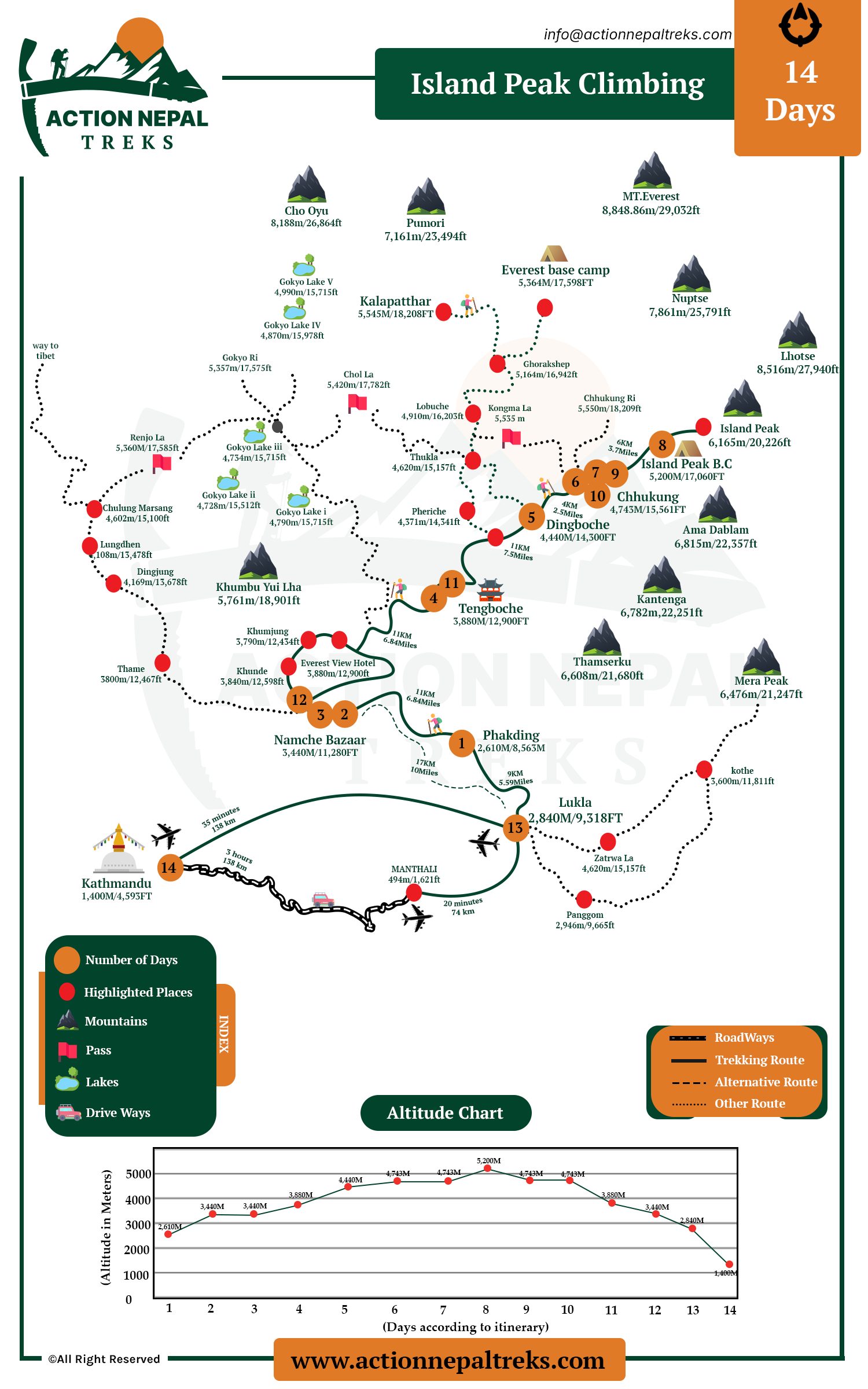
Island Peak Climbing Route Map

Explore the Trek Route in Google Satellite View for Better Clarity.

Trail
Return Trail

Why Climb Island Peak?

Climbing Island Peak (6,189m) is widely regarded as the ultimate gateway into Himalayan mountaineering. It transitions high-altitude trekkers into genuine climbers while delivering an authentic expedition experience in the shadow of Mount Everest.

Key Reasons to Choose Island Peak:

  • First Opportunity for Himalayan Mountaineering: A perfect intermediate goal for non-technical adventurers stepping beyond high-altitude trekking.
  • Seamless Combination of Trekking and Climbing: Blends classic tea-house trekking through Sagarmatha National Park with glacier camping and rope work.
  • World-Class Everest-Region Scenery: Unrivaled summit views of Everest, Lhotse, Nuptse, Baruntse, Makalu, and Ama Dablam.
  • Authentic Sherpa Culture: Chance to immerse yourself in high-altitude Sherpa villages, monasteries, and hospitality.
  • Glacier and Snow Experience: Practical exposure to glacier travel, crevasses, snow walls, and fixed-line climbing.
  • Progression to Higher Peaks: Excellent stepping-stone peak toward 7,000m+ expeditions like Baruntse, Himlung, or Mera Peak.

What Makes Island Peak Different From a Normal Everest Trek?

An Everest Base Camp (EBC) trek is entirely non-technical hiking on mountain trails. Island Peak introduces real mountaineering tools and alpine terrain:

  • Crampon use on steep glacier ice
  • Ice axe handling and self-arrest principles
  • Navigating crevasses and glacier travel
  • Ascending fixed lines using Jumars (mechanical ascenders)
  • Descending headwalls using Figure-8 descenders
  • High-altitude tented camping at Base Camp

Is Island Peak Right for You?

Island Peak is a good choice if you’re physically fit, comfortable at high altitudes, and ready to try technical mountaineering. You don’t need previous climbing experience. All you need is solid trekking experience and preparation for a demanding summit day.

This climb may suit you if you:

  • Have high-altitude trekking experience: You’ve trekked above 4,000 m, ideally on routes like Everest Base Camp or the Annapurna Circuit.
  • Have good endurance: You can manage several hours of walking on consecutive days and prepare for a summit day lasting 10 hours or more.
  • Are ready to learn climbing skills: You’re willing to practice using crampons, an ice axe, a harness, and a Jumar ascender.
  • Can handle challenging conditions: You’re prepared for freezing temperatures, a midnight start, and exposed sections that require focus and careful movement.

Previous climbing experience is helpful but not essential. Your fitness, preparation, and the conditions on summit day all influence whether you can reach the top.

What Happens on Island Peak Summit Day?

Island Peak summit day is the most challenging part of the climb, requiring physical endurance, careful movement, and good decision-making. You’ll start climbing in the early hours, use the mountaineering skills practiced before summit day, and follow your guide’s instructions throughout the ascent. Weather and route conditions can change quickly at this altitude, so summit success always depends on safety.

What Time Does Summit Day Start?

The summit attempt usually begins around 12:30-1:00 AM from Island Peak Base Camp. Starting early gives you time to reach the summit and descend before conditions become less favorable later in the day. You’ll climb in the dark using a headlamp, so watch your footing and maintain a steady pace. Higher up, the route includes glacier travel and steep snow or ice sections where you’ll use appropriate climbing equipment and follow your guide’s lead.

What Happens If Weather or Route Conditions Are Unsafe?

Strong winds, heavy snowfall, poor visibility, or unsafe snow and ice conditions can delay or prevent a summit attempt. If conditions are unsuitable, your guide may decide to turn back rather than risk the ascent or descent. The itinerary includes a reserve day that may allow another attempt if the weather and route improve. However, the extra day does not guarantee a summit, and the final decision depends on conditions at the time.

How Our Guides Make Summit-Day Decisions

Your climbing guide monitors weather and route conditions throughout the climb and checks how you’re coping with the altitude and physical effort. They may adjust the pace, set a turnaround time, or stop the ascent if continuing becomes unsafe. You’ll need to follow instructions carefully, especially on steep or exposed sections where crampons, an ice axe, and fixed ropes may be required. The goal is to give you a fair chance of reaching the summit while prioritizing a safe descent to Base Camp.

What is the best time to climb Island Peak?

Seasonal weather plays a crucial role in summit success rates, visibility, and overall mountain safety. Choosing the right climbing window guarantees clearer skies, manageable temperatures, and safer ice conditions.

The best seasons to climb Island Peak are Spring (March to May) and Autumn (September to November).

  • Spring: Mild daytime temperatures, stable weather, clear mornings, and blooming rhododendron forests along the lower trail.
  • Autumn: Post-monsoon clear skies, crisp mountain vistas, dry trails, and stable high-altitude conditions.

Can You Climb Island Peak During Winter or Monsoon?

  • Winter (Dec-Feb): Possible for experienced, cold-tolerant climbers, but subject to extreme freezing temperatures (-20°C or lower), heavy snow, and closed tea houses.
  • Monsoon (Jun-Aug): Not recommended due to heavy rainfall, cloudy skies hiding views, leeches at lower altitudes, high avalanche risk, and frequent flight delays to Lukla.

How difficult is Island Peak to climb?

Island Peak (6,189 m) is a challenging trekking peak that combines high-altitude trekking with basic mountaineering. It is graded PD (Peu Difficile) on the Alpine Grading System, meaning “slightly difficult.” However, this grade refers mainly to the technical difficulty of the climb, not the physical strain of spending long hours at high altitude.

The climb involves glacier travel, crampons, an ice axe, and fixed ropes on steep snow and ice sections. Summit day can take around 10-13 hours, depending on conditions and your pace. At this elevation, thin air, freezing temperatures, and accumulated fatigue make the ascent strenuous even for fit trekkers.

Is Island Peak good for beginners with no climbing experience?

Island Peak can be a suitable first climbing peak for fit trekkers without previous technical mountaineering experience. Before the summit attempt, your guide will provide basic training in Chhukung to help you practice using a climbing harness, crampons, an ice axe, and a Jumar ascender.

However, PD does not mean easy. The climb is physically strenuous because of the altitude, long summit day, and steep sections that require careful movement. Beginners should have good cardiovascular endurance, preferably some high-altitude trekking experience, and enough preparation to handle sustained physical effort. Following your guide’s instructions and allowing time to acclimatize are also important for a safer attempt.

Common Island Peak Climbing Mistakes

Even experienced trekkers make avoidable mistakes when transitioning to high-altitude peak climbing. Being aware of these common pitfalls allows you to avoid unnecessary exertion and stay healthy.

  • Rushing the Ascent: Walking too fast in early trekking days leads to premature fatigue and altitude sickness.
  • Inadequate Footwear: Attempting the glacier section without rigid, double-insulated mountaineering boots leads to cold feet and crampon slippage.
  • Under-Hydration: Not drinking 4-5 liters of fluids daily accelerates AMS symptoms.
  • Skipping Gear Practice: Skipping pre-climb training in Chhukung can cause delays on the fixed ropes on summit day.
  • Inadequate Layering: Wearing cotton garments instead of moisture-wicking synthetic or merino layers.

How do I prepare for the Island Peak Expedition?

Preparing for an Island Peak expedition requires a balanced approach that combines physical conditioning, technical skill, mental toughness, and altitude risk management. A structured training routine 2 to 3 months before departure helps your body handle the demands of 6,000-meter mountaineering.

Physical Training for Island Peak

Preparation should start 2-3 months prior to departure. Focus on:

  • Cardiovascular Endurance: Run, cycle, swim, and do stair-master workouts 4-5 times a week.
  • Strength & Core Training: Weighted squats, lunges, step-ups, planks, and pull-ups to build leg power and back strength.
  • Practice Hiking: Full-day weekend hikes carrying a 10-12 kg backpack over uneven terrain.

Technical Skills You Should Learn Before the Summit

While comprehensive training is provided on the trail at Chhukung, practicing these basics ahead of time is beneficial:

  • Ascending fixed lines using a mechanical ascender (Jumar).
  • Rappelling/abseiling using a Figure-8 or ATC descender.
  • Walking with crampons on snow/ice (duck-walk and front-pointing techniques).
  • Self-arrest and balance support using a non-technical ice axe.

Mental Preparation for Island Peak

Island Peak summit day can involve 10-13 hours of strenuous effort in cold, high-altitude conditions. Prepare yourself for limited sleep, basic mountain accommodation, and periods of physical discomfort. Focus on one section of the climb at a time, maintain a steady pace, and trust the skills you practice with your guide. Most importantly, communicate openly if you’re struggling and be ready to turn back if conditions become unsafe.

Island Peak Climbing Safety and Emergency Planning

Island Peak involves risks associated with high altitude, cold weather, glacier travel, and steep climbing sections. Good acclimatization, suitable equipment, and experienced guide support help manage these risks, although no safety plan can remove them entirely.

  • Monitor your health: Pay attention to symptoms such as headaches, nausea, dizziness, or unusual fatigue. Tell your guide promptly if you feel unwell so they can assess whether you should continue.
  • Carry appropriate medical and emergency supplies: A suitable first-aid kit and access to necessary emergency equipment are important for a high-altitude expedition. Confirm with your operator whether supplementary oxygen and specific emergency medicines are included.
  • Maintain reliable communication: Communication between the climbing team and support staff can help coordinate assistance if conditions change or an emergency occurs. Ask your operator what communication equipment is available in remote areas.
  • Understand evacuation arrangements: Helicopter evacuation may be possible in a serious emergency, depending on weather, visibility, location, and aircraft availability. Confirm your travel insurance covers high-altitude climbing and helicopter rescue, and understand how emergency costs are handled.

Island Peak Acclimatization and Altitude Safety

As you climb above 5,000 m, lower oxygen availability puts you at greater risk of altitude sickness, including Acute Mountain Sickness (AMS). More serious conditions, such as High Altitude Pulmonary Edema (HAPE) and High Altitude Cerebral Edema (HACE), can also develop. Your itinerary includes acclimatization days in Namche Bazaar and Chhukung to give your body time to adjust before gaining more elevation.

Walk slowly, drink fluids regularly, eat enough to maintain your energy, and avoid pushing yourself when you feel unwell. Tell your guide immediately if you develop symptoms such as a headache, nausea, dizziness, or unusual fatigue. Never ignore worsening symptoms or continue ascending when altitude sickness is suspected. Acclimatization reduces risk but cannot guarantee that you’ll avoid altitude-related illness.

What permits are required for Island Peak climbing?

Climbing Island Peak (6,189 m) requires four distinct permits: the Island Peak Climbing Permit, the Sagarmatha National Park Entry Permit, the Khumbu Pasang Lhamu Rural Municipality Tourism Fee, and the TIMS Card. You also need to get a separate, fully refundable garbage deposit of USD 500 per expedition before departure.

For foreign nationals, the exact non-refundable permit cost totals USD 410 per person in Spring and USD 235 per person during all other seasons.

Island Peak Climbing Permit

The Nepal Mountaineering Association (NMA) issues the climbing permit for Island Peak. Fees vary by season.

Climbing season Permit fee per person
Spring (March-May) USD 350
Summer/monsoon (June-August) USD 175
Autumn (September-November) USD 175
Winter (December-February) USD 175

Mandatory Regional Permits


TIMS Card (Trekker’s Information Management System)

In addition to the regional municipality fees, foreign nationals must obtain a TIMS card. Per official trekking regulations, this registration must be issued via a government-authorized trekking agency before starting the route. It costs NPR 2,000 (approx. USD 20).

Refundable Garbage Deposit

A USD 500 garbage deposit per expedition may be required. This is a group deposit, not a per-person fee, and is refundable when the expedition meets the applicable waste-return requirements. We’ll confirm the applicable deposit and refund arrangements as part of your trip planning.

Important Permit Requirements

  • Booking through a registered agency: We arrange the Island Peak climbing permit and required paperwork for our climbers.
  • Qualified climbing guide: Our expedition includes climbing guide support to help you navigate the route and manage the technical sections safely.
  • Permit inclusions: We will clarify which climbing and regional permit fees are included in your package price and whether the refundable garbage deposit requires a separate payment.

Permit fees and regulations can change, so we’ll confirm the applicable requirements for your climbing season before departure.

Island Peak Climbing Accommodation and Services

Accommodation during Island Peak Climbing includes local teahouses along the trekking route and tented camping at Island Peak Base Camp. We balance simple mountain lodging with the essential services needed for a high-altitude expedition throughout the trip.

What type of food is available on the Island Peak trek route?

During the trekking phase, high-quality meals are served in tea houses. At Base Camp, our private chef prepares fresh, hot meals:

  • Breakfast: Oatmeal, eggs, porridge, pancakes, Tibetan bread, muesli, hot tea/coffee.
  • Lunch & Dinner: Dal Bhat (rice & lentils), vegetable curries, momo dumplings, noodles, pasta, Sherpa stew, soups, and seasonal fresh fruits.

What is the accommodation like during Island Peak climbing?

  • Trekking Route (Lukla to Chhukung): Clean, comfortable local tea houses in twin-sharing rooms with shared or attached bathrooms.
  • Base Camp: High-altitude, weather-tested 4-season dome tents (2 climbers per tent) with insulated sleeping mats, alongside dedicated dining and kitchen tents.
  • Kathmandu: 3-Star hotel with standard modern amenities.

Why Book Your Island Peak Climbing Package With Us?

Selecting the right expedition operator is the single most important decision you will make for your safety, comfort, and summit success. We combine decades of local experience with uncompromised mountaineering safety standards.

Our Island Peak Climbing Experience and Local Expertise

With decades of direct experience operating in the Khumbu region, Action Nepal Treks delivers uncompromised safety standards, high summit success rates, and seamless local logistics. Our team of IFMGA/NMA-certified Sherpa climbing guides has logged hundreds of successful summit ascents on Island Peak.

We continually refine our itineraries based on real seasonal observations, incorporating dedicated acclimatization days in Chhukung and mandatory technical skills sessions before summit day. Our Base Camp team supplies quality 4-season high-altitude tents, nutritious cooked meals, and safety monitoring systems to maximize safety and success.

What Should You Ask an Island Peak Operator Before Booking?

Before choosing an expedition operator, ask these critical questions:

  • What is the guide-to-climber ratio on summit day? (We maintain a maximum 1:2 to 1:4 guide ratio for safety).
  • Does the itinerary include pre-climb gear training? (Yes, at Chhukung).
  • What high-altitude camping gear is provided at Base Camp? (We provide 4-season dome tents, dining setups, and insulated sleeping mats).
  • Is a contingency/weather day included in the package? (Yes, Day 10).
  • Are guides licensed and insured for high-altitude emergency rescue? (All our guides carry comprehensive high-altitude insurance.

Dates & Prices

Our fixed departure dates and per-person pricing make it simple for both solo travelers and small groups to join the adventure. It’s a great chance to meet new people and share the experience with other trekkers. Just choose your preferred date, and we’ll take care of the rest.

Island Peak Climbing Departure Date

Start Monday

26 Oct

Status

Booking Open

Days

14

Per Person

USD 2,099

Island Peak Climbing

Start Friday

30 Oct

Status

Booking Open

Days

14

Per Person

USD 2,099

Island Peak Climbing

Packing List for Island Peak Climb

The right gear keeps you warm, dry, and safe as conditions change from tropical lowlands to sub-zero summit ridges. Below is the recommended equipment inventory for Island Peak.

  • Clothing & Footwear

    • Moisture-wicking base layers (merino wool/synthetic)
    • Insulated fleece jacket & pants
    • Heavy down jacket (-20°C rated)
    • Waterproof/windproof hard-shell jacket & trousers
    • Rigid high-altitude mountaineering boots (crampon compatible)
    • Sturdy waterproof trekking boots & camp shoes
    • Thermal socks & wool gloves/mittens
  • Climbing & Technical Gear

    • Climbing Harness
    • Crampons (fitted to boots)
    • Ice Axe
    • Jumar / Mechanical Ascender
    • Figure-8 or ATC Descender
    • Lockable & non-locking carabiners
    • Climbing Helmet
  • Personal Essentials

    • 0°F to -20°F rated sleeping bag
    • UV-protection glacier sunglasses (Category 4) & headlamp with extra batteries
    • 40-50L trekking backpack & water purification tablets

Island Peak Climbing Altitude Chart

Altitude in:

Island Peak Climbing Temperature Chart

FAQs for Island Peak Climbing

General

Permits & Payments

Preparation & Experience

Food & Accommodation

Safety & Altitude

Logistics & Flights

Gear & Equipment

Climbers Review on Island Peak Climbing

Action Nepal Treks is a reliable trekking company run by a professional guide who has been active in Nepal’s tourism industry for 15 years.

Verified

Island Peak Solo Climb, Full Support

I went solo for Island Peak, but I never felt alone. My climbing guide was very skilled and made everything clear. We took time to trek through the Khumbu, and I loved the mix of Sherpa villages and snowy peaks. The summit day was long and cold, but with the guide’s help, I made it. Action Nepal Treks arranged everything...

Verified

Island Peak Solo Climb, Full Support

I went solo for Island Peak, but I never felt alone. My climbing guide was very skilled and made everything clear. We took time to trek through the Khumbu, and I loved the mix of Sherpa villages and snowy peaks. The summit day was long and cold, but with the guide’s help, I made it. Action Nepal Treks arranged everything so smoothly. This trip gave me confidence and joy.

Verified

Challenging Peak Climb with a Great Team

I joined a group trip to Island Peak, and it was the best decision. The whole team from Action Nepal Treks was professional and friendly. They helped us stay strong, safe, and happy every day. The climb was tough but not too technical. The guide made sure we practiced with ropes before the summit. We reached the top just after...

Verified

Challenging Peak Climb with a Great Team

I joined a group trip to Island Peak, and it was the best decision. The whole team from Action Nepal Treks was professional and friendly. They helped us stay strong, safe, and happy every day. The climb was tough but not too technical. The guide made sure we practiced with ropes before the summit. We reached the top just after sunrise, and the mountains looked golden. I’ll never forget that feeling.

Verified

My First Himalayan Climb at Island Peak

Island Peak was my first big mountain climb, and I couldn’t have done it without Action Nepal Treks. I was a bit nervous, but my guide taught me how to use the gear and always encouraged me. The trek to base camp was also beautiful. We took time to adjust to the altitude, and I felt ready on summit day....

Verified

My First Himalayan Climb at Island Peak

Island Peak was my first big mountain climb, and I couldn’t have done it without Action Nepal Treks. I was a bit nervous, but my guide taught me how to use the gear and always encouraged me. The trek to base camp was also beautiful. We took time to adjust to the altitude, and I felt ready on summit day. It was hard but so worth it. The view from the top was amazing. I still smile when I think about it.

Similar Climing like Island

Join us on similar trips in the same region

View Details
14 days mera peak climb-summit mera peak

Mera Peak Climbing

View Details
Everest Three High Passes Trek

Everest Three High Passes Trek

View Details
Why action nepal treks

Three High Passes Trek with Lobuche Peak Climbing

USD 2,099/ pp