



Everest Three High Passes Trek


Max. Altitude
5,545m/ 18,208ft

Duration
16 Days

Grade

Activity
Trekking

Best Season
Spring, Autumn

Transportation
Domestic flight, Car, Jeep

Meals Included

Accommodation

Trek Region
Everest Region Trek Packages

Destination
Tours & Treks in Nepal

Group Size
1 - 20

Activity Per Day
Approx. 6 hrs walking

Start/End Point
Kathmandu / Kathmandu

Nature Of Trek
Lodge to Lodge trekking
Overview of Everest Three High Passes Trek
The 16 Days Three High Passes Trek is a great and challenging trek that takes you through the Everest/Khumbu region and provides the finest trekking experience. You will see breathtaking mountain views, including Mt Everest, along with the glaciers, the ancient valleys, and the thrilling passes. The trek is ideal for strong trekkers looking to traverse the three highest passes: Kongma La (5,535m/ 18,159ft), Cho La (5,420m/ 17,782ft), and Renjo La (5,360/ 17,585ft). Furthermore, traversing three high passes while trekking to the three peaks of Renjo La, Kongma La, Kala Patthar, and Everest Base Camp adds excitement to the journey.
The Everest Three High Passes trek begins with a flight from Kathmandu to Lukla. You will trek through the beautiful Namche Bazaar, Tengboche, Dingboche, and other magnificent locations. The locals are Sherpa, who are well-known for their mountain-climbing abilities. You’ll be able to immerse yourself in their distinct culture and lifestyle. You can hike through Sagarmatha National Park and encounter wildlife such as musk deer, mountain goad, snow leopard, etc.
Along the route, you will see several bridges, monasteries, and chortens with colorful Buddhist flags. The Nepal’s Three Passes trek is tough, so you should be physically fit before starting the trip.
16 Days Everest Three High Passes Trek Itinerary
Day 1: Kathmandu to Lukla, trek to Phakding
Your journey begins with a short flight to the Everest region from Kathmandu to Lukla, which takes about 35 minutes. You can see amazing views of the Himalayas. If you start from Manthali, it’s about a 3-hour drive at 1 am, followed by a 20-minute flight to Lukla. The flight from Kathmandu covers 138 kilometers, and from Manthali, it’s about 74 kilometers, landing you at Lukla’s airport, which is 2,860m/ 9,370ft above sea level.
After arriving at Lukla, you’ll begin your trek to Phakding. The trek from Lukla to Phakding takes about 3 hours. The trail goes down through the Dudh Koshi Valley, passing through small villages, forests, and rice fields. You will cross several suspension bridges decorated with blue prayer flags. By late afternoon, you will reach Phakding and stay overnight.
| Itinerary Fact | Details |
|---|---|
|
|
BLD |
|
|
Lodge |

|
9km/ 5.6miles |
|
|
2,860m/ 9,370ft |
|
|
3hrs trekking and 35 min (Kathmandu–Lukla), 20 min (Manthali–Lukla) flight |

|
3hrs |

Day 2: Phakding to Namche Bazaar
Today, you’ll trek to Namche Bazaar, a well-known village in the Everest region of Nepal. You will pass through a lovely pine forest along the Dudh Koshi River on your way. You will cross many suspension bridges as you go through Sherpa villages like Benkar, Chimaya, Monjo, and Jorsale. At Jorsale, you’ll enter the Sagarmatha National Park and have to check your permits. The route continues across the Dudh Koshi riverbed to the confluence of the Bhote and Dudh Koshi rivers.
Later, you’ll gradually ascend and pass the high Tenzing Hillary suspension bridge. On the trail, you’ll see the breathtaking view of Mount Everest up to the Nuptse-Lhotse ridge. You’ll finally arrive at Namche Bazaar, the region’s main economic hub, after 6 to 7 hours, covering a distance of about 11km. You’ll stay the night at Namche Bazaar.
| Itinerary Fact | Details |
|---|---|
|
|
BLD |
|
|
Lodge |
|
|
11km/ 6.8miles |
|
|
3,440m/ 11,280ft |
|
|
6/7hr |


Day 3: Acclimatization Day at Namche Bazaar, hike to Everest View Hotel
You will spend a day in Namche Bazaar for acclimatization. To adjust to the altitude, you’ll hike up to Khumjung, a quiet village in the Hidden Valley, and then return to Namche through the Everest View Hotel. This day hike takes about 4 hours and is an easy walk. In the village, you’ll see amazing views of snow-covered mountains, including Everest, Ama Dablam, Thamserku, and more.
Afterward, you’ll walk for about an hour down a rocky hill to the Everest View Hotel, where you’ll have lunch. You’ll enjoy stunning views of Mt Everest Ama Dablam and Thamserku from the hilltop, along with beautiful valleys, green forests, and charming villages. After taking in the scenery, you’ll head back to Namche village. Exploring Namche Bazaar is also fun. Today, the distance you trek is 5.4km/ 3.35miles. You’ll stay overnight at the lodge.
| Itinerary Fact | Details |
|---|---|
|
|
BLD |
|
|
Lodge |
|
|
5.4km/ 3.35miles |
|
|
3,880m/ 12,900ft |
|
|
4 hour |
Day 4: Namche Bazaar to Tengboche
Following breakfast, you will continue your Everest Three Pass trek from Namche Bazaar to Tengboche, covering a distance of about 11km. The routes on this walk lead through rough and rugged terrain. The narrower trail goes through steep terrain, which might be difficult. During this trip, you’ll see a variety of monasteries, waterfalls, rivers, suspension bridges, and more. As you trek, you will pass through a forest route with rhododendrons and juniper trees.
Tengboche monastery is a major monastery in the Khumbu region. After arriving in Tengboche, you can see several snow-capped mountains from a viewpoint. Before spending the night at a lodge, you will participate in evening prayers at the Tengboche monastery.
| Itinerary Fact | Details |
|---|---|
|
|
BLD |
|
|
Lodge |
|
|
11km/ 6.83miles |
|
|
3,880m/ 12,900ft |
|
|
6/7hr |
Day 5: Tengboche to Dingboche
Following breakfast, you will continue your trek to Dingboche from Tengboche. Today’s trek distance is 12km/ 7.45miles. The air pressure decreases as the trail ascends along these trails. It takes approximately g hours to arrive in Dingboche. You will trek by heading through Imja Valley and then gradually climb to Pangboche. This route takes you through many Buddhist landmarks, including chortens, main walls, prayer flags, and others.
You will stop for lunch along these trails. You can also see the breathtaking views of Mt Ama Dablam. The eastward track will rake you through the Imja Valley’s remote and rugged landscapes. The trail will then continue across the valley, eventually arriving at the Lobuche River. Then, you’ll have a tough uphill climb to Dingboche. The village’s magnificent beauty will charm you as you walk these routes.
| Itinerary Fact | Details |
|---|---|
|
|
BLD |
|
|
Lodge |
|
|
12km/ 7.45miles |
|
|
4,440m/ 14,300ft |
|
|
6hr |
Day 6: Dingboche to Chhukung
Today, you’ll trek to Chhukung from Dingboche, covering a distance of about 5.3km/ 3.2miles. You will continue your journey across the alpine terrain, traveling through the Imja Valley trails. The pathways will be straightforward after about an hour of trekking along moraine walls. You will also see stunning views of Island Peak.
These routes lead to Chhukung, a starting point for climbers attempting to reach Island Peak’s summit. The highest peak offers a magnificent view of Ama Dablam, Lhotse, and other mountains. You will hike for a few hours to Chhukung, where you can see the Himalayas up close. You can explore the area and then spend the night at the lodge.
| Itinerary Fact | Details |
|---|---|
|
|
BLD |
|
|
Lodge |
|
|
5.3km/ 3.2miles |
|
|
4,740m/ 15,551ft |
|
|
3hr |
Day 7: Acclimatization Day at Chhukung
On this day, you’ll stay in Chhukung to acclimate to the higher altitude, which helps your body adjust and prepare for the challenging days ahead. You will take an optional hike up to Chhukung Ri. You will hike 5.5km/ 3.4miles today. You can see majestic views from the peak, including Ama Dablam, Lhotse, and others. After soaking in the views, you’ll return to Chukkkung and rest overnight at the lodge.
| Itinerary Fact | Details |
|---|---|
|
|
BLD |
|
|
Lodge |
|
|
5.5km/ 3.4miles |
|
|
4,740m/ 15,551ft |
|
|
3/4hr |
Day 8: Chhukung to Lobuche
After breakfast, you will continue your long trek to Lobuche via the Kongma La Pass, covering a distance of 10.5km/ 6.5miles. You will cross the river and then ascend uphill along the routes. You should proceed with caution as this is a landslide-prone terrain. The trail then becomes steeper until you reach a green hill.
Then, you’ll travel along short pathways before finally climbing a steep ridge to the lake. After another tough ascent from the lake, you’ll eventually reach Kongma La Pass. Finally, you will make a difficult descent till you reach the bottom of the Kongma La Pass. Following a final climb through the Khumbu Glacier, you arrive in Lobuche.
| Itinerary Fact | Details |
|---|---|
|
|
BLD |
|
|
Lodge |
|
|
10.5km/ 6.5miles |
|
|
5,535m/ 18,160ft |
|
|
7/8hr |
Day 9: Lobuche to Gorakshep to EBC
Today, you’ll trek from Lobuche to Gorak Shep and Everest Base Camp after that. Your total trek distance for today is about 15km/ 9.32miles. You will travel to Gorakshep, a stunning natural sand bed that was once an ancient base camp. This route was used by the first expeditions to reach Mount Everest. The trail then goes through the Khumbu glaciers’s lateral moraine. Before arriving at Gorakshep, you will climb steeply while admiring the breathtaking views of the Himalayas.
After arriving in Gorakshep, you will leave your belongings in a lodge before going to Everest Base Camp. After traversing over up and down trails, you will reach Everest Base Camp. The Everest Base Camp of Mount Everest offers a beautiful scenario with climbers setting up their colorful tents. After sightseeing, you will trek back to Gorakshep and stay overnight.
| Itinerary Fact | Details |
|---|---|
|
|
BLD |
|
|
Lodge |
|
|
15km/ 9.32miles |
|
|
5,364m/ 17,598ft |
|
|
7/8hr |
Day 10: Gorakshep to Kala Patthar to Dzongla
You will get up early in the morning to trek to Kala Patthar. This Kala Patthar viewpoint is well-known for its spectacular views of Everest. From here, you can see breathtaking vistas of a golden sunrise over the entire Everest Mahalangur Range. You can see Lhotse, Nuptse, Ama Dablam, and other snow-capped summits from this viewpoint. After exploring, you will return to Gorakshep.
Following breakfast in Gorakshep, you will continue your trek to Dzongla. You will continue your journey over these same trails until you reach Lobuche. The route then takes you to the Lobuche Khola, from where you will trek to Dzongla. The total distance you covered today is 10.5km/ 6.5miles. You’ll stay overnight at Dzongla.
| Itinerary Fact | Details |
|---|---|
|
|
BLD |
|
|
Lodge |
|
|
10.5km/ 6.5miles |
|
|
5,545m/ 18,208ft |
|
|
7/8hr |
Day 11: Dzongla to Chola Pass to Thangnak
You must get up early in the morning to see the breathtaking views of Cholatse. Starting from Dzongla, you’ll trek uphill to reach the Chola Pass, one of the trek’s highest points. As you reach the top of Chola Pass, you’ll be at an elevation of about 5,420m/ 17,782ft The pass is often windy and cold, so dressing warmly is essential.
After crossing the pass, the trail descends towards Thangnak. The descent can be tricky, especially on loose rocks and snow, so careful steps are needed. Once past the challenging parts, the path becomes easier as you approach Thangnak after trekking for 6 to 7 hours, covering a distance of about 15km/ 9.32miles. Thangnak is a small village where you will rest after a long day.
| Itinerary Fact | Details |
|---|---|
|
|
BLD |
|
|
Lodge |
|
|
15km/ 9.32miles |
|
|
5,420m/ 17,782 |
|
|
6/7 hrs |
Day 12: Thangnak to Gokyo
On this day of the 16 Days 3 High Passes Trek, you’ll trek from Thangnak to Gokyo, covering a short distance of 3.7km/ 2.29miles. Your trek will take about 2 to 3 hours. Even though the distance isn’t long, the high altitude and the challenging terrain make it a tough but rewarding day. Along the way, you can see breathtaking views of mountain. Once you arrive in Gokyo, you’ll settle into a cozy lodge. Gokyo is a special place on the trek, known for its gorgeous turquoise lakes.
(Please note)
that on Day 12, the trek from Thagnak to Gokyo takes approximately 2.5 to 3 hours. After arriving in Gokyo and enjoying lunch, we’ll have plenty of time to explore the beautiful Fourth and Fifth Gokyo Lakes. For this reason, our standard itinerary includes one overnight stay in Gokyo.
The next day, we’ll cross the spectacular Renjo La Pass. Since the mountain views from Renjo La Pass are very similar to those from Gokyo Ri, we believe one night in Gokyo offers the best balance between sightseeing and keeping the trek at a comfortable pace.
That said, every trekker has different interests, and we’re happy to customize the itinerary. If you’d like to spend two nights in Gokyo and hike to Gokyo Ri for sunrise or additional exploration, we can easily add an extra day to the itinerary. We are completely flexible and will tailor the trip to match your preferences.
| Itinerary Fact | Details |
|---|---|
|
|
BLD |
|
|
Lodge |
|
|
3.7km/ 2.29miles |
|
|
4,750m/ 15,580ft |
|
|
3/4 hrs |

Day 13: Gokyo to Renjo-La Pass to Lungden
Today, you’ll trek from Gokyo to Renjo-La Pass to Lungden. You’ll cover a distance of 9km/ 5.59miles, which takes about 7 to 8 hours. The route leads you through many remote, harsh terrain in the Everest region. The pathway passes through the northern region of Gokyo Lake. You ascend the scree slope and eventually arrive at the highland meadow. Before arriving at Renjo La Pass, the trail traverses through several screens and boulders. The region has numerous Buddhist religious prayer flags, mani walls, chortens, and others. From this viewpoint, you can see the breathtaking vista of Nangpa Valley, Everest, and Makalu.
You will then descend along these pathways and hike through loose rocks and scree. You will trek to the glacial lake. From here, as the valley opens up, you will descend through wide pastures until you reach Lungden. You’ll stay the night at Lungden.
| Itinerary Fact | Details |
|---|---|
|
|
BLD |
|
|
Lodge |
|
|
9km/ 5.59miles |
|
|
5,360m/ 17,585ft |
|
|
7/8hr |
Day 14: Lungden to Namche Bazaar
Today, you’ll trek from Lungden to Namche Bazaar, covering a distance of 18km/ 11miles. The trail passes through remote terrain and arrives at Thame. The routes from Thame to Namche Bazaar are quite short and straightforward compared to other regional paths. You can visit the ancient monastery, where you can see religious prayers early in the morning.
You will continue to descend the trails. You’ll leave the rhododendron and pine-forested pathways behind. The walk then leads you along the rivers till you reach Namche Bazaar. You’ll stay the night at Namche Bazaar.
| Itinerary Fact | Details |
|---|---|
|
|
BLD |
|
|
Lodge |
|
|
18km/ 11miles |
|
|
4,380m/ 14,370ft |
|
|
7/8 hrs |
Day 15: Namche Bazaar to Lukla
This is the final day of your trek in the Everest region. On this day, you’ll start your trek from Namche Bazaar to Lukla, covering a distance of about 17km/ 10miles. Before arriving in Lukla, you will cross the suspension bridge and travel up and down several trails. Your walk will take about 7 hours. After you reach Lukla, you can explore the area and spend the night at the lodge.
| Itinerary Fact | Details |
|---|---|
|
|
BLD |
|
|
Lodge |
|
|
17km/ 10miles |
|
|
3,440m/ 11,208ft |
|
|
7hrs |
Day 16: Lukla to Kathmandu
Today, you’ll take a morning flight from Lukla to Kathmandu. The 35-minute flight gives you one last look at the Himalayan peaks before you return to Kathmandu. The flight covers 138km/ 85.7miles to Kathmandu, or 74km/ 45.9miles if you fly to Manthali. Once you reach Kathmandu, you can spend the rest of your day relaxing. After having breakfast, you can choose to explore the city.
| Itinerary Fact | Details |
|---|---|
|
|
Breakfast |
|
|
1,400m/ 4,593ft |
|
|
35 min (Kathmandu–Lukla), 20 min (Manthali–Lukla) |
|
|
3hrs |
Three High Passes Trek Route Map
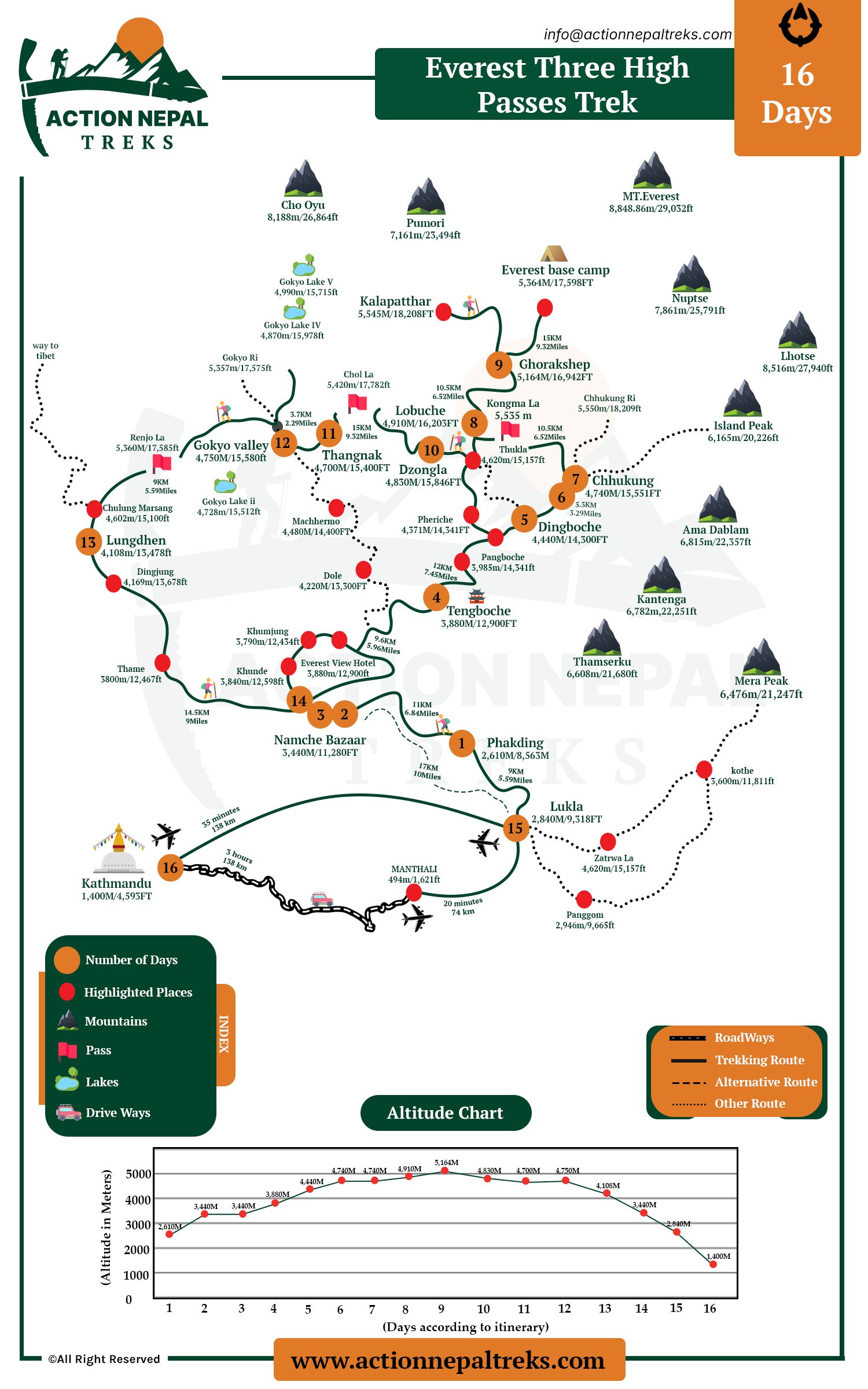
Explore the Trek Route in Google Satellite View for Better Clarity.
Everest Three High Passes Trek Difficulty
The Everest 3 High Pass trek takes you through remote and rugged paths. These difficult trails in the varied Himalayan landscapes take you via high-altitude mountain passes. Altitude sickness is a common issue in the Everest 3 High Pass trek. So, you must acclimatize when trekking in these high-altitude areas.
Furthermore, even experienced trekkers may find the steep and rugged terrain hard. So, you must have proper strength, stamina, and endurance to complete your high passes trek. In 3 high passes trek, teahouses, and lodge accommodations are basic. So, you must compromise along these trails in these aspects.
Food items must be delivered high up these trails by porters or yaks. So, there are limited food options, and as you move up, the prices increase. Aside from that, you can face unexpected challenges of unpredictable weather, such as heavy rainfall, snowfall, landslides, and so on. The trek can be completed easily with proper packing, preparation, and training.
Training Plan for the Three Passes Trek in Everest
- Start Early: Begin training at least 3-4 months before your trek.
- Cardio Workouts: Focus on activities like running, cycling, or swimming to build endurance.
- Hiking Practice: Do long hikes with a backpack to get used to walking on uneven terrain.
- Stair Climbing: include exercises like squats and lunges to build leg and core strength.
- Altitude Training: If possible, train at higher altitudes to get used to thin air.
- Flexibility: Do stretching exercises to keep your muscles flexible and reduce injury risk.
- Rest Days: Allow time for recovery to avoid overtraining and injury.
- Hydration and Nutrition: Stay hydrated and eat a balanced diet to fuel your workouts.
- Test Gear: Practice with your trekking gear to make sure everything fits and works well.
Food and Accommodation during Everest Three High Passes
Another aspect that you should consider before starting your Everest High Passes Trek is food and accommodation. You will stay in lodges or teahouses along the paths. These lodges or teahouses are perfect for staying along trails since they provide warmth and safety. Furthermore, they will offer you delicious meals throughout your stay. Tea houses provide various services, like twin beds, pillows, mattresses, and warm blankets. Aside from that, squat-style toilets are typically located outside of these areas. Wi-Fi, hot water, electronic charging, and other facilities are available at additional cost.
Dal Bhat is a popular dish served at these lodges and teahouses twice a day for lunch and dinner. You usually get rice, dal, lentils, vegetables, pickles, meat, and others for lunch and dinner. For breakfast, you get bread, eggs, and porridge. Tea, garlic soup, coffee, and noodle soup are common hot beverages in the region. Furthermore, some tea houses, particularly in the lower regions, offer a variety of cuisines and food items like momo, noodles, chowmein, thukpa, and other dishes.
When to Go Everest Three High Passes Trek
The best time for the Everest Three Pass Trek in Nepal is in the spring (March to May) and autumn (September to November). These months have the best weather and trekking conditions in the Everest/Khumbu region.
Spring
March to May
- Weather: Temperatures are mild, ranging from 10 degrees Celsius to 15 degrees Celsius. It can get colder at high altitudes, with nights dropping below freezing.
- Visibility: Clear skies provide stunning views of mountains like Everest, Lhotse, and Nuptse.
- Flora and Fauna: Rhododendron forests are in full bloom with red, pink, and white flowers, making the trek more beautiful.
- Crowds: Spring is popular for trekking, so expect moderate to high numbers of trekkers, especially near Everest Base Camp and Namche Bazaar.
Autumn
September to November
- Weather: The weather is stable, with daytime temperatures between 10 degrees Celsius and 20 degrees Celsius at lower elevations. The higher areas can be colder.
- Visibility: Autumn offers some of the clearest and most breathtaking mountain views. The skies are clear and provide stunning views of the Everest range and other peaks.
- Festivals: Major festivals like Dashain and Tihar occur during this time, adding cultural experience to your trek.
- Crowds: Autumn is the busiest trekking season, particularly in October and November. So, you should book your accommodation and flights to Lukla in advance.
Dates & Prices
Our fixed departure dates and per-person pricing make it simple for both solo travelers and small groups to join the adventure. It’s a great chance to meet new people and share the experience with other trekkers. Just choose your preferred date, and we’ll take care of the rest.
FAQs for Everest Three High Passes Trek
Everest Three High Passes Trek Traveler Reviews
Action Nepal Treks is a reliable trekking company run by a professional guide who has been active in Nepal’s tourism industry for 15 years.


Similar Trips
Join us on similar trips in the same region

Everest Base Camp Helicopter Tour

7 Days Pikey Peak Trek

Mera Peak Climbing
USD 1,420/ pp
